Trump removes 25% penal tariff: What happens if India stops buying Russian crude oil?
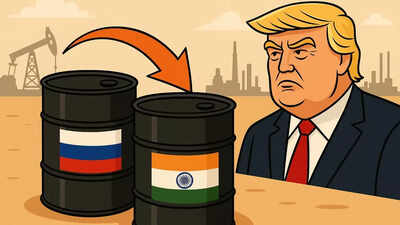
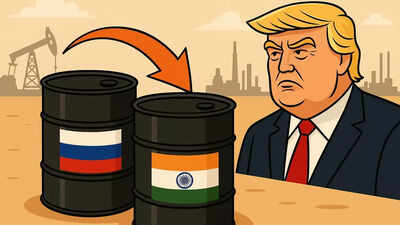
Will India stop buying Russian crude oil? US President Donald Trump has signed an executive order revoking the 25% penal tariffs on India for its imports of crude from Russia. However, the executive order clearly says that this 25% penal tariff may be restored if India doesn’t stop buying oil from Russia. With the removal of 25% penalty tariff and the reduction in reciprocal tariff, Indian exports to the US will now face a duty of 18%.A key element of the understanding, according to Trump, is India’s commitment to stop both direct and indirect imports of Russian crude oil, a move Washington considers essential to increasing economic pressure on Moscow over the conflict in Ukraine. While the executive order says that India has committed to ending direct or indirect imports of Russian oil, New Delhi has reiterated that safeguarding the energy needs and security of its 1.4 billion citizens remains its foremost priority.
During much of 2024 and 2025, India was one of the largest purchasers of discounted Russian oil, with imports of over two million barrels per day at their peak.
Will India stop buying Russian crude?
Government sources, referring to a recent Ministry of External Affairs statement, told TOI that India’s strategy centres on diversifying energy supplies in line with market conditions and evolving global developments, and that all decisions are guided by this objective.According to a PTI report, while Indian refiners have not yet received any formal instructions to halt Russian crude imports, they have been informally advised to begin scaling back purchases. Refiners are expected to honour existing contracts, typically placed six to eight weeks in advance, but refrain from placing fresh orders after that.Also Read | 18% tariffs, boost to exports, agriculture protected: How India benefits from trade deal with US? Explained Experts believe that while Russian crude may drop in the coming months, the chances of it completely disappearing from India’s crude basket appear slim.Sumit Ritolia, Lead Research Analyst, Refining and Modeling at Kpler sees no immediate reduction since contracts are already in place.“Russian volumes remain largely locked in for the next 8-10 weeks and continue to be economically critical for India’s complex refining system, supported by deep discounts on Urals relative to Brent. Imports are expected to stay broadly stable in the 1.1-1.3 million barrels a day range through Q1 and early Q2,” he said.“Despite a recent moderation in purchases, India is unlikely to fully disengage in the near term.”Sourav Mitra, Partner, Oil and Gas, Grant Thornton Bharat told TOI, “India has always maintained that it will continue to prioritize the energy security of its 1.4 billion citizens. India reaffirmed this position recently in response to the claims by the United States that India will stop purchasing Russian crude oil while announcing the broader contours of the trade deal with India. India has strategically diversified its crude oil import basket and will continue to stay the course.”“The oil flow from Russia to India is unlikely to vanish completely anytime soon as these strategic decisions are based on existing contractual obligations, prices offered, supply chain reorientation, and refining capabilities/ margins of refiners. Though Russia’s share in India’s imports has fallen off the peak of ~40%, it still tops the list, and any scale back is expected to be more gradual,” he added.
What are the alternatives to Russian crude for India?
Before India ramped up its crude oil import from Russia, the West Asian suppliers dominated the supply with Russia contributing in lower single digits. India has diversified its sources of supply to about 40 countries with more supply coming onto the market from Guyana, Brazil and Canada.Kpler’s Ritolia emphasises that crude sourcing diversification is expected to continue, with incremental volumes likely to come from the Middle East and the US as India broadens its supplier base while maintaining flexibility across origins.
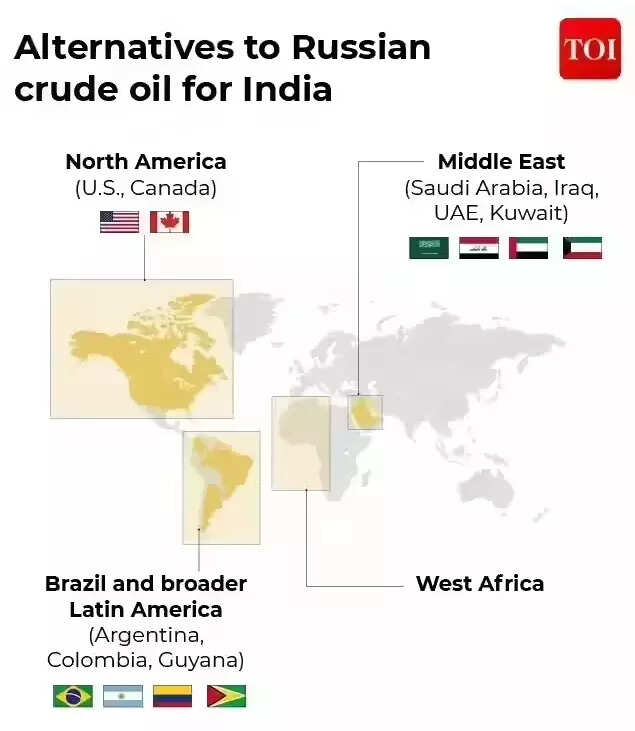
According to Sourav Mitra of Grant Thornton Bharat, in a remote eventuality of Russian oil imports ceasing completely, the import basket may reorient towards Middle East-based suppliers; led by Iraq, Saudi Arabia, and UAE. The US is already one of the top 5 exporters of crude oil to India. India can look to augment the oil purchase from the US depending on the prices offered, he says.African suppliers can be potential alternatives to backfill the gap. Their crude is sweeter and more suitable to Indian refiners. India has already seen an increase from oil imports from African countries such as Nigeria, Angola, Egypt, Libya in FY26 as Russian oil imports reduce.“India can opportunistically look at the Venezuelan oil, but the volumes can be constrained by pricing considerations and limited capacity of Indian refiners to process the Venezuelan oil. Venezuela’s crude oil is heavy and sour grade which requires hydro processing, consequently squeezing the refining margins,” Mitra adds.
Rising Crude Imports From The US
Russia’s share in India’s crude imports fell to 33.7% during the April–November 2025 period, compared with 37.9% in the corresponding months of 2024. Over the same timeframe, the United States’ share increased to 8.1% from 4.6%. Kpler estimates indicate that Russian crude imports declined from 1.8 million barrels per day in November to 1.2 million barrels per day in December, and further to 1.16 million barrels per day in January 2026.
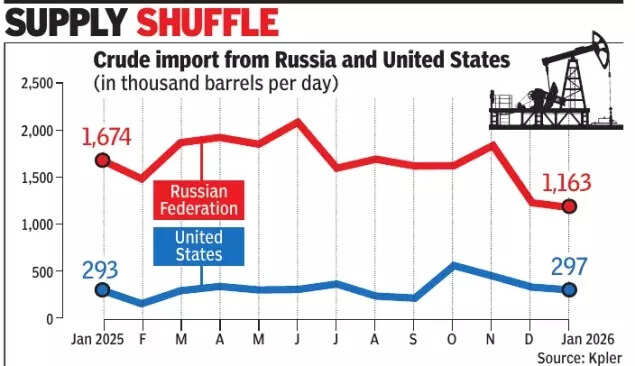
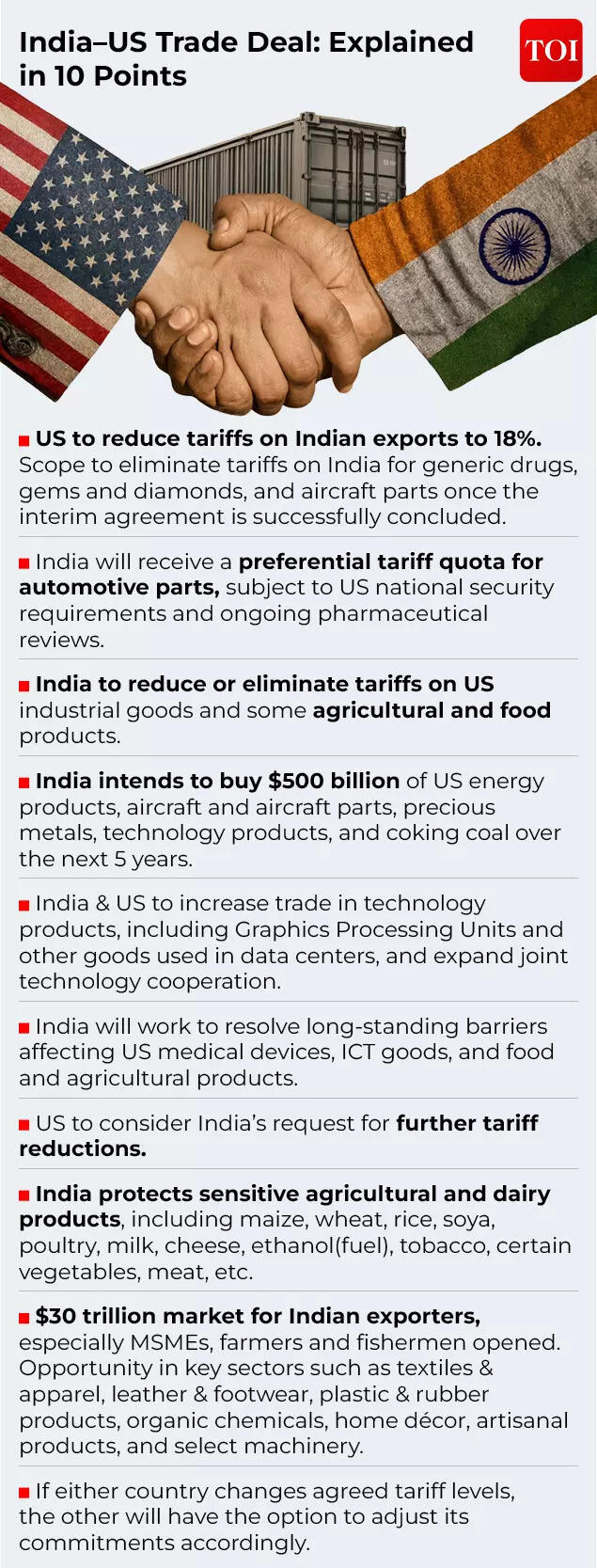
The US has said that India plans to acquire American energy products, technology goods and agricultural commodities worth $500 billion over the next five years. These are expected to include crude oil, liquefied natural gas, aircraft and related components, advanced technologies such as graphics processing units, and farm products.According to the Grant Thornton expert, this signals that India will likely ramp up crude oil purchase from the US which may be a mix of crude oil, LNG, coking coal among others. “India’s purchase from the US is already on an upward trend, with the US now constituting around 8% of India’s total oil purchase. However, the scale of oil purchase from the US would largely depend on the commercial considerations,” he says.Also Read | India-US trade deal: Which Indian goods will face zero tariffs in America? Piyush Goyal lists out
India’s Crude Import Bill To Be Hit?
India’s crude oil import is 4.5-5 million bpd. Russian oil imports hit a peak of ~2 million bpd in June 2025, which has come down to about 1.1 million bpd in January 2026. Sourav Mitra of Grant Thornton Bharat notes that if the Russian oil purchase were to cease entirely, the adverse impact on India’s crude oil import bill could be anywhere between 1-2%. “This impact can be set off by ramping up oil purchase from Venezuela though. However, this reorientation has its own challenges. India’s decision to buy oil from Venezuela will primarily depend on the discounts offered. The Venezuelan oil should come at a discount of $10-14/barrel vis-à-vis Brent to outweigh the additional costs stemming from freight, insurance, and higher processing by the Indian refiners,” he tells TOI.
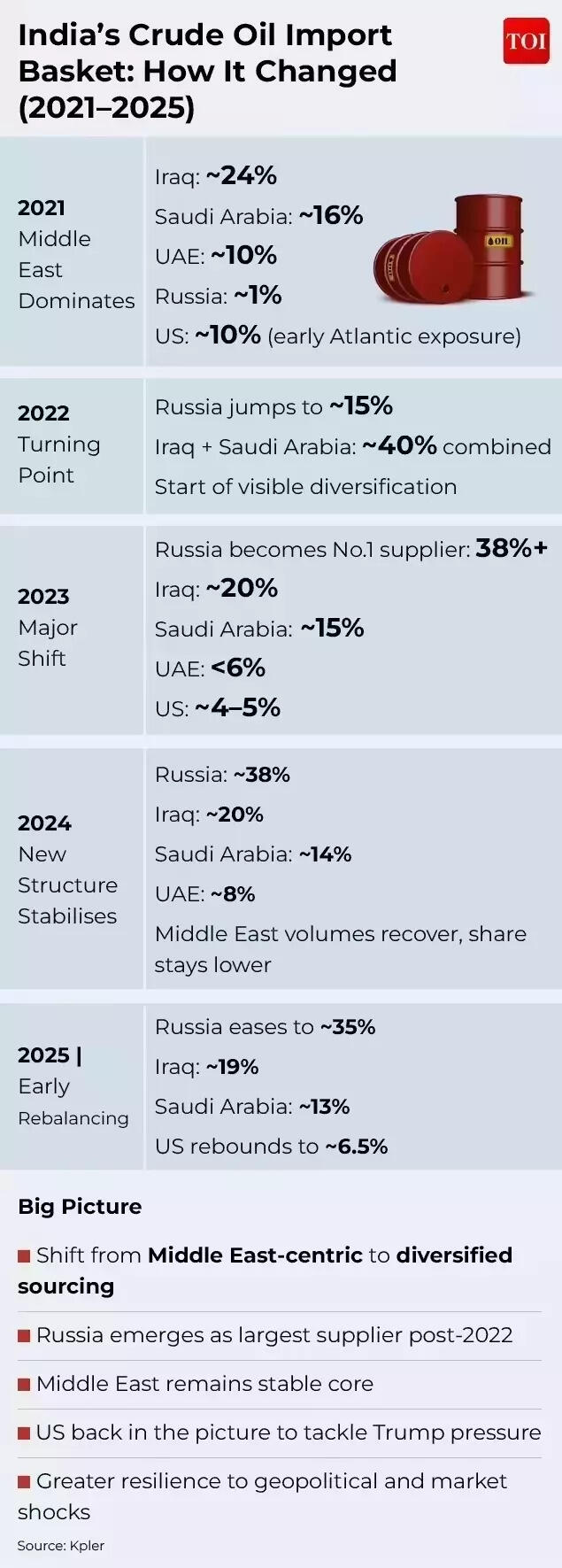
As SBI Research notes in a new report this month: India turned to purchasing Russian oil sold at a discount (capped: $60 per barrel), to ensure its energy security, after Western countries-imposed sanctions on Moscow and shunned its supplies over its invasion of Ukraine in February 2022. Consequently, Russia’s share has increased to 35.1% in FY25 and it is now the biggest oil importer for India.“The substitution of Russian crude by Merey 16 has clear positives for the domestic economy as private and PSU oil refineries can exploit the heavy crude discount. Heavy crude discounts in range $10-12 can make good the Russian discount, ensuring commercial viability. This implies the trade deal will not affect the domestic inflation after sacrificing the Russian discount. India’s fuel import bill could even decline by $3 billion in the event of shifting to Venezuela. The discount of $10-12 could make the choice agnostic,” says SBI.However, Mitra warns that what may complicate the math is the fact that if India stops buying the Russian crude oil, it will tighten the global crude market due to its sheer volumes. “Where the crude oil prices stabilize will primarily depend on where the additional Urals go and how easy it is for the Venezuelan oil to find buyers,” he says.