
Scientists are racing to solve the mystery of Poland’s 90-year-old Crooked Forest before its bizarre C-shaped pine trees die out forever |
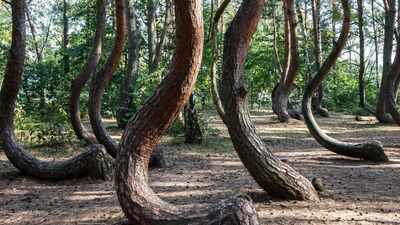
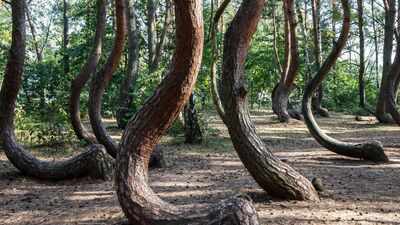
There is a small patch of woodland in western Poland where the landscape quietly breaks expectations. At first glance, it looks like an ordinary pine forest, but after walking a few steps further, the pattern becomes impossible to ignore. As reported by Russian and East European studies, hundreds of trunks curve sharply near the ground before rising upright again, creating a collection of trees that appear to have been bent by the same invisible hand. The grove has attracted photographers, travellers and scientists for decades, yet there is still no widely accepted explanation for why it exists.Local stories have grown alongside scientific ideas, and neither has fully settled the question. Unlike many natural curiosities that eventually receive a clear geological or biological answer, this one continues to sit in an unusual space between documented history and unanswered speculation.
How the Crooked Forest origin became a lasting mystery
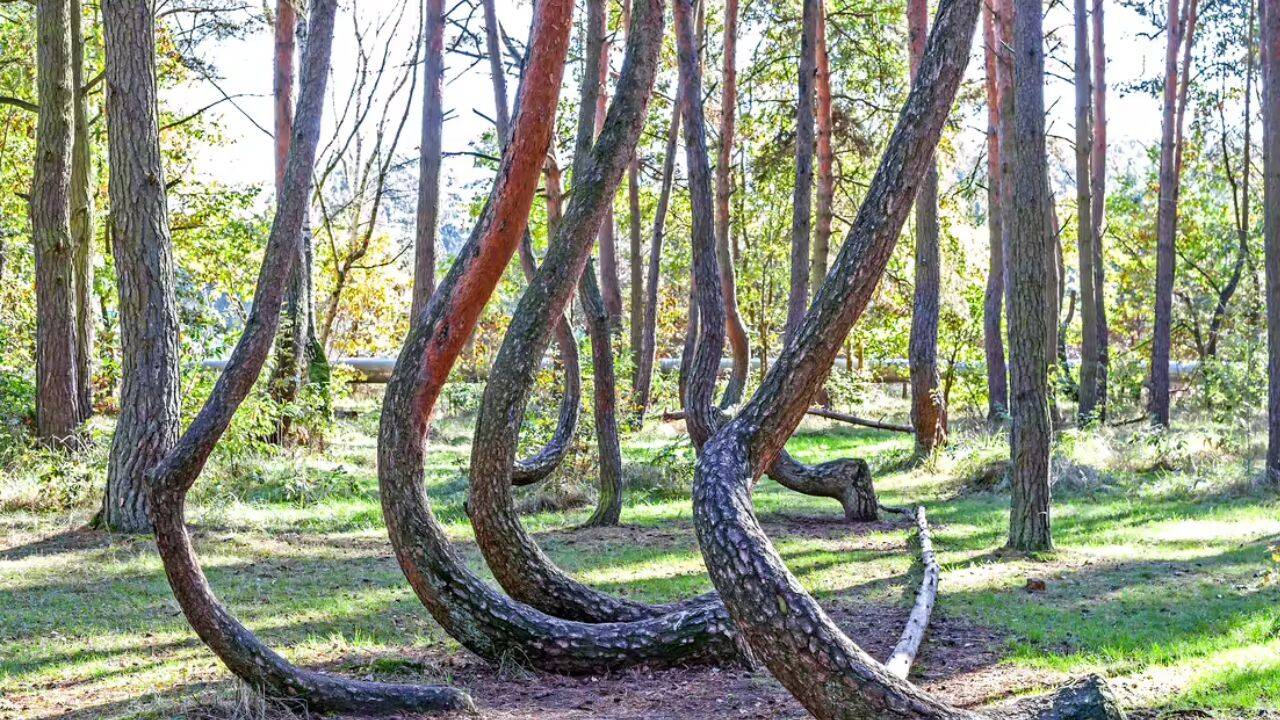
Known as the Crooked Forest, or Krzywy Las in Polish, the site contains around 400 pine trees whose lower trunks sweep into broad curves approximately to 90 degrees as reported before turning skyward. Each bend begins close to the base, giving the trees a distinctive J-shaped appearance. The curves are remarkably consistent, and almost all lean in the same northerly direction before straightening.Outside this small section, the surrounding woodland looks entirely ordinary. The neighbouring pines grow vertically without any unusual distortion, making the contrast even more striking. That sharp boundary has long suggested that whatever happened affected only a carefully defined area rather than the wider forest.Historical records indicate that the pines were planted during the second half of the 1920s, at a time when forestry was an important local industry. By the time they were still relatively young, Europe was moving towards a period of enormous political upheaval.Russian and East European studies reported that any planned work on the trees would have been interrupted by the outbreak of the Second World War in 1939. Much of the local population was displaced during the conflict, and any practical knowledge about the plantation may simply have disappeared with them. Without written records or surviving witnesses, later generations have been left trying to reconstruct events from the shapes of the trees alone.
Scientists race to preserve Poland’s Crooked Forest

PC: Facebook
Poland’s mysterious Crooked Forest is facing a race against time. As the grove’s distinctive pine trees approach the end of their natural lives, scientists and local conservation groups are stepping up efforts to protect the woodland and better understand how its unusual shapes came to be. Despite decades of research, no single explanation has been able to account for the remarkably uniform bends found across the forest.
How human intervention may explain the Crooked Forest
Among the various ideas, the most widely discussed is also the least mysterious. Many forestry historians believe the unusual bends were created deliberately while the trees were still flexible.Young pine trunks can be reshaped if they are carefully held in position for long enough. According to this theory, foresters bent the saplings when they were around a decade old, hoping to produce naturally curved timber for furniture, boat building or specialised construction work where unusual wooden shapes were valuable.If that work had begun, the war may have prevented it from ever being completed. The plantation would then have been abandoned before the trees could be harvested, leaving behind a living record of an unfinished forestry project.
Snow, gravity and other Crooked Forest theories
Natural explanations continue to appear in discussions about the forest, although they remain difficult to prove. Heavy snow has often been suggested as one possibility. A deep snowfall during the trees’ early years could, in theory, have forced young trunks towards the ground before they recovered their upward growth.The difficulty is explaining why nearly every affected tree bent in such a similar way while neighbouring pines escaped the same fate. That level of consistency is unusual for damage caused by weather alone.Less conventional suggestions have also circulated over the years. Some visitors have linked the formation to unusual gravitational effects or other unexplained natural forces. These ideas have attracted attention largely because no definitive evidence has emerged to support the more practical theories, but they have not gained scientific acceptance.
How the Crooked Forest trees continued to grow
Whatever altered the young pines did not prevent them from surviving. After the curved section formed near the base, the trunks resumed vertical growth and continued developing into mature trees.Their survival demonstrates how adaptable pines can be when injury occurs early in life. Although the lower trunks remain permanently deformed, the trees continued producing foliage and carrying out normal growth for decades afterwards. The grove therefore became both a botanical curiosity and an unexpected example of how resilient trees can be after significant physical stress.
A mystery preserved by history
The Crooked Forest has remained intact largely because no one returned to finish whatever work may once have been planned. Had the trees been harvested as intended, the unusual shapes would probably have disappeared long ago.Instead, visitors are left with a rare landscape where the evidence survives but the explanation does not. Every trunk tells the same story, yet the opening chapter appears to have been lost. The interruption of local life during the Second World War removed much of the knowledge that might have settled the question, leaving the grove as one of Poland’s most enduring natural mysteries.Whether the curves came from careful human craftsmanship, an unusual environmental event or a combination of both, the forest continues to stand as a reminder that not every historical puzzle leaves behind the records needed to solve it.