S Jaishankar: ‘Global order under stress’: Jaishankar calls for stronger multilateralism at UNGA | India News
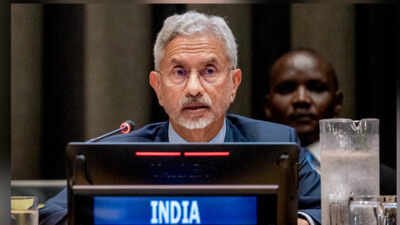
External affairs minister S Jaishankar called for stronger multilateralism to navigate rising geopolitical tensions, conflicts and global competition, as he co-chaired the first Partners for Multilateralism, International Law, Peace & Prosperity (P4M) Summit with European Council President Antonio Costa on Monday (local time). The summit was held on the sidelines of the 81st United Nations General Assembly in New York.Minister Jaishankar stressed the need for greater international cooperation and called for steps to address ongoing conflicts, create safeguards for emerging technologies and reduce risks linked to dominance and disruption. He also stressed the importance of international law, rules and norms.In a post on X, Jaishankar said the summit provided an opportunity to underline the importance of multilateralism at a time when international cooperation is facing pressure from intense competition, geopolitical tensions and conflicts.He highlighted the need to address the specific dimensions of ongoing conflicts, establish frameworks and safeguards for emerging capabilities, and reduce risks by diversifying against dominance and disruption. He also underlined the importance of international law, rules and norms.The EAM further called for “reformed multilateralism”, saying more participative discussions and transparent decision-making could help restore hope in the UN system and strengthen countries’ resolve to work together.Addressing the summit, Jaishankar thanked European Council President Antonio Costa for initiating the forum and said India was pleased to join as a co-sponsor. He said the global order was under stress, with a long-running rebalancing of the world taking a different shape amid intensifying competition, geopolitical tensions and conflicts.He said that if these pressures were left unchecked, they could undermine the spirit of international cooperation, making it crucial for multilateralism to assert itself more strongly.“We meet at a time when the global order is under stress. For some decades, the world has witnessed a steady rebalancing, which was a long-expected structural evolution. However, extreme competition, geopolitical tensions, and actual conflicts have given this an entirely different character. If left unchecked, it would call into question the very spirit of international cooperation. That is why it is so essential that multilateralism asserts itself strongly at this juncture.“Jaishankar also highlighted the range of issues that he said depended on countries’ willingness to cooperate, including peace and international security, climate action and climate justice, emerging technologies, development finance, countering terrorism, strengthening supply chains, disaster resilience and pandemic preparedness.“At stake here are very real issues, not just words and expressions. The future of peace and international security, of climate action and climate justice, of emerging technologies and development finance, of countering terrorism and strengthening supply chains, and of ensuring disaster resilience and preparing for pandemics. All depend on a will to cooperate.”The summit also saw Jaishankar make a case for Reformed Multilateralism, with participative deliberations and transparent decision-making being highlighted as ways to provide hope and optimism to the UN system and reinforce countries’ resolve to work together.Meanwhile, Slovakia backed India’s bid for a permanent seat on the United Nations Security Council on Monday, with foreign minister Juraj Blanár saying India, as a leading country of the Global South and an emerging power in the Indo-Pacific, should have a place at the UN’s top decision-making body.
Share your thoughts in the comments
Be respectful · TOI community guidelines
Blanar’s remarks came after Jaishankar participated in the first high-level Visegrád Group (V4) plus India meeting on the sidelines of the 81st UN General Assembly in New York.“We all agree, as V4 countries, that India, as part of the Global South, an upcoming superpower in the Indo-Pacific region, must be at the table as a permanent member of the UN Security Council,” Blanár said.The V4 comprises Poland, Hungary, Slovakia and Czechia. The four countries held their first ministerial-level meeting with India in the new V4+India format during the UNGA high-level week.Jaishankar described the meeting as a “new historic occasion”. Discussions covered political, economic, defence, technology, space, connectivity and people-to-people ties.Jaishankar is leading the Indian delegation at the 81st UN General Assembly high-level week in New York and is scheduled to address the General Debate on September 26.