
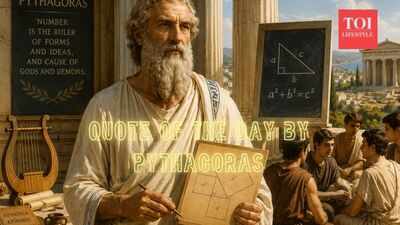
Quote of the Day by Pythagoras, “Do not go to bed until you have gone over the day three times in your mind. What wrong….”
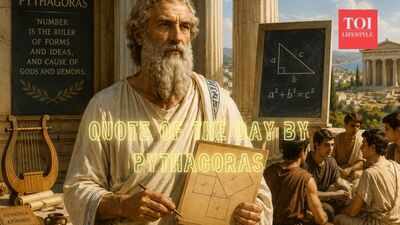
Almost everyone who went to school knows Pythagoras. His Pythagorean theorem, a mathematical principle is taught in schools all over the world. For centuries, students have been memorising the relationship between the sides of a right triangle, often unaware that the man behind the theorem was more than a mathematician. Pythagoras was a philosopher, spiritual teacher, scientist, musician and founder of one of the most remarkable intellectual communities of the ancient world. His oral teachings were later compiled in form of books.He had influence far beyond mathematics. He believed that the universe was governed by numbers, that music reflected the harmony of the cosmos, that the soul could be refined by disciplined living, and that each person should strive to become wiser by constant self-examination. Two and a half thousand years after his death, many of his ideas still influence philosophy, science, education and even modern practices of self-improvement.The mysterious life of PythagorasBorn on the island of Samos in the eastern Aegean Sea, Pythagoras was born c. 570 BCE. Like many famous philosophers he left no writings of his own. Historians know him only from the writings of later authors, many of whom lived hundreds of years after him. His life, therefore, is a curious compound of history and legend. Pythagoras was an inquisitive child. There are old tales of a wandering seeker of knowledge who journeyed far and wide for wisdom. It is said that he spent many years in Egypt, studying geometry, astronomy, religion and sacred rites at the feet of the priests of that country. Some historical traditions also have him travelling to Babylon, where he encountered the advanced mathematical knowledge and astronomical observations developed by Babylonian scholars.Historians cannot ascertain all the facts about these journeys, but they do agree that Pythagoras was influenced strongly by the civilisations with which he came in contact. Unlike many thinkers of his day he saw knowledge as universal. He believed that truth could be discovered by looking at other cultures and watching nature. Pythagoras settled in Croton, a Greek colony in southern Italy, about 530 BCE. Here he founded the school that made him one of the most influential thinkers in history.A school that was life itselfThe community built by Pythagoras was not just an ordinary school. Students didn’t merely come to lessons and go home. They lived together, ate together, studied together, discussed ideas and followed strict rules of ethics. It was something like a philosophical monastery, where education was life and life was education.Community members learned mathematics, geometry, astronomy, music, ethics, medicine and philosophy. They also studied disciplines that were meant to build self-control, honesty, moderation, and compassion. Silence was the key in their education. New students were said to have to listen for months or even years before they were permitted to participate fully in the discussions. Pythagoras believed that there were times when listening was more important than speaking extemporaneously.Simplicity was also valued by the community. Luxury and excess were discouraged as they were believed to distract the mind from wisdom. Some followers became vegetarians, following the belief of Pythagoras that all living beings had a common spiritual essence and deserved compassion.Beyond a mathematicianNumbers meant something much deeper to Pythagoras than they do to us today, even though history remembers him for mathematics. He thought the universe itself was ordered mathematically. In his philosophy, numbers were not just instruments for reckoning; they were the language in which nature spoke.One of the greatest discoveries of his followers was that of music. They found that if the lengths of strings were in simple mathematical ratios to each other, the notes they produced were harmonious. Pythagoras was now convinced that mathematics was at the heart of beauty and harmony.He extended this idea to the heavens, suggesting that the planets and stars moved according to mathematical relationships . Later writers in antiquity referred to this belief as the “music of the spheres,” the idea that the heavenly bodies moved in perfect harmony, creating a cosmic order beyond the reach of ordinary human senses. Modern astronomy does not take this literally, but it does convey a deep insight: nature has patterns, and those patterns can often be described mathematically. Later, this belief would inspire scientists such as Johannes Kepler, Galileo Galilei and Isaac Newton.His philosophy: To live in harmonyFor Pythagoras, philosophy was not an academic discipline. It was a handbook for living. His teachings were built on the concept of harmony. Just as beautiful melodies are created when musical notes are in harmony, so too human life is at its best when our thoughts, emotions, actions and desires are in harmony. He believed that people ought to practise moderation rather than excess. Anger, greed, jealousy, pride, uncontrolled desires disturbed the harmony of the spirit. Wisdom was the mastery of these impulses, not their mastery of you.Pythagoras, unlike many of the philosophers who were concerned only with abstract theory, insisted that knowledge should improve the individual. He felt that intelligence without virtue was incomplete.His legacyAlthough the original Pythagorean community did eventually die out in the wake of political upheaval in southern Italy, the ideas persisted and spread throughout the ancient world. The philosopher Plato was much impressed by many Pythagorean notions, and through Plato they impressed Aristotle and many generations of Western thinkers. Pythagorean mathematics was one of the bases of geometry. He believed the universe followed mathematical laws . This belief affected the development of astronomy and physics . His focus on discipline and self-control predated later ideas in Stoicism, and his insistence on self-examination resembles practices now advocated by psychologists and mindfulness experts.Today Pythagoras is not only known for a single theorem, but because he proved that mathematics, science, ethics, philosophy, music and personal development are all inextricably linked. To him wisdom was not knowledge for the sake of knowledge, but harmony with oneself, with others, and with the universe.Quote of the Day“Do not go to bed until you have gone over the day three times in your mind. What wrong did I do? What good did I accomplish? What did I forget to do?”For Pythagoras, the end of each day was an opportunity to stop and think before starting another. He urged people to look at the way they had lived, instead of rushing through life without learning from it. He believed that reflection transformed everyday experiences into valuable lessons. If you continually assessed your decisions, you would be smarter, more compassionate, more disciplined than someone who kept doing the same thing over and over.The first question (“What wrong did I do?”) is a call to honest self-accountability. Notice that Pythagoras does not ask who disappointed us, who was unfair to us, who caused our troubles. Instead he directs our gaze inward. Did we blow our top? Speak without care? Waste time ? Judge someone unfairly ? Break your word? He never wanted to make people feel guilty. Instead, he felt that the first step to correcting our shortcomings was to recognise them. No growth without self-knowledge. The idea is echoed by modern psychologists, who argue that people who regularly reflect on their behaviour are better able to regulate emotions, improve relationships and make wiser decisions.The second question is just as important: “What good did I do? Many people tend to dwell on the mistakes they made and forget about the good things they did. Pythagoras understood that real self improvement had to be balanced. It can be discouraging to focus only on failures, but acknowledging kindness, patience, honesty or perseverance reinforces behaviours to repeat. Perhaps you helped a colleague, made a friend’s day, kept your cool in a crisis, did a big job well, or just listened to someone who needed you to pay attention. These are moments to notice, for they serve as a reminder that growth is happening already. Even today, neuroscience tells us that when we consciously acknowledge positive actions, the brain boosts its ability to repeat these behaviours in future.Of the three questions, the last might be the most profound: ‘What did I forget to do?’ Because it is about the opportunities we let slip away. Our lives are shaped not only by what we do, but by what we do not do. Perhaps you intended to call your parents but put it off. Maybe you didn’t exercise. You didn’t thank someone who did something nice for you. You didn’t have that important conversation. You broke a promise to yourself. These are often the times that turn into our biggest regrets. By asking what we forgot to do, Pythagoras teaches us that wisdom also consists in seeing what duties we have neglected, and in making an effort to perform them tomorrow.