In 2025, scientists made sound behave like a rainbow, separating different frequencies and sending them in different directions
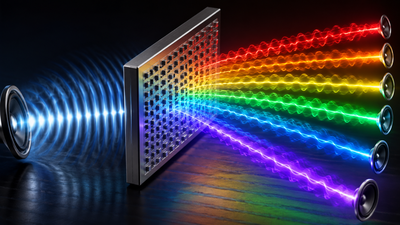
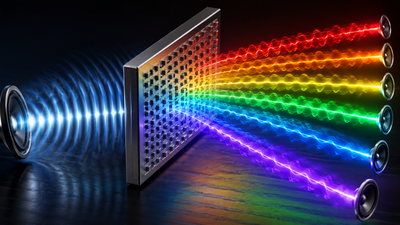
A rainbow of light forms because different wavelengths travel through a prism or water droplets at different angles. Scientists have now shown that sound can be made to behave in a way that splits a broadband acoustic signal into separate frequency components that travel in different directions or come to rest at different positions within a material. According to a study published in Science Advances, titled ‘Morphogenesis of sound creates acoustic rainbows’, a single-material acoustic scattering structure is capable of decomposing white noise into a spatio-spectral “rainbow” with efficiency exceeding that of the source radiating into free space. Separately, according to Physics Magazine, two teams working with elastic waves in solid materials have demonstrated ways to trap and then redirect vibrational energy using engineered synthetic fields, offering a route towards devices that sort, concentrate and deliver specific frequencies to chosen locations.
How computational morphogenesis creates an acoustic rainbow
The team used a method called computational morphogenesis, a form of topology optimisation, to shape a single hard material into complex scattering structures. Their acoustic rainbow emitter (ARE) was designed so that when a single monopolar source emits white noise from 7,600 to 12,800 Hz, the surrounding structure directs each frequency towards a different angle, producing a continuous angular shift from −50° to 50° across the band. Three-dimensional printed test devices were built and measured, with experimental results found to be in close agreement with numerical simulation, and the device measured a spatial separation of at least one order of magnitude in acoustic power between the main emission lobe and any side lobes.The same research group also built a second device, described as a lambda splitter. This structure sounds in the 6.5 to 8.4 kHz range towards +35° and sounds in the 9.4 to 12 kHz range towards −35°, achieving over 88% of emitted power in the intended lobe for the lower band and 82% for the higher band. Notably, the “above unity” efficiency, meaning the source radiated more total power when placed inside the structure than it would into free space, is a result the authors contrast with earlier resonance-based acoustic prism designs that reported efficiencies of only a few per cent. The researchers state the device does not rely on resonance but instead uses phase interference between waves scattered along paths of different lengths.
Scientists create rainbow trapping of elastic waves at different frequencies
Rainbow trapping of elastic waves, the vibrations that deform solid materials as they pass through. The discrete energy states available to electrons in a magnetic field. Structures can be patterned to generate synthetic “pseudomagnetic” and “pseudoelectric” fields that mimic this behaviour for elastic waves without any real magnetic field, causing different wave frequencies to slow down and localise at different positions within the bulk of a material rather than only at its edges.A patterned aluminium plate was used, and laser scanning was used to directly visualise elastic waves near 1.1 MHz coming to rest at different positions depending on frequency, in agreement with their simulations. A silicon chip was built incorporating topological edge states that could selectively couple to a bulk localised mode of matching frequency and carry its energy across the sample to the opposite edge. Tests involving defects and disorder showed no obvious backscattering under the conditions examined; they note that energy loss, fabrication imperfections and the fixed, non-reconfigurable nature of the structures remain challenges for practical use.