Archaeologists discover rare 1,700-year-old Roman marble busts buried near an ancient winepress in Israel | World News
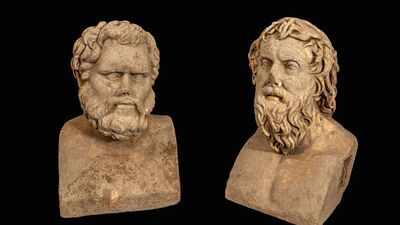
Across the landscapes of the eastern Mediterranean, traces of Roman life continue to surface in unexpected places. A fragment of wall, a forgotten road, a buried coin hoard- each discovery adds another small piece to a much larger story. Occasionally, though, archaeologists uncover objects that seem strangely out of place, raising questions about why they ended up where they did. That appears to be the case at a site near Israel, where two remarkably well-preserved marble busts were recovered from the bottom of an ancient pit associated with a winepress. Rather than lying in a grand public building or a wealthy residence, the sculptures had been hidden away, surviving centuries beneath the ground until recent excavations brought them back into view.
Ancient Roman busts found at winepress site near Binyamina
The discovery was made near Binyamina during archaeological work at a complex linked to wine production in the Roman and Byzantine periods. Winepresses were common features of the region’s agricultural economy, serving communities that cultivated grapes and processed them on a large scale.According to Archaeology Magazine and Haaretz, what drew immediate attention was not the industrial nature of the site but the contents of a collection pit connected to it. Buried within were two marble busts dating to roughly 1,700 years ago. Their state of preservation was unusual. Sculptures from antiquity are often recovered in fragments, having been damaged by time, reuse of building materials or deliberate destruction. These examples survived largely intact.The choice of hiding place has become one of the more intriguing aspects of the find. Archaeologists believe the figures may have been deliberately concealed rather than discarded. The pit appears to have served as a convenient location where valuable objects could be placed out of sight during a period of instability.
Archaeologists investigate the identity of Lycurgus bust
One of the busts carries a Greek inscription identifying the figure as Lycurgus. The name has prompted discussion because it could refer to different individuals known from the ancient world.As reported, among the possibilities is Lycurgus, the semi-legendary Spartan lawgiver traditionally credited with shaping the city’s social and political system. Another candidate is the Athenian statesman and orator of the fourth century BC who bore the same name.The inscription does not settle the matter. Roman collectors and patrons frequently displayed images of historical figures, philosophers, writers and political leaders whose reputations remained influential centuries after their deaths. A sculpted portrait did not necessarily represent a contemporary individual. Instead, it could reflect education, cultural taste or admiration for the classical Greek past. For archaeologists, the inscription offers a rare clue, even if it leaves room for interpretation.
Archaeologists search for clues to identify the bearded bust
The second bust presents a different challenge. No inscription has yet revealed its identity. The figure is distinguished by a pronounced beard and features that suggest intellectual or philosophical associations. In Roman art, beards often appeared in portraits of thinkers, teachers and philosophers, though they were not limited to those groups alone.Without written identification, specialists must rely on artistic style, facial details and comparisons with other surviving sculptures. Such work can take years, particularly when dealing with figures whose likenesses were copied repeatedly across the Roman world. For now, the bearded man remains unnamed.
Where did the ancient Roman busts originally come from
Marble portrait busts were expensive possessions. They required skilled craftsmanship and access to quality stone, often transported over considerable distances. Their owners were typically members of prosperous households or institutions capable of displaying works of art in prominent settings.Archaeologists do not believe they originated from a modest rural property. The workmanship and material suggest a more affluent setting. One possibility is that the sculptures once stood in a bathhouse discovered nearby. Public baths were social centres as much as places for washing, and decorative sculpture formed a familiar part of their architectural environment.Another theory points toward Caesarea, a major urban centre located several miles away. During the Roman period, Caesarea contained monumental buildings, public spaces and wealthy residences where sculptures such as these would not have looked out of place.
Mystery behind the burial of the Roman marble busts
The circumstances of the burial remain open to debate. One explanation is that the busts were concealed during an invasion or period of unrest, with the intention of recovering them later. Such episodes were not uncommon in late antiquity. Communities facing military threats sometimes hid valuable possessions underground, hoping to protect them from looting. Not every cache was retrieved. Owners may have fled, died or simply lost access to the place where their belongings had been stored. If that happened here, the marble portraits may have remained forgotten for centuries, preserved only because nobody returned for them.Reportedly, Excavations rarely provide complete stories. More often, they uncover fragments that hint at events long removed from living memory. The two busts from the winepress pit fit that pattern. Their artistic quality is evident, yet their journey from a wealthy Roman setting to a concealed pit in the countryside remains only partly understood.For the moment, the sculptures offer a glimpse of the cultural world that flourished in this part of the Roman Empire, and a reminder that some of antiquity’s most revealing discoveries emerge from places where nobody expected to find them.