
An Oklahoma wind farm is creating an invisible river of wind that reaches much higher than scientists once thought |
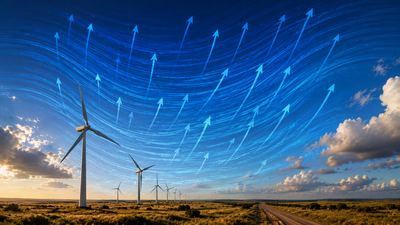
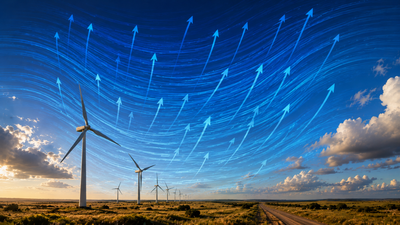
A wind farm is usually thought of as a place where moving air is turned into electricity. Yet the flow does not simply continue on its way once it has passed through the turbines. It changes, rises and mixes with layers of the atmosphere above, leaving behind an invisible trail that can stretch far beyond the turbines themselves. That behaviour has now been mapped in unusual detail at an operating wind farm in Oklahoma. By comparing conditions before the wind reached the turbines and after it passed through them, scientists observed a broad upward transfer of momentum extending through much of the atmospheric boundary layer. According to the study published in the European Academy of Wind Energy, titled “Observations of wind farm wake recovery at an operating wind farm”, rather than remaining confined to the height of the turbine blades, the disturbance spread vertically, creating what could be described as a “river of wind” flowing upwards through the atmosphere. These effects varied with weather conditions and sometimes reached far higher than earlier models had suggested.
How scientists studied wind farm wakes at Oklahoma’s King Plains wind farm
The research centred on the King Plains wind farm near Enid, Oklahoma, where the US Department of Energy’s AWAKEN field campaign installed an extensive network of instruments around the site. Doppler lidars, meteorological stations and sonic anemometers were positioned both upwind and downwind so scientists could compare the atmosphere before it encountered the turbines with the air after it had travelled through the wind farm.According to the study, Oklahoma provided an ideal setting because it produces a large share of its electricity from wind while also experiencing frequent stable atmospheric conditions across the Southern Great Plains. Those conditions make wind farm wakes easier to observe over long distances, allowing researchers to measure how momentum is exchanged between the surface and the atmosphere above.
How vertical momentum flux helps wind farm wakes recover
The team focused on something known as vertical momentum flux, which describes how faster-moving air from higher in the atmosphere is transported downward while slower air near the turbines is replaced by upward mixing. This exchange gradually restores wind speeds behind the turbines, a process known as wake recovery.The measurements showed that the wind farm was generating turbulence that extended far above the rotor blades. The strongest momentum exchange often occurred above the turbine layer rather than inside it, and the influence of the wind farm could be detected throughout almost the entire atmospheric boundary layer instead of fading away close to the ground.The researchers also found that these wake effects remained measurable around 22 rotor diameters beyond the final row of turbines under a range of atmospheric conditions. During stable nights, when natural mixing is weaker, the upward transport of momentum persisted for longer distances than during more turbulent daytime conditions.
How low-level jets influence wind farm wake recovery
The atmosphere itself turned out to play a major role in how this “river of wind” behaved. One important influence came from low-level jets – fast-moving ribbons of air that commonly form a few hundred metres above the Great Plains after sunset.When these jets developed between roughly 250 and 500 metres above the ground, momentum was transferred more effectively into the wake, allowing wind speeds behind the turbines to recover more quickly. When the jets formed closer to the turbine layer, the wind farm altered their height, lifting them farther above the ground downstream. An event involving atmospheric gravity waves, which are ripple-like disturbances moving through the air rather than ocean waves. During this episode, upward momentum transfer became much stronger than usual, suggesting that these natural atmospheric waves can temporarily intensify the exchange of air above a wind farm.
Oklahoma wind farm study could improve future wind energy models
Most wind farm studies have concentrated on changes in wind speed close to turbine height, but the Oklahoma observations indicate that the interaction reaches much higher into the atmosphere. According to the researchers, measuring only the rotor layer may overlook important exchanges occurring across the full depth of the atmospheric boundary layer.The findings could help improve computer models used to estimate energy production, plan wind farm layouts and understand how neighbouring wind farms interact with one another. The authors also argue that longer-term observations will be needed to examine how features such as gravity waves, low-level jets and changing atmospheric stability influence wake recovery over time.