Mount Everest visible from Bihar: NASA astronaut shares breathtaking image of the Himalayas from space |

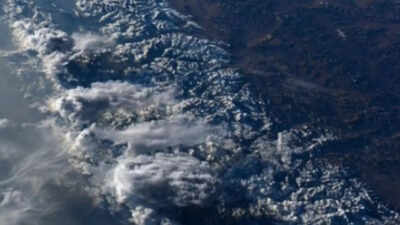
A spectacular and rare view of Mount Everest has recently captured worldwide attention, offering perspectives both from space and the Indian plains. NASA astronaut Don Pettit shared a striking image from the International Space Station (ISS), showcasing the snow-covered peaks of the Himalayas in vivid detail. The photograph highlights Everest’s iconic summit rising above Nepal’s…

Read More

Nobel Prize Winners 2025: Trio win Nobel Prize in chemistry for work on ‘Hermione’s handbag’ materials |

File photo: Scientists Susumu Kitagawa, Omar Yaghi and Richard Robson STOCKHOLM: Scientists Susumu Kitagawa, Richard Robson and Omar Yaghi won the 2025 Nobel chemistry prize for developing a new form of molecular architecture, yielding materials that can help tackle challenges such as climate change and lack of fresh water.The three laureates worked to create molecular…

Read More

Interstellar comet 3I/ATLAS is leaking water in space, NASA says it’s unlike anything ever seen before |

In a rare cosmic discovery, scientists have detected an interstellar comet, 3I/ATLAS, releasing water vapour while still far from the Sun, a phenomenon that has left astronomers astonished. Using NASA’s Neil Gehrels Swift Observatory, researchers identified ultraviolet signatures of hydroxyl (OH), a byproduct of water molecules broken apart by sunlight. What makes this extraordinary is…

Read More

Paralvinella hessleri: The deep-sea worm that fights poison with poison, and shines like gold |

Deep in the Pacific Ocean, a tiny bright yellow worm called Paralvinella hessleri thrives where almost nothing else can, around boiling hydrothermal vents that gush metal-rich, poisonous fluids. These underwater chimneys are packed with toxic substances, including arsenic and hydrogen sulphide. Yet, instead of dying, the worm uses these poisons to its advantage. According to…

Read More

4-billion-year-old secret is hidden in the Moon’s south pole: NASA’s Artemis mission could uncover it soon |

For decades, the Moon’s south pole has captivated scientists as one of the most mysterious and unexplored places in our solar system. Unlike the sunlit plains visible from Earth, this region lies in perpetual darkness, preserving traces of the Moon’s early history, possibly dating back over 4 billion years. Now, with NASA’s Artemis program, humanity…

Read More