Absence of saptapadi alone cannot invalidate marriage: What Delhi High Court said on a Hindu marriage
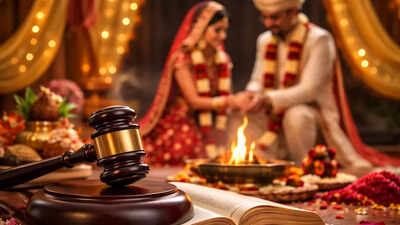
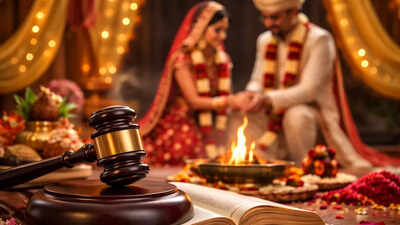
Restating the legal presumption in favor of the validity of marriage, the Delhi High Court has held that, in the absence of direct evidence showing performance of Saptapadi, the traditional taking of seven steps before the sacred fire, such absence alone does not render a Hindu marriage invalid. The Court noted that when the circumstances show that the parties did undergo some sort of marriage ritual and then proceeded to live together as a married couple, the presumption of legitimacy remains strong, particularly when a child has been born from the union.Delivering judgement on 27.08.2025 in an appeal under Section 19 of the Family Courts Act, a Division Bench comprising of Justice Anil Kshetrapal and Justice Harish Vaidyanathan Shankar dismissed a husband’s challenge to a Family Court ruling which had rejected his plea seeking declaration that his marriage was null and void on the ground that Saptapadi had not been performed.The appeal arose from proceedings in which the appellant sought declaratory relief and a permanent injunction, arguing that the essential marriage ceremonies were absent. The Family Court had ruled the claim was unfounded based on oral and documentary evidence, leading to the present appeal.Before examining the factual controversy, the High Court analyzed the statutory scheme under Section 7 of the Hindu Marriage Act, 1955, which governs ceremonies required for solemnization. The Bench noted that the provision grants flexibility regarding rites and ceremonies rather than mandating uniform ritual compliance.Referring to the statute, the Court observed:“Sub-section (1) of Section 7 confers discretion on the parties to solemnise marriage as per the customs and ceremonies of either party, without mandating any particular ceremony.”It further clarified the role of Saptapadi within this framework:“Thus, performance of Saptapadi is not an indispensable requirement in every case to establish a valid marriage. Sub-section (2) only clarifies that where Saptapadi is a part of the customary rites performed, the marriage attains completeness and binding force with the seventh step.”This interpretation of the statute was the basis of further consideration of the Court on the argument that the non-performance of Saptapadi by the appellant made the marriage void.The Court emphasized that Section 7 does not prescribe a uniform ritual requirement but recognizes diversity of customary practices governing solemnization. The provision, therefore, requires examination of surrounding circumstances and evidence rather than mechanical insistence on proof of a specific ceremony.As per the pleading before the Court, the parties exchanged garlands in Delhi on 19.06.2016. According to the appellant, ceremonies, which are in accordance with the relevant customs, such as the Saptapadi, were never performed. It was admitted, however, that thereafter, the parties continued to stay together and that the marriage was consummated and a daughter was born out of marriage.Appellant argued that he lived with the respondent until October 2016 but subsequently decided that the marriage was invalid because it did not include necessary rituals. The respondent refuted this version, saying that in October 2017, she had been pushed out of her matrimonial home and that ceremonies were actually conducted, including the Saptapadi ceremony.Following trial, the Family Court dismissed the husband’s suit, holding that he failed to substantiate his allegations. The appellate proceedings therefore centred on whether this conclusion suffered from legal or evidentiary infirmity.Evidentiary Contentions Before the High CourtThe main argument of the appellant was based on the inference of evidence. Counsel argued that the respondent had failed to produce a marriage album documenting the ceremony and the court ought to have made an adverse inference against the respondent. It was submitted that absence of proof of Saptapadi indicated that the marriage lacked legal validity.Opposing the appeal, the counsel for the respondent argued that the appellant bore the burden of proof and that no ceremonies were performed, especially when he was the one who wanted to have marital status nullified. The respondent insisted that rituals were carried out and stressed the fact that cohabitation and a child was born.After examining the record, the High Court observed that there were some significant weaknesses in the approach of the appellant to evidence. In the process of entering the witness box and submitting the affidavit reiterating his claim, he did not even examine any priest, guest or elder that was there at the ceremony to substantiate his statements. The Bench noted that these omissions were significant weakening factors to the plea that the necessary rites were not performed.Presumption of Marriage and LegitimacyThe Court’s reasoning then shifted to the doctrine of presumption favoring marriage validity. Referring to established jurisprudence, including precedent from the Bombay High Court, the Bench emphasized the legal principle that long cohabitation and societal recognition reinforce presumptions of lawful marriage.The Court highlighted:“When a man and a woman live together as husband and wife for sufficiently long time and were treated as husband and wife… there is always a presumption in favour of their marriage. If children are born to such a couple, there is a further presumption in favour of their legitimacy.”Using this doctrine and the facts, the Bench observed that the appellant himself admitted cohabitation and marital relationship. The birth of a child further strengthened the presumption of a valid marriage. The Court said that such presumption is not weakened merely by absence of direct proof of Saptapadi or similar ceremony, especially when some form of marriage ceremony is acknowledged.On the submission involving the failure to produce a marriage album, the Court rejected the argument that an adverse inference ought to be drawn. It held that the onus was on the appellant to prove the absence of ceremony and not on the respondent to prove it took place.The bench observed:“The burden of proof being on the Appellant to establish that no Saptapadi was performed, an adverse inference cannot be drawn against the Respondent for not producing the marriage album.”It further noted that even production of photographs would not conclusively determine whether Saptapadi occurred, underscoring limitations of such evidence.Final DeterminationAfter an examination of statutory provisions, evidence, and presumptive doctrines, the Court determined whether it was appropriate to interfere with the findings of the Family Court. It held that the trial court had made a decision resting on a plausible evaluation of the evidence, and that the decision had not revealed an error to be corrected by the court of appeals.The Bench recorded that the appellant failed to discharge the burden of proof necessary to invalidate the marriage and that the presumption of legitimacy remained intact in light of admitted cohabitation and parenthood.Accordingly, the Court held:“We do not find any reason to interfere with the impugned judgement because the conclusion of the Family Court is plausible and possible.”The appeal was dismissed, affirming the Family Court’s rejection of the husband’s suit seeking declaration of nullity.MAT.APP. (F.C.) 317/2023 X vs YFor Appellant: Mr. Deepak Kumar Sharma, AdvocateFor Respondent: Mr. S.P. Yadav and Mr.Deepak Kumar, Advocates(Vatsal Chandra is a Delhi-based Advocate practicing before the courts of Delhi NCR.)