A football-field-size asteroid hit the North Sea and sent a 330-foot tsunami racing across Europe |
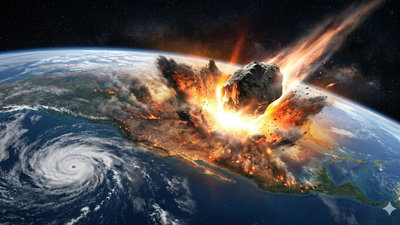
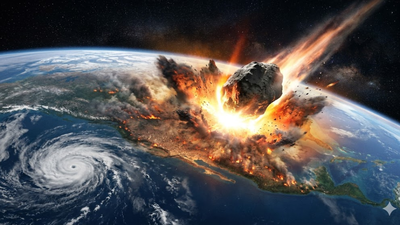
Picture a space rock the size of a football pitch crashing into the North Sea’s shallow seabed 43 to 46 million years ago. This terrible event created a hidden crater and triggered a tsunami over 100 meters tall, taller than many modern skyscrapers. According to Science Daily, scientists have finally put an end to a 20-year-old argument. They used shocked minerals and cutting-edge seismic scans to prove that an explosion created the Silverpit Crater. Dr Uisdean Nicholson from Heriot-Watt University led the discovery. It gives us a clear picture of the chaos that existed on the coast of Yorkshire before humans arrived, and it changes what we know about how asteroids hit our planet. This breakthrough, funded by the Natural Environment Research Council, highlights the raw power of nature and shows how dynamic Earth’s history has been.
Silverpit crater: North Sea asteroid impact confirmed
The Silverpit Crater lurks 700 metres beneath the North Sea waves, about 80 miles off Yorkshire’s shore. First spotted in 2002, its three-kilometre-wide bowl and 20-kilometre ring of faults puzzled experts for years. Some blamed shifting salt layers or volcanic slumps, but fresh evidence points squarely to a hypervelocity asteroid strike. Dr Uisdean Nicholson, a sedimentologist at Heriot-Watt University’s School of Energy, Geoscience, Infrastructure and Society, led the charge. “New seismic imaging has given us an unprecedented look at the crater,” he explained. Rock samples from a nearby oil well revealed rare shocked quartz and feldspar crystals – tiny minerals deformed only by the insane pressures of an impact, like a needle in a haystack find. Professor Gareth Collins of Imperial College London, who joined the 2009 debate to reject the impact theory, now celebrates the proof. “I always thought that the impact hypothesis was the simplest explanation… It is very rewarding to have finally found the silver bullet,” he said. Published in Nature Communications, the study integrates seismic data, microscopy, and simulations to provide ironclad confirmation.
The asteroid strike: How the 330-foot tsunami unfolded
Picture an asteroid that is 160 meters wide and about the same length as London’s Tower Bridge coming in from the west at a shallow angle. It hits the seabed with cosmic force, turning rock and water into a plume that rises 1.5 kilometres into the air and blocks out the sky. That huge curtain falls back into the sea in just a few minutes, creating a tsunami that is more than 100 meters (330 feet) high. Dr Nicholson paints a clear picture: “Our evidence shows that a 160-meter-wide asteroid hit the seabed at a low angle from the west.” In just a few minutes, it built a 1.5-kilometre-high wall of rock and water that collapsed into the sea, generating a tsunami more than 100 meters high. Back then, the North Sea basin was shallower, amplifying the waves’ fury. These mega-waves would have ravaged prehistoric coasts from Britain to Europe, a stark reminder of the impacts’ ripple effects. Computer models support this, showing how even mid-sized rocks can cause such devastation in coastal shallows.
Why the North Sea asteroid impact matters today
Silverpit is now part of a small group of 33 known submarine craters around the world, like Mexico’s Chicxulub, which killed dinosaurs, or Africa’s recent Nadir find. Dr Nicholson says, “Silverpit is a rare and very well-preserved hypervelocity impact crater.” “These are rare because the Earth is always changing; plate tectonics and erosion destroy almost all traces.” This study of an asteroid hitting the North Sea helps us find hidden threats more easily. It shows how impacts shape the planets’ interiors, which are hard to see from distant worlds like Mars. Professor Collins says that now “we can get on with the fun job of using the amazing new data to learn more about how impacts shape planets.” In our asteroid-vigilant era, Silverpit’s tale urges better monitoring. By tracking near-Earth objects, agencies can better understand ancient strikes like this one, bolstering defences against future cosmic visitors. It underscores Earth’s battered past, fuelling curiosity about what other secrets lie buried under our seas.