Scientists solve mystery of black hole ‘burps’; new study reveals when these cosmic objects launch powerful jets after eating stars |
When a star strays too close to a supermassive black hole, gravity can tear the star apart in what astronomers call a tidal disruption event. Some of the debris gets swallowed, while the rest can be blasted back out in powerful jets, sometimes months or years after the star is destroyed. A new study titled ‘A universal critical accretion rate for black hole jet information’ in Nature Astronomy, led by Curtin University’s Adelle Goodwin and Andrew Mummery of Princeton’s Institute for Advanced Study, has pinned down when these delayed burps occur.
When black holes launch jets after tearing stars apart
Goodwin and Mummery analysed 20 tidal disruption events using optical, ultraviolet, X-ray, and radio observations, narrowing the sample to 10 events where they could reliably model both the black hole’s feeding rate and the timing of its radio jets. They found two distinct windows in which jets appear. The first comes early, while the black hole is still feeding at extreme rates shortly after the star is destroyed. The second comes much later, sometimes hundreds to thousands of days afterward, once the feeding rate has dropped to roughly two percent of the black hole’s Eddington limit, the point where outward radiation pressure balances its gravity.
Why astronomers call these delayed outflows black hole ‘burps’
“When a black hole tears apart a star, it does not swallow everything neatly,” Goodwin said in the press release announcing the study, issued by the Forrest Research Foundation and distributed via Scimex, “Some of the material is consumed, and some is launched back into space in powerful jets and outflows. You can think of it as a black hole burp, except these burps can blast material across enormous distances and influence the galaxies around them,” he elaborated further. Goodwin also said the project began with a simple puzzle, why do some black holes fire off radio jets soon after destroying a star, while others appear to stay quiet for months or years before suddenly switching on, seemingly without warning or any obvious external trigger.
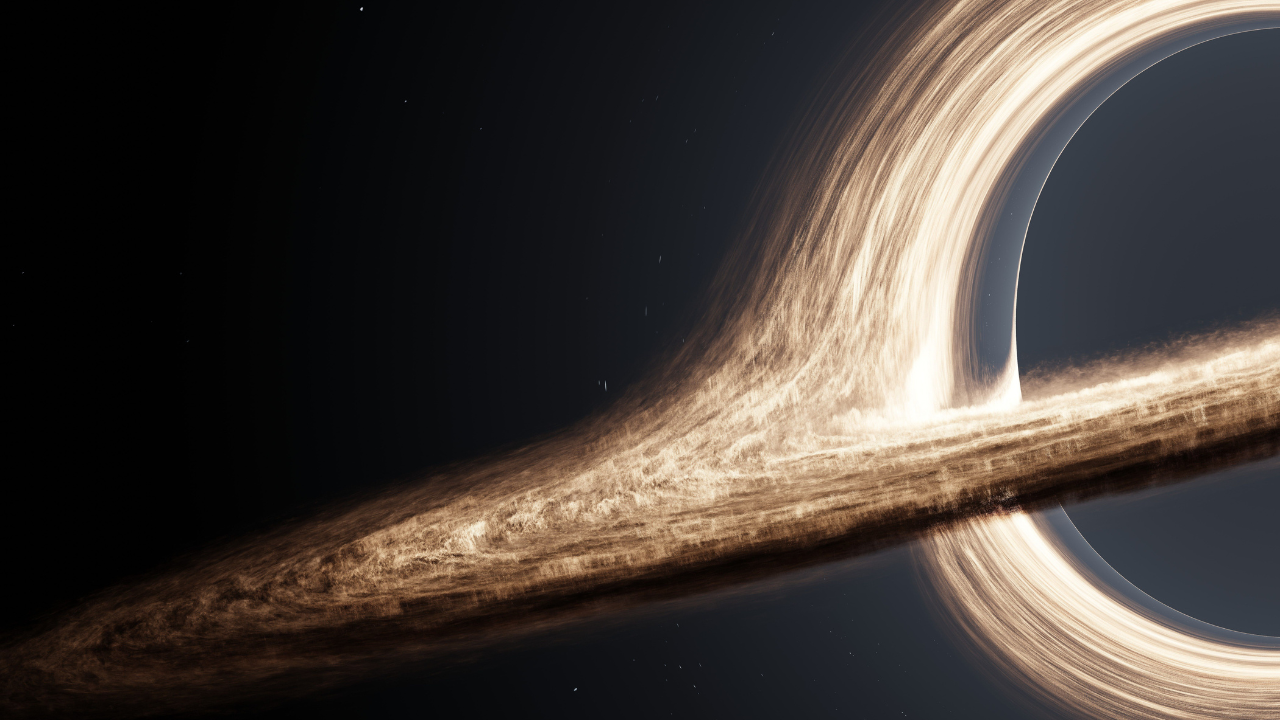
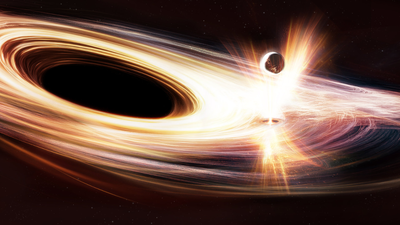
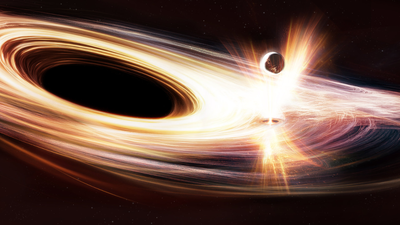
Astronomers call these delayed outflows black hole ‘burps’ (Image: Canva)
How radio telescopes revealed the delayed jet-launching phase
Radio observations proved essential to solving that puzzle, since they let astronomers trace outflowing material long after the initial flare had faded from optical view. Tracking that emission over time revealed the delayed second phase of jet activity, something that had been difficult to spot by studying individual events in isolation. According to Goodwin, the pattern became clear once she and Mummery compared multiple cases side by side, the late jets consistently switched on once the black hole’s feeding rate crossed that same two-percent threshold, rather than appearing at some arbitrary point in time after the star’s original destruction by the black hole.
Why the same feeding limit appears across black holes of any size
The two-percent Eddington limit was already known to trigger jets in much smaller, stellar-mass black holes within our own galaxy, typically only around ten times the mass of the Sun. Finding the same threshold at work in supermassive black holes, millions of times heavier, suggests the underlying physics of jet formation does not depend on a black hole’s size. “These black holes are separated by enormous differences in mass, but they appear to switch on their jets at the same point in the feeding process,” Goodwin said. “That tells us something fundamental about black holes, the physics does not seem to care how big they are.”