Middle East, Russia crisis: India new ‘swing supplier’ for refined oil products. Can it sustain?
India’s oil-products export map is expanding and the country is fast emerging as an important ‘swing supplier’ in the world’s refined fuel markets as the Middle East crisis continues to disrupt flows.As TOI recently reported, Singapore has become India’s third-largest goods export destination. The ongoing Middle East crisis has reshaped India’s oil-product export markets, with Italy and Spain among the fastest-growing destinations, and Singapore and Tanzania overtaking several traditional buyers.Tanzania and South Africa have entered the top 10. Among countries that are importing nearly $1 billion or more from India, Tanzania, Jordan and Sri Lanka saw strong growth, driven largely by higher oil-product shipments amid supply disruptions, although higher prices also boosted export values.Oil products now account for a much larger share of India’s exports to several destinations. Singapore became India’s largest refined-product export destination at $4.3 billion, followed by Tanzania at $2.2 billion and the Netherlands at $2 billion.
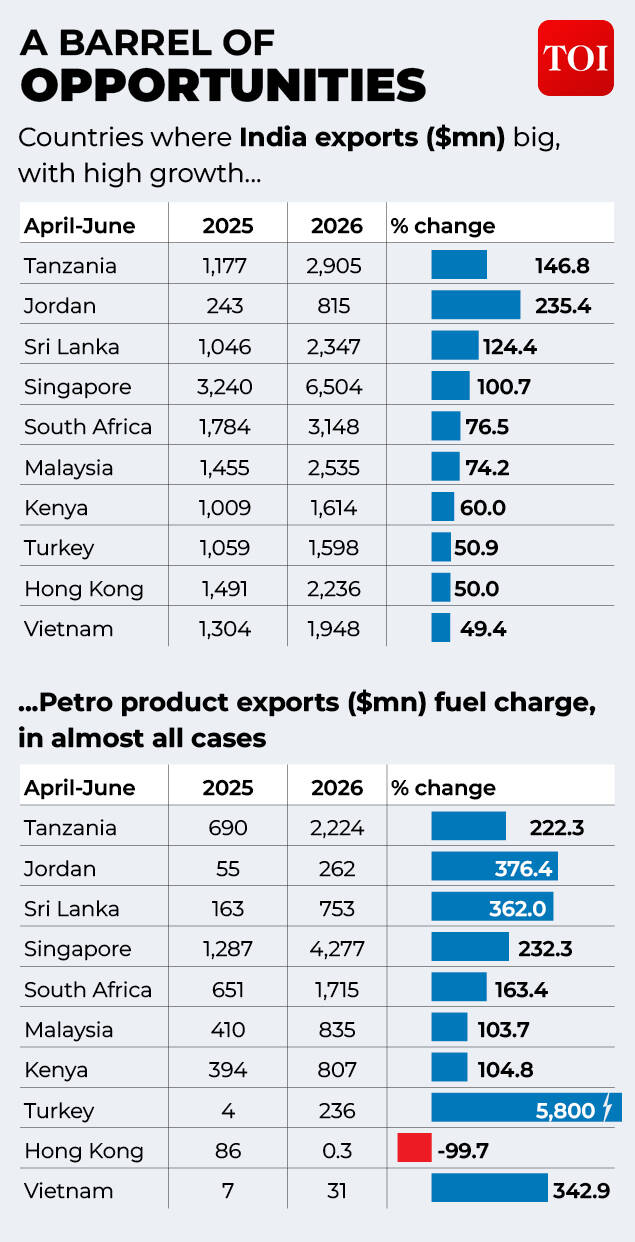
Countries where India’s petro exports have grown
Recent refinery expansions, coupled with consistently high operating rates, have enabled India to capitalize on a global supply gap created by refinery outages in Russia, logistical disruptions in the Middle East, and lower fuel exports from China.But can this momentum continue? Can India sustain its new found position as a major ‘swing player’ in the global refined oil products market?
India’s growing prominence & refining capacity
India’s global prominence as a supplier of refined fuel has grown rapidly in recent years. During 2023-24, India was the largest supplier of refined fuels to the European Union, overtaking Saudi Arabia. And, the capacity is only expected to expand.Refining capacity is expected to go up from 258.1 million tonnes to about 309.5 million tonnes. Experts believe this is reflective of a strategic effort to strengthen both domestic energy security and India’s position in international fuel markets.According to government data, India is the world’s third-largest crude oil importer, fourth-largest refiner, and fifth-largest exporter of petroleum products.India has about 258.1 million tonnes of installed refining capacity across 23 refineries. It is the fourth-largest refining centre globally after the US, China and Russia.In fact, India’s refining sector is undergoing a structural shift, with capacity expected to increase by 800 thousand barrels per stream day by 2028. The start-up of the Barmer refinery and upcoming upgrades at state-owned refineries will strengthen India’s position as a major petroleum-product exporter.According to Pankaj Srivastava, Senior Vice President, Commodity Markets-Oil, Rystad Energy, this contrasts with China’s strategy: while China is expanding petrochemical capacity to support its solar and EV industries and boost petrochemical exports, India remains focused on leveraging its refining infrastructure to expand fuel production and exports.What sets India apart is the scale and sophistication of its refining assets.“Reliance Industries’ Jamnagar complex remains the one of the world’s largest and most complex single-site refineries and accounts for roughly 70% of India’s refined fuel exports. This gives India a level of export flexibility that few refining hubs can match,” say Praveen Rai, Director, Grant Thornton Bharat.
Importance of Russian crude
Experts acknowledge that discounted Russian crude is giving Indian refiners a competitive edge, but that is not the sole driver of the record exports.“Expanding capacity and strong product cracks encourage refiners to capitalize on favorable global markets, while domestic fuel-pricing constraints weigh on realizations for oil-marketing companies. Product exports therefore provide a valuable hedge against losses being made by refineries with integrated oil market companies in the domestic market,” explains Pankaj Srivastava of Rystad Energy.According to Harsha Kapoor, Partner, Energy sector, EY-Parthenon India, the risk isn’t losing Russian crude, it’s losing feedstock advantage.Russian crude hit a record 50.83% of India’s crude imports in July 2026, up from near zero before 2022. But the number that matters is price, not volumes.“The discount that made those barrels attractive has narrowed sharply through 2026, and the arbitrage refiners built their economics on is thinner than it’s been in years. As that discount narrows, refiners have less room to rely on crude arbitrage to support margins. If Russian crude becomes less attractive or less available the advantage then shifts back to the refinery itself: complexity, crude flexibility, yields and operational efficiency,” he tells TOI.India’s refining export advantage remains closely tied to access to discounted Russian crude, although that advantage has narrowed significantly over the past few months.Praveen Rai of Thornton Bharat notes that Russia accounted for more than 50% of India’s crude import bill by value in July 2026. At the refinery level, the dependence is also evident, with Russian crude accounting for around 35% of feedstock processed at the Jamnagar complex during the three months ending July 2026.However, the economics are becoming less favourable, as the discount on Russian crude narrowed sharply from $77.7 per tonne in April 2026 to just $10.6 per tonne by June, he tells TOI.At the same time, geopolitical risks around Russian supplies are increasing. The European Union’s ban on refined products derived from Russian crude came into effect in January 2026, while a US Senate bill passed in August 2026 could potentially authorize tariffs of up to 100% on major buyers of Russian energy.“These developments have increased uncertainty around the long-term viability of Russian crude flows. If Russian supplies were significantly curtailed, Indian refiners would still be able to source crude from the Gulf, the United States, or Africa. However, these alternatives are generally more expensive and, in some cases, involve longer shipping times. While imports from West Asia can reach Indian refineries within one to two weeks, cargoes from the United States may take more than a month to arrive. As a result, the key risk is not physical availability of crude, but the loss of the cost advantage that has helped Indian refiners remain highly competitive in global fuel markets over the past few years,” Rai explains.
India the ‘swing’ player: Is a structural shift emerging?
India is already a leading refining hub, in fact it ranks among the top five in terms of refining capacity.The next important question is whether it can become a structurally important swing supplier.Oil and gas sector experts see a structural shift underway, with the possibility of India fast emerging as a ‘swing player’ in the refined products market whenever supply tightens.Harsha Kapoor of EY-Parthenon India says that while the spike in exports is cyclical, India’s emergence as a swing supplier is structural.“The recent July numbers ~1.55bpd is more war driven, circumstantial and shouldn’t be seen as the new normal. Also, what’s interesting is how quickly India was able to respond and capability of materially increasing exports whenever regional supply tightens. The structural shift isn’t permanently higher exports every quarter; it’s the ability to swing volumes faster than most refining hubs when conditions align,” he tells TOI.“India is already the world’s fourth-largest refiner, with ~258 MMTPA of current capacity and exports of roughly $44 billion. An important aspect going forward is whether Indian refiners sustain that position through scale, flexibility and operational excellence rather than through the Russian feedstock advantage,” says Harsha Kapoor.“If they can, India moves from a major refining hub to an indispensable one in global product markets. If the advantage was primarily arbitrage-driven, today’s leadership becomes harder to sustain as discounts disappear,” he adds.Praveen Rai also sees India’s record fuel-export surge as both a temporary war windfall and evidence of a deeper structural shift in global energy trade.The sharp jump in July 2026 was largely driven by exceptional refining margins following renewed Middle East tensions and disruptions to regional supply chains. Such spikes are unlikely to be sustained once geopolitical risks ease and margins normalize.Praveen Rai explains the underlying trend which is structural. Since the Russia-Ukraine war, global oil trade flows have been fundamentally reshaped. As European buyers reduced dependence on Russian energy, Russia redirected crude exports towards Asia, with India emerging as one of the largest buyers of discounted Russian crude.Indian refiners leveraged this cost advantage, expanded their role in global fuel markets, and increasingly supplied refined products to destinations across Europe, Asia and other regions. In parallel, substantial additions to India’s refining capacity have strengthened its long-term export capability.“The result is that India’s recent export boom is not solely a consequence of the latest Middle East conflict. Rather, it reflects a broader repositioning of India as a major global refining hub within a reconfigured energy-trading system. July’s export volumes may moderate as geopolitical conditions stabilize, but the baseline level of India’s petroleum product exports is likely to remain structurally higher than it was before the Russia-Ukraine war,” Praveen Rai tells TOI.
The bottom line
India is gaining global prominence for its refined fuel products. But domestic demand is expected to be a factor that may constrain the ability to expand exports beyond a point.And geopolitics, sanctions, and tariff related dynamics may play a key role in limiting expansion prospects as well.Pankaj Srivastava of Rystad Energy says India’s complex refineries, deep bottom-of-the-barrel conversion capabilities, strategic location, middle-distillate-focused production, and planned capacity addition position the country to become a major refined-product exporter.“However, geopolitical tensions, an unfavorable US–India trade framework, and potential constraints on Russian crude supplies could hinder this growth,” he says.India’s petroleum consumption is growing at around 3-4% annually and the country is expected to remain one of the largest contributors to global oil demand growth over the rest of this decade.Praveen Rai of Grant Thornton Bharat doesn’t see India overtaking the US or China as a refining superpower in absolute terms. However, it is increasingly consolidating its role as one of the world’s most export-oriented refining hubs, leveraging scale, complex refining configurations, and a favourable geographic location to optimize crude sourcing and serve multiple product markets across Europe, Asia and Africa.“That said, the operating environment remains highly dynamic. Geopolitical developments surrounding Russian energy trade, evolving sanctions regimes, and the phased rollout of new refining projects through 2027-28 could all influence market shares and export flows. As a result, current rankings and trade patterns should be viewed as a snapshot of a rapidly evolving global energy landscape rather than a fixed long-term outcome,” he cautions.Though one point is clear: India occupies a unique position in the global refining landscape, dominant at the refinery level and increasingly influential at the national level.