Louis Pasteur: Quote of the day by Louis Pasteur: “Chance favours the prepared mind.” – why preparation matters more than luck |
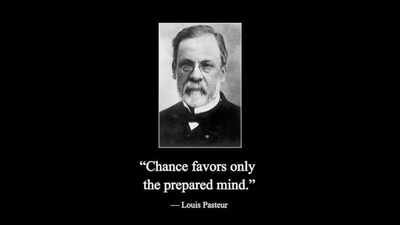
Two scientists can stumble into the same unplanned accident in the lab and walk away from it completely differently. One sees a ruined experiment, discards it, and starts again from scratch. The other recognises, almost instantly, that the accident has revealed something nobody had intentionally set out to find. Louis Pasteur, the chemist and microbiologist whose work founded modern germ theory and gave the world vaccination as a deliberate scientific method, spent his career on the second side of that divide, and had a clear explanation for why. “Chance favours the prepared mind,” he said, describing not luck itself but the specific condition that makes luck usable at all.
Quote of the day by Louis Pasteur
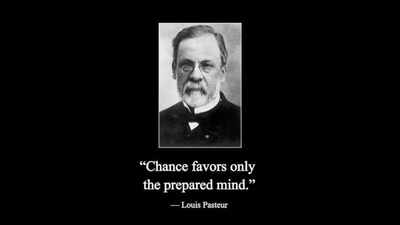
“Chance favours the prepared mind.”
What Louis Pasteur actually meant
He was not claiming that some people are simply luckier than others, or that careful preparation guarantees a lucky break will eventually arrive. His point was narrower and more useful than that. Unplanned, accidental results happen to everyone working in a field, regularly and unpredictably. What separates the person who benefits from an accident from the person who simply experiences it is whether they have already built enough background knowledge to recognise what the accident actually means the moment it occurs.Two researchers can watch the same unexpected result happen in front of them and walk away with completely different outcomes, because one has spent years studying the relevant subject closely enough to immediately understand its significance, while the other lacks the framework to see it as anything but a mistake. Pasteur was not diminishing the role of luck. He was pointing at something more specific: that luck only becomes useful once someone is prepared enough to notice it, understand it, and act on it before the moment passes.
Written by someone who turned a forgotten culture into a vaccine
What gives this line extra weight is how directly Pasteur’s own most important discoveries confirmed it. While researching chicken cholera in the early 1880s, Pasteur’s laboratory left a culture of the bacteria unused for several weeks during a break, and when it was later injected into chickens, the animals became only mildly ill rather than dying, and were subsequently found to be immune to fresh, fully virulent strains of the disease. Where an unprepared researcher might have simply discarded the weakened, seemingly failed culture, Pasteur immediately recognised the underlying principle: the bacteria had been attenuated by exposure to air over time, and a weakened form of a pathogen could train the body’s defences without causing full disease.That single recognised accident became the foundation of the modern vaccine, a term Pasteur himself extended in honour of Edward Jenner’s earlier smallpox work, and he went on to apply the same principle deliberately to develop a vaccine against anthrax and, in 1885, the first vaccine against rabies, tested directly on a human patient for the first time. None of it would have amounted to anything without the years of prior study into microorganisms and disease that let Pasteur recognise, in a single overlooked and nearly discarded culture, the outline of a method that would go on to save millions of lives.
Why this idea keeps coming back
The basic claim in this quote, that background knowledge is what converts a random event into a meaningful discovery, echoes throughout the history of science, in stories ranging from Alexander Fleming’s recognition of the significance of a contaminated petri dish to countless other cases where the same accident, happening to someone without the relevant expertise, would have produced nothing at all.Pasteur was describing, from firsthand experience, a pattern historians of science have since documented repeatedly across many different fields. That overlap is a large part of why the line remains one of the most quoted in the history of science. It is not describing a rare stroke of fortune reserved for great researchers. It is describing something anyone can actively build toward: the deliberate accumulation of knowledge that makes it possible to recognise an opportunity the moment it appears rather than long after it has already passed.
A simple way to actually use this idea in daily life
The useful move here is treating ongoing learning as preparation for opportunities that haven’t shown up yet, since the value of broad, sustained knowledge often only becomes visible retroactively, at the exact moment an unplanned situation calls for it.A fair test is to ask, after something unexpected happens, whether enough background exists to actually recognise what just occurred, or whether it will simply be missed for lack of context. That question will not manufacture luck on demand. It usually determines whether the luck that does show up gets noticed at all.
Other famous quotes by Louis Pasteur
- “Science knows no country, because knowledge belongs to humanity, and is the torch which illuminates the world.”
- “Let me tell you the secret that has led me to my goal: my strength lies solely in my tenacity.”
- “In the field of observation, chance favours only the prepared mind.”