Quote of the day by Alexander Fleming: “I did not invent penicillin. Nature did that. I only discovered…” – why one accident changed the history of medicine |
Two scientists can notice the exact same odd result in a failed experiment and walk away from it completely differently. One sees a ruined sample, clears it off the bench, and moves on to the next attempt. The other stops, looks closer, and asks what could have caused something that was never supposed to happen. Alexander Fleming, the Scottish bacteriologist whose accidental discovery went on to save more lives than almost any single finding in the history of medicine, understood exactly which kind of scientist he needed to be in that moment. “I did not invent penicillin. Nature did that. I only discovered it by accident,” he said, insisting on a distinction that mattered a great deal to him even after the world had already decided to call him a genius for it.
Quote of the day by Alexander Fleming
“I did not invent penicillin. Nature did that. I only discovered it by accident.”
What Alexander Fleming actually meant
He was not being falsely modest, and he was not minimising the years of training and instinct that let him recognise what he was looking at. His point was narrower and more precise than that. Invention implies deliberately building something from nothing. Discovery means noticing something that already existed and understanding what it means. Fleming wanted credit for the second thing, not the first, because claiming the first would have been simply untrue.Two people can stand in front of the same accidental result and come away with completely different conclusions, because one assumes an unexpected outcome is just noise to be discarded, while the other assumes it might be signal worth investigating. Fleming was not claiming that luck did all the work by itself. He was pointing at something more specific: that the raw material of the discovery belonged to nature entirely, and the only thing he contributed was paying enough attention to notice it and enough training to understand what he was seeing.
Written by a scientist known for a famously untidy lab
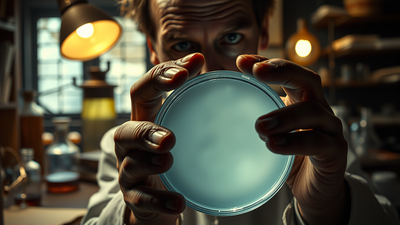
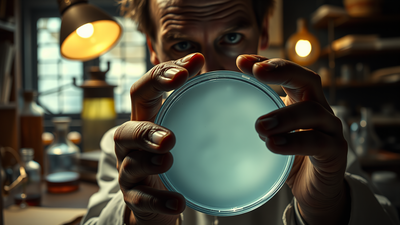
What gives this line extra weight is exactly how the discovery happened. In September 1928, Fleming returned from a holiday to his laboratory at St Mary’s Hospital in London to find a petri dish, one he had carelessly left uncovered on his bench before leaving, contaminated with a stray mould. Around that mould, the bacteria he had been culturing had died off completely. Fleming was well known among colleagues for a cluttered, disorganised lab, and it was that same untidiness, a dish left out by accident, that produced the exact conditions needed for the discovery to occur at all.He isolated the mould as Penicillium notatum and published his findings in 1929, but lacked the chemistry expertise and resources to purify the compound into something usable as a medicine, and the discovery sat largely unnoticed for over a decade. It was not until Howard Florey and Ernst Chain, working separately in Oxford, developed methods to produce and stabilise penicillin at scale in the early 1940s that it became the drug that transformed the treatment of infection during the Second World War and after. Fleming shared the 1945 Nobel Prize in Physiology or Medicine with both men, a fact that fits precisely with his own account of what he had and had not done.
Why this idea keeps coming back
The basic claim in this quote, that many of the most important discoveries come from noticing an accident rather than executing a plan, echoes across the history of science, from the discovery of X-rays to the invention of the microwave, both of which began as unplanned observations that someone happened to be paying close enough attention to investigate.Fleming was describing, from direct experience, something historians of science would later formalise as a recurring pattern: preparedness meeting chance, rather than chance alone. That overlap is a large part of why the line still gets quoted, well outside laboratories. It is not describing a special kind of luck reserved for scientists. It is describing something anyone can practise, the discipline of staying curious about the thing that went wrong instead of immediately clearing it away.
A simple way to actually use this idea in daily life
The useful move here is treating an unexpected result as a question rather than a mistake, since most people’s first instinct when something goes differently than planned is to dismiss it and start over rather than to ask what it might be revealing.A fair test is to ask, when something surprising happens, whether it is worth five extra minutes of attention before being written off. That question will not turn every accident into a discovery. It usually stops a genuinely useful observation from being cleared off the bench before anyone notices it.
Other famous quotes by Alexander Fleming
“One sometimes finds what one is not looking for.”“When I woke up just after dawn on September 28, 1928, I certainly didn’t plan to revolutionise all medicine by discovering the world’s first antibiotic.”“The microbe is so small you can’t see it with the naked eye, yet it can nearly kill you.”