No retakes, no filters: Why our souls crave theatre’s raw power | India News
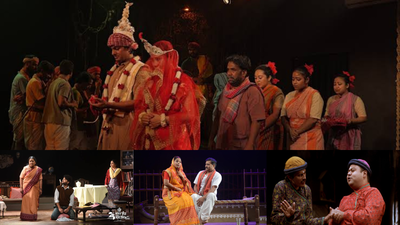
On any given evening, the pavements around Delhi’s cultural hub begin to fill up long before the curtains rise. Outside auditoriums in Mandi House, a crowd gathers, students, families, regular theatre-goers, some clutching tickets, others waiting to collect them. Nearby, theatre artists stand in small groups, going over lines, scribbling last-minute ideas, cups of chai in hand. There’s an artsy air about the place, a sense of something extraordinary quietly coming together. Conversations drift through the crowd, debates over past performances, excitement about the evening’s play, whispered recommendations passed from one enthusiast to another.Among them is an elderly woman who returns to watch the same play again and again, each time taking something different back with her. A young enthusiast stands nearby, watching closely, seeing in the stage not just a performance but something he hopes to be a part of one day. And somewhere in the crowd, a man finds himself reconnecting with a kind of vulnerability that everyday life often asks him to hide.There is collective anticipation, but also an unspoken understanding. What they are about to witness will unfold only once, raw and unfiltered.. No retakes, no edits. Just a moment that is fleeting, fragile, and alive, and demands all of your senses. Like life itself.
An ancient art form rooted in time
Theatre is one of humanity’s oldest art forms, a space where stories come alive, emotions are shared, and society reflects upon itself. Long before cinema or digital screens, people gathered to witness myths, histories, and human dilemmas unfold in real time. In ancient Greece, theatre served not only as entertainment but as a civic ritual, performed in vast amphitheatres to explore questions of morality, fate, and the human condition. Plays such as Oedipus Rex by Sophocles and Medea by Euripides examined themes of destiny, power, and social order with striking intensity and their legacy was carried forward by modern classics such as the prime example of the theatre of absurd Waiting for Godot and the famous memory play The Glass Menagerie.In India, theatrical traditions trace back over two millennia, finding their most influential foundation in sage Bharata Muni’s Natyashastra, an ancient Sanskrit treatise on the performing arts that offers a rich and extraordinarily detailed framework for performance, codifying every aspect of theatre, from stage design and music to gesture (mudra) and expression (abhinaya). At its core lies the profound concept of rasa, the aesthetic experience or emotional essence evoked in the audience, making Indian theatre not merely an act of storytelling, but a deeply immersive and philosophical art form.Building upon these principles, classical Sanskrit drama flourished, reaching remarkable artistic heights through playwrights such as Kalidasa and Śūdraka. Kalidasa’s Abhijnanaśākuntalam and Vikramorvaśīyam are celebrated for their lyrical beauty and exploration of love, nature, and destiny, while Śūdraka’s Mricchakatika(The Little Clay Cart) stands out for its portrayal of virtues, social justice, and political intrigue. Over time, Indian theatre evolved into a rich tapestry of regional folk forms such as Ramlila in Uttar Pradesh, Nautanki in North India, Bhavai in Gujarat, Swang in Haryana and Western Uttar Pradesh, and Yakshagana in Karnataka with each deeply rooted in local culture and language, yet united by a shared devotion to storytelling through music, movement, and dialogue. These folk performances were not confined to formal stages. They flourished in open grounds, temple courtyards, and village squares, bringing theatre directly to the people and making it an integral part of everyday life.
The modern plays
Modern Indian theatre continues to carry forward this legacy, tackling social, political, and personal themes. Some the most celebrated plays include Girish Karnad’s Tughlaq which uses the 14th-century Sultan Muhammad bin Tughlaq to explore idealism, ambition, and disillusionment, whereas Mohan Rakesh’s Aadha Adhure brilliantly portrays the quiet tensions, unspoken expectations, and emotional pulse of a middle-class family, exploring dysfunction, economic struggle, and the emptiness that often underlies domestic life. Ashadh Ka Ek Din follows the poet Kalidasa torn between love and ambition, while Dharamvir Bharti’s Andha Yug, set on the last day of the Mahabharata war, depicts total devastation, moral decay, and the profound cost of human conflict.
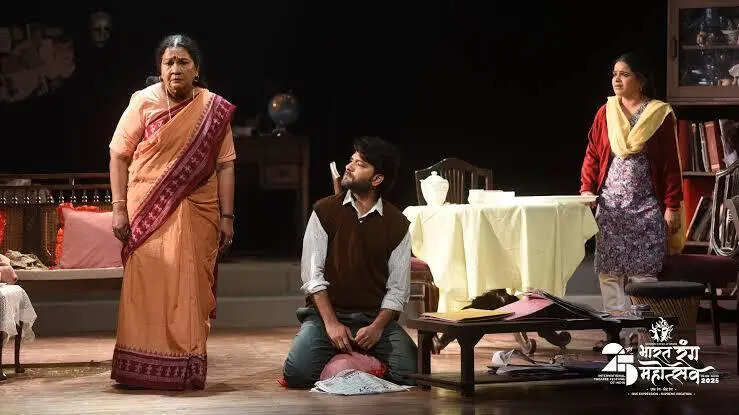
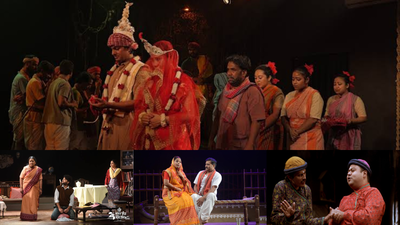
Famous hindi play ‘Adhe Adhure’ being performed on stage (Photo credit: @nsd_official_)
Saadat Hasan Manto’s Toba Tek Singh, set against the Partition of India, reflects the absurdity, horrors, and deep traumas that came with the upheavel, and Mahasweta Devi’s Bayen brings to life the painful story of Chandi Dasi, a woman ostracised as a “witch,” confronting superstition, patriarchy, and social exclusion. Each of these works demonstrates how theatre not only entertains but also challenges, provokes, and invites reflection on society and the human condition.
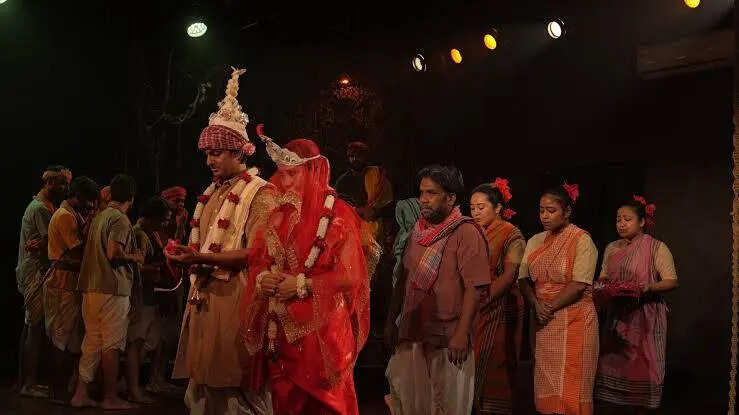
‘Bayen’ by Mahasweta Devi (Photo credit: @nsd_official)
These plays do more than entertain, they question, provoke, and linger. Theatre, at its core, remains a mirror to society.
Spaces that keep theatre alive and nurture the artform
Across India, spaces dedicated to theatre continue to nurture this art form. From the National School of Drama and Shri Ram Centre for Performing Arts, alongside renowned groups like Asmita Theatre Group and Act One, to Mumbai’s Prithvi Theatre, home to influential collectives such as Prithvi Theatre Company and Ekjute, and Bengaluru’s Rangashankara, closely associated with groups like Ranga Shankara Repertory and Indian Ensemble, these venues are more than just performance spaces, they are cultural ecosystems where stories are rehearsed, refined, and characters are brought to life.Yet, what unfolds on stage is only the visible tip of a much larger process. Behind every performance lies a world of discipline, struggle, and relentless preparation.
Behind the curtain: Life backstage
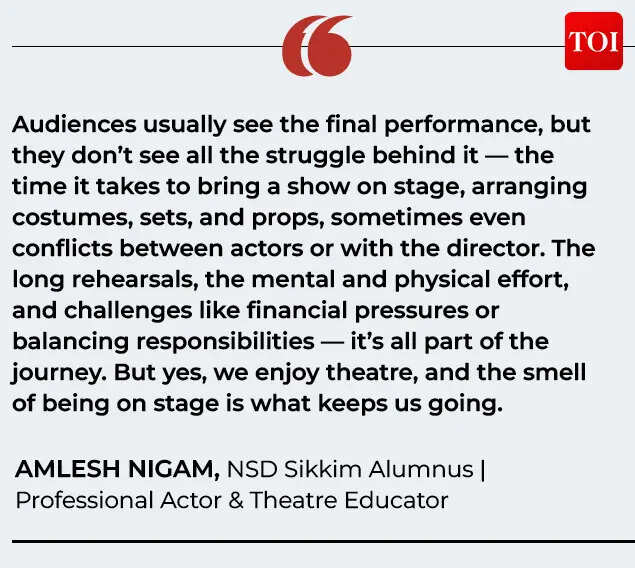
Audiences often see only the final act, unaware of the hours of work that make it possible. Amlesh Nigam, an NSD Sikkim alumnus and theatre educator, points out that putting together a production involves far more than memorising lines. From arranging costumes and props to navigating creative disagreements and enduring physically and mentally demanding rehearsals, the journey to the stage is layered and intense. Financial instability and the challenge of balancing personal responsibilities add to the strain, especially for emerging artists. Yet, despite these hurdles, the pull of theatre remains irresistible, the energy of the stage, the immediacy of performance, and even the distinct smell of the space keep artists returning.
–
For many performers, the most exhilarating moment comes at the end, the curtain call. The applause, the cheers, the acknowledgment from the audience affirm their choice. But equally meaningful are quieter moments beyond the spotlight. One artist recalls how, as a school teacher involved in theatre, parents would speak of the transformation they saw in their children, their growing confidence, their evolving personalities. Such moments reinforce theatre’s deeper impact, extending far beyond the stage.
What theatre demands from the artist
The craft also reshapes the artist. Theatre demands observation of people, behavior, and emotion. Over time, performers become more attentive to the world around them, more empathetic, and more aware of themselves. As one actor reflects, observation becomes second nature; one begins to notice details in others and uncover aspects of oneself that might otherwise remain hidden.At its heart, theatre is a collaboration of senses. It is not merely acting, but a synthesis of voice, movement, rhythm, music, and silence, loud and all consuming for the time being. A pause can speak louder than dialogue; a glance can convey more than words. Once the curtains open, the boundary between actor and audience dissolves. A final glance in the mirror before stepping onto the stage is not just about adjusting a costume, it is about stepping into another life. The character an actor carries is built over weeks of rehearsal, shaped by choices, failures, and discoveries. And when the lights come up, there is no turning back.For Sagar Vashisht, an NSD Varanasi alumnus and theatre educator, the practice of theatre lies in this continuous process of becoming. A typical day, he explains, balances routine and improvisation, voice work, movement exercises, rehearsals, and moments of creative exploration. But beyond routine lies a deeper demand: theatre requires psychological, physical, and even spiritual stamina. It is a discipline rooted in honesty, where the artist must constantly learn, unlearn, and relearn. Mastery is never complete; the pursuit itself becomes the craft.He also reflects on the impact theatre leaves on its audience. Entertainment, he suggests, is only the surface. The real work of theatre happens internally, within the spectator. A gesture, a pause, or a subtle shift in lighting can trigger something deeply personal, an emotion or realisation that lingers long after the performance ends. When an audience member carries home a feeling they cannot fully articulate but cannot forget, that is when theatre achieves its purpose.
Theatre in the digital age
In today’s digital age, this immediacy makes theatre uniquely powerful. While screens dominate entertainment, offering polished, edited, and repeatable content, live theatre exists only in the present moment. As Amlesh Nigam notes, the experience of sharing space with an actor, their voice, presence, and energy, cannot be replicated on screen. Theatre is raw and unfiltered. It demands attention and offers no second chances. There is no retake.Theatre is raw, unfiltered, and demands complete presence from both artist and audience. As a young theatre artist Shivang Misra puts it, “Theatre, to me, is not just an art form, it’s a living, breathing experience. It’s the only space where stories unfold in real time, where actors and audience share the same energy, the same silence, the same heartbeat. Unlike films or digital content, theatre is raw and immediate, there are no retakes, no filters. That vulnerability is what makes it powerful.”
–
From stage to the silver screen
For many of India’s most celebrated film actors, this rawness was their starting point. Performers like Irrfan Khan, Manoj Bajpayee, Shah Rukh Khan, Naseeruddin Shah, Om Puri, Shabana Azmi, Paresh Rawal, Neena Gupta, Ratna Pathak Shah, Nawazuddin Siddiqui, Amol Palekar, and Piyush Mishra all honed their craft on stage before transitioning to cinema. Theatre gave them discipline, presence, and an emotional authenticity that continues to define their performances.
The enduring legacy
World Theatre Day, observed annually on March 27, celebrates this enduring art form and its ability to bring people together and offer a collective experience that is, at the same time, deeply personal. It is a reminder of theatre’s role in fostering dialogue, questioning norms, and reflecting society. But it is also a call to preserve it, ensuring it does not fade into a relic of the past.As Oscar Wilde once reflected, “I regard the theatre as the greatest of all art forms, the most immediate way in which a human being can share with another the sense of what it is to be a human being.”And perhaps that is why, even today, the stage continues to breathe, why people still line up in queues, waiting to step into a world that is at once unfamiliar and deeply their own, and remains relevant, resonating with large audiences and mirroring the society we live in like a social X-ray.Much like life, the live and fleeting nature of theatre leaves no room for a take-two. As the lights dim and the curtain falls, only memories remain, lingering long after the stage goes dark, the sound of applause fades and silence settles in.