
Long, dry spring season puts Himalayan rivers under stress
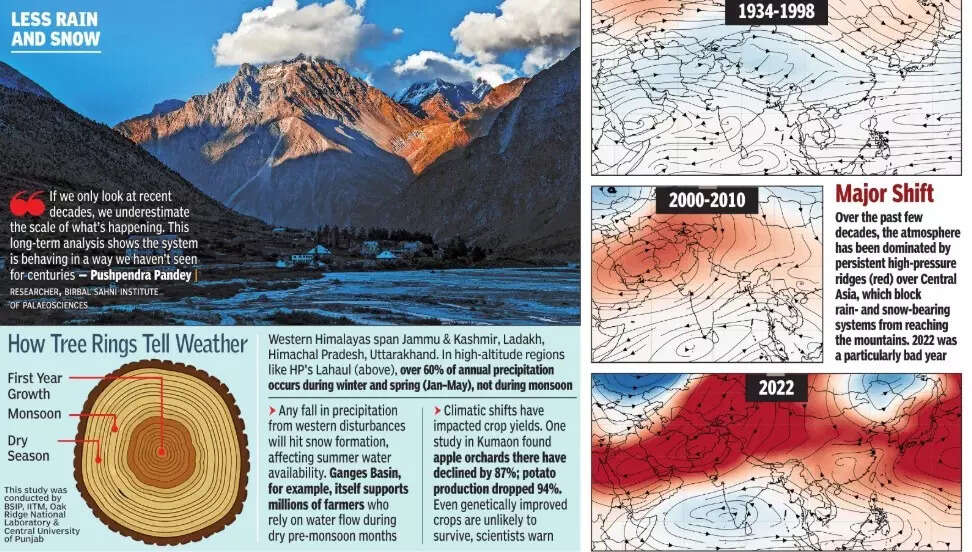
For centuries, the forests of western Himalayas have quietly recorded every wet spring and every failed one. This record can be found in the rings trees form annually. If winter and spring precipitation is good, the trees grow wider rings. When it fails, the rings narrow.And when scientists studied this ancient data, one year stood out: 2022. Its spring was the driest in the western Himalayas, in at least 396 years.Alarmingly, the scientists also found that the two decades from 2000 to 2022 were the driest sustained spring seasons in the region since early 1600s, an unprecedented drought.“When you extend the record back nearly 400 years, 2022 emerges as the driest spring we’ve seen,” said Pushpendra Pandey, a researcher from Birbal Sahni Institute of Palaeosciences (BSIP) and lead author of the study, which used tree-ring samples from high-altitude deodars forests in Himachal Pradesh’s Lahaul to reconstruct spring rainfall patterns from 1627. It was published recently in Science of the Total Environment.The findings matter far beyond the mountains. Winter and spring precipitation from Feb to May feeds glaciers and sustains river flows before the monsoon. A sustained failure in this season threatens water availability downstream, where hundreds of millions rely on Himalayan-fed rivers.“While long droughts did occur in the past, including part of the Little Ice Age, the period since 2000 stands out for both its intensity and duration,” Pandey said. “The spring rainfall deficit during these years is nearly one-third below the long-term average.”BSIP scientist Mayank Shekhar said 2022 appears to be as an “extreme outlier”. “Tree-ring data, ground studies and satellite reanalysis all converge on the same conclusion: that spring precipitation collapsed across the Western Himalayas that year,” he said.This drying, researchers said, is closely linked to largescale shifts in atmospheric circulation rather than local factors alone. Warmer-thannormal sea surface temperatures in the tropical Indian Ocean and the western Pacific are associated with changes in the subtropical westerly jet, the high-altitude wind system that steers western disturbances into north India.
.
Western disturbances are responsible for most winter and spring precipitation in the western Himalayas. When the jet weakens or shifts northward, fewer moisture-bearing systems reach the region.“In recent dry years, we see a consistent northward displacement of the westerly jet and stronger high-pressure ridges over Central Asia,” Pandey added. “These are conditions that suppress rainfall over the Himalayas.”Satellites add one more layer to the picture. The study found a steady rise in outgoing radiation over the region during spring, a sign of low cloud cover. The highest values were recorded in 2022.“This increase in outgoing longwave radiation reflects clearer atmospheric conditions over the Western Himalayas,” said Bhupendra Bahadur Singh, a climate scientist in Pune-based IITM, who was part of the study.“Combined with changes in large-scale circulation, this points to fewer moisturebearing systems reaching the region during spring.”While the study does not directly attribute the trend to climate change, the authors said the alignment with ocean warming and atmospheric shifts was concerning. “The frequency of dry springs has clearly increased, which suggests we may be transitioning to a drier spring regime,” said Parminder Singh Ranhotra, a BSIP scientist and co-author of the research.Other studies show a similar shift, said M Rajeevan, former secretary at the ministry of earth sciences. “This drying during winter and spring is clearly evident in observational data. Several studies have linked this to a northward shift of the subtropical jet stream and changes in westerly circulation, which have reduced frequency of western disturbances over the Himalayas.”Netrananda Sahu, associate professor at Delhi School of Economics, said drying signals have also emerged from hydrological studies in the region. “Our research shows a consistent decline in rainfall, rising heat and decreasing snow depth, all of which reduce soil moisture across seasons,” Sahu said, adding that the scale and persistence of recent drying suggested more than short-term variations. “Our analysis of IMD data from 1901 to 2021 shows a prolonged dry phase, and our field studies of springwater sources in Himachal Pradesh, indicates growing stress on Himalayan water systems,” he said.Pandey added that the findings underline the need to rethink how Himalayan water security is assessed. “If we only look at recent decades, we underestimate the scale of what’s happening. This long-term perspective shows the system is behaving in a way we haven’t seen for centuries,” he said.