Anand Mahindra wonders why the world is not visiting this unique travel destination, calls it heaven |


Anand Mahindra regularly shares his travel musings on X (formerly Twitter) that often draws spotlight to destinations that leave a lasting impression on him and, in turn, inspire others to explore them. His latest features the ever-so-beautiful Key Monastery in Spiti Valley. Captivated by its setting, he wrote: “Living proof that Heaven can descend on Earth. It’s a mystery why the whole world isn’t flocking here. But perhaps its silence is its greatest gift.” It’s hard to disagree. Spiti indeed has a quiet way of drawing travellers in, and inspires them to explore the dramatic and diverse landscapes India has to offer. Perched at an altitude of about 13,500 ft, Key Monastery is the oldest and largest monastery in Spiti Valley. Its tiered structure, rising sharply against the mountains, bears a resemblance to Thiksey Monastery near Leh.

The monastery is closely associated with the revered reincarnations of Lochen Rinchen Zangpo, also known as the ‘Great Translator,’ who lived between 958 and 1055 AD. It is deeply rooted in the ancient Kadampa lineage and is regarded as the seat of the Lochen Tulkus lineage. Through this lineage, Key Monastery is connected to the renowned 11th-century Buddhist scholar and saint, Atisha Dipankara. In 2000, a new and much larger assembly hall was consecrated by His Holiness the 14th Dalai Lama. The hall features old wall hangings that depict tales from the Buddha’s previous lives. There is a prayer room, opposite the main assembly hall, that houses a large prayer wheel and impressive statues of Padmasambhava and Amitayus. Read more: 5 unique wildlife species found in the Indian Himalayas
Its history
Key Gompa is among the most historically significant monasteries in Spiti and holds an important place in Tibetan Buddhism. It was founded in the early 15th century by Sherap Zangpo, a disciple of Je Tsongkhapa, the founder of the Gelugpa sect. Over the centuries, the monastery endured repeated invasions and natural disasters. In the 17th century, Mongol forces attacked the monastery during the reign of the 5th Dalai Lama, after which it formally became part of the Gelugpa school. It suffered further destruction during the Ladakh–Kullu conflict in 1820 and was heavily damaged by the Dogra army in 1841, followed by attacks from Sikh forces later that year. A devastating fire in the 1840s and a major earthquake in 1975 caused additional damage. Restoration work was later carried out by the Archaeological Survey of India and the State Public Works Department.
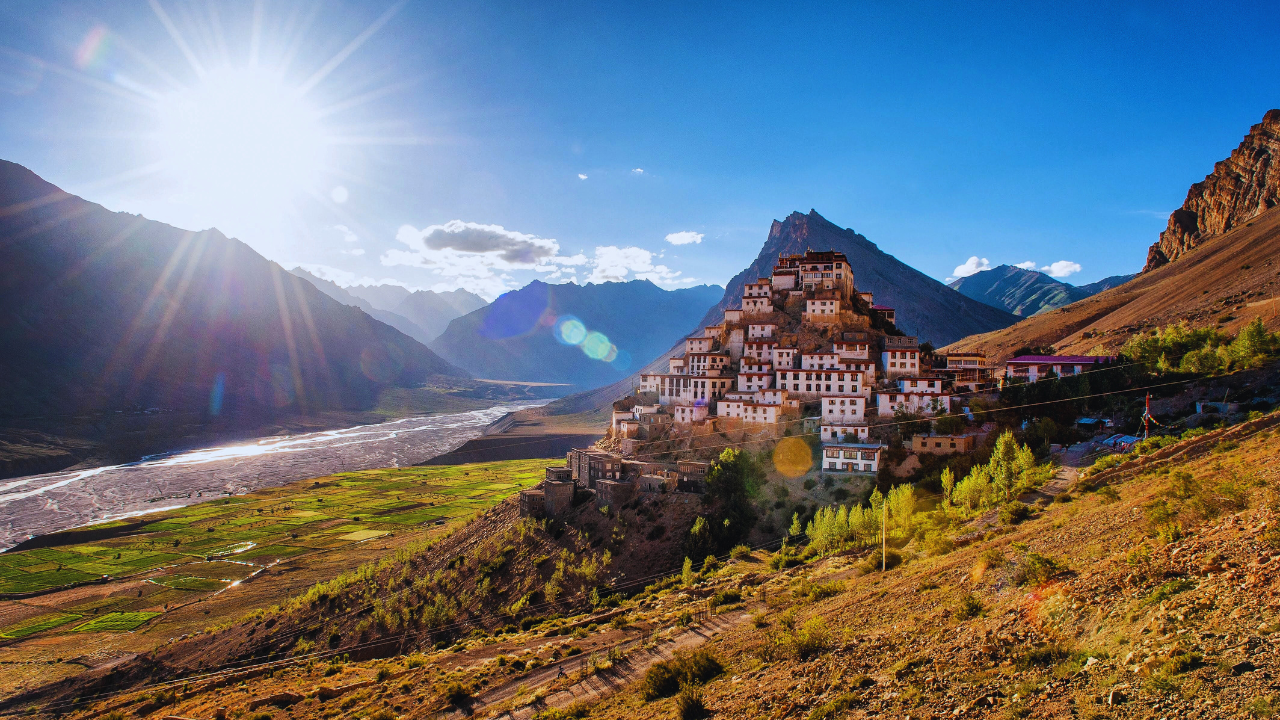
Despite its turbulent past, Key Monastery is renowned for its rare wall hangings and historical artefacts brought from Central Tibet by successive Lochen incarnations. The top floor houses an apartment reserved for the Dalai Lama and a chamber containing the remains of the 18th Lochen Tulku. A chapel dedicated to the monastery’s protector deities is located on a lower level, while another assembly hall beneath it is used for smaller rituals. This monastery also retains the remains of the 17th Lochen Tulku, precious scriptures, old wall paintings, and a statue of Maitreya, the future Buddha. The protector chapel is reached through a narrow staircase and corridor, which is normally used in the winter months. Apart from its historical and religious importance, Key Gompa is also famous for its beautiful architecture and peaceful ambiance. Read more: Canada Visitor Visa for Indian passport holders: Current timelines and how to apply
Best time to visit
To visit Key Monastery, the ideal time will be between May and October, when the weather is pleasant, roads also remain open, and the Spiti Valley is at its most vibrant, when the temperatures typically range from 10C to 25C. Winters are severe here, with temperatures that can drop below –20C, while the roads are frequently blocked by heavy snowfall. Although the monastery remains open, access can be challenging. Travellers interested in cultural experiences may plan their visit in July, when the Ki Cham Festival is held. The festival features traditional masked dances performed by monks, symbolising the victory of good over evil.