


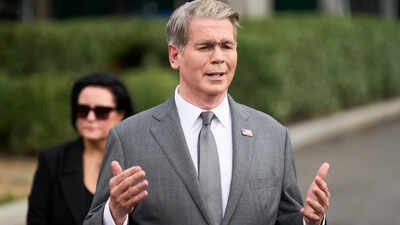
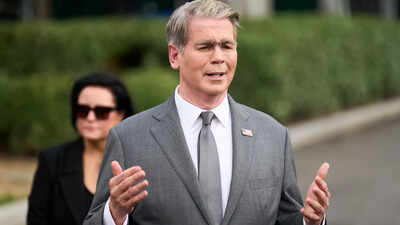
The United States is preparing what treasury secretary Scott Bessent described as the “toughest sanctions in history” against Iran, as Washington seeks to intensify economic pressure on Tehran and force the country towards a settlement.Bessent said the measures would form part of a broader campaign of economic isolation and suggested they could help Washington avoid a renewed large-scale military operation. He also called on China, Iran’s biggest oil customer, to cooperate with the US in efforts to reopen the Strait of Hormuz.China, however, rejected the approach, saying sanctions and pressure would not help resolve the conflict and urging the parties to pursue political and diplomatic solutions.
Bessent promises ‘one-two punch’ against Iran
Speaking to CNBC on Thursday, Bessent said Washington would combine its existing blockade with sweeping new sanctions.“It is a one-two punch. We have the blockade, and we are going to have the toughest sanctions in history,” he said.Bessent added that the measures would be designed to put further pressure on Iran’s economy and said, “It is going to work in Iran and we are going to collapse this regime.”He said he would hold a press conference on Monday to explain the measures in detail, adding that Washington was considering maximum economic pressure rather than a renewed large-scale military campaign.“Maximum economic pressure means likely not a kinetic restart,” Bessent said, suggesting the US does not currently expect to resume major military action against Iran.His remarks came a day after President Donald Trump announced what he called the “MOST CRUSHING ECONOMIC OPERATION EVER TAKEN AGAINST ANY COUNTRY”, warning countries providing financial, commercial or government support to Tehran of “tremendous economic consequences”.Trump said the campaign would target Iran’s economic lifelines, including oil-smuggling networks, financial transfers, exchange houses, ship registries and front companies.
US puts pressure on China over Iranian oil
Washington’s next challenge is China, which remains a major buyer of Iranian crude.China purchases more than 80% of Iran’s seaborne oil exports, according to 2025 data from analytics firm Kpler cited by Reuters. Any attempt by Washington to impose additional economic pressure on Chinese companies dealing with Iran could therefore have significant consequences for the global oil trade.Bessent urged Beijing to support US efforts to reopen the Strait of Hormuz, a crucial energy shipping route that has been at the centre of the confrontation.“We are confident that everyone wants the Strait reopened, and for energy prices to come back down,” he said.He added, “Keep in mind that the Chinese get 50% (of their) energy from inside the Gulf. So it would do them a big service to get with the programme.”When asked whether the US could target China for continuing to do business with Iran, Bessent said some discussions were better held privately.China rejected the US approach. A spokesperson for the Chinese embassy in Washington said: “Sanctions and pressure do not help resolve the problem. China calls on the relevant parties to take responsible actions and resolve the issue through political and diplomatic means.”
Trump warns countries helping Tehran
Trump’s latest measures widen the economic pressure campaign beyond Iran itself by warning foreign governments, companies and financial institutions against providing Tehran with what he calls a “lifeline”.In his announcement on Wednesday, Trump said, “Oil smuggling, swap lines, cash transfers, exchange houses, ship registries, front companies — It all needs to stop NOW.”He also urged US allies to join Washington in isolating Tehran, calling the campaign an “ECONOMIC D-DAY”.Trump has repeatedly said that Iran must not be allowed to acquire a nuclear weapon. Tehran, meanwhile, has rejected Washington’s pressure campaign.Iranian foreign minister Abbas Araghchi accused Trump of using the economic campaign to divert attention from problems inside the United States, including rising debt and interest costs.Araghchi called the so-called “Economic D-Day” a diversion from America’s own economic problems and said doubling down on sanctions would bring further “defeat” and “enmity of Iranians”.
Hormuz remains key to the confrontation
The sanctions threat comes as Washington and Tehran remain locked in a dispute over the Strait of Hormuz, through which a major share of global oil supplies normally passes.Trump has insisted that the waterway remains open and said the US naval blockade has been effective. Iran, however, has linked the reopening of the strait to demands including the lifting of the blockade, release of frozen Iranian assets and easing of oil sanctions.The confrontation has also contributed to volatility in global oil markets. Oil prices rose to more than three-week highs on Thursday, although Bessent said he believed markets were misinterpreting the significance of the latest economic pressure.“I think oil markets are misinterpreting what this economic pressure means,” he said.Bessent argued that maximum economic pressure could reduce the likelihood of renewed military escalation, even as Washington prepares its most aggressive sanctions campaign yet.For China, the situation presents a difficult choice. Beijing has strong economic ties with Iran and relies heavily on Gulf energy supplies, while any escalation with Washington over Iranian oil could threaten a broader US-China economic relationship.