


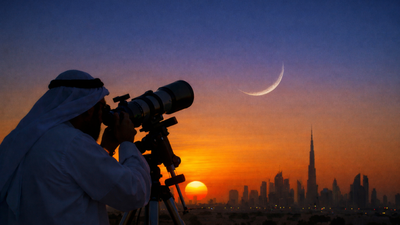
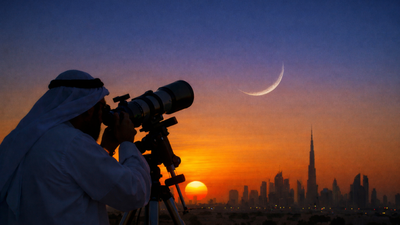
Astronomers in the UAE have issued a safety advisory ahead of the expected Ramadan crescent sighting on Tuesday, February 17, warning the public against attempting to observe the moon using telescopes or binoculars due to serious eye safety risks.The International Astronomical Centre (IAC), based in Abu Dhabi, cautioned that the moon will be positioned extremely close to the sun at sunset across much of the Arabian Peninsula. This rare alignment coincides with a solar eclipse earlier in the day, significantly increasing the danger of accidental exposure to direct sunlight through optical instruments.According to the IAC, directing telescopes or binoculars towards celestial objects located very close to the sun without certified solar filters can cause temporary or permanent eye damage, including blindness.Because of the moon’s position on February 17, any attempt to sight the crescent at sunset would likely place the sun within or extremely near the field of view of the optical instrument. Astronomers stressed that this creates a real danger not only to observers but also to equipment, as lenses and internal components could be damaged by concentrated sunlight.Professional observatories avoid pointing telescopes at objects positioned so close to the sun unless strict safety standards and specialised solar filters are applied.
Why angular separation matters
On the evening of February 17, moon-sighting committees across the Arab and Islamic world are expected to search for the Ramadan crescent. However, the angular separation between the sun and moon at sunset will be exceptionally small.In Riyadh, Saudi Arabia, the angular separation at sunset is expected to be just one degree. In practical terms, this means that if a crescent were present, it would be positioned approximately half a degree from the edge of the sun’s disc.Khadijah Al Hariri, Operations Manager at the Dubai Astronomy Group, told Khaleej Times that although the solar eclipse will occur earlier in the day, by sunset the moon will still remain extremely close to the sun.This proximity means that any telescope directed towards the crescent’s expected position would almost certainly capture direct or near-direct sunlight.
Visibility conditions across the region
The International Astronomical Centre stated that the moon will not meet the required visibility conditions across the Arabian Peninsula on that evening.In several Saudi cities, the moon’s elevation at sunset is expected to remain below recognised visibility thresholds. In Jazan, which is forecast to record the highest altitude in the Kingdom, the moon’s elevation will be around half a degree. In other locations, the altitude will be less than one degree.Astronomers explained that by the time the sun fully sets, the lower edge of the moon’s disc would already have dipped below the horizon, leaving no visible crescent to observe.In parts of the western Arabian Peninsula, the moon may set approximately one minute after sunset. However, experts said that this brief interval would still be insufficient for visibility.
Scholarly and historical perspective
The centre also referenced earlier scholarly discussions in Saudi Arabia concerning lunar visibility standards.Saudi astronomer Mulham Hindi, a researcher at King Abdulaziz University, has previously published data indicating that the moon’s altitude on Tuesday will remain below accepted visibility thresholds.The statement also cited medieval Islamic scholar Ibn Taymiyyah, who wrote that a crescent at a separation of one degree would not be visible. He noted that separations of around 20 degrees typically allow sighting, unless obstructed by atmospheric conditions.Astronomers said Tuesday’s measurements fall below what both classical jurists and modern astronomical standards consider sufficient for confirmed crescent visibility.The International Astronomical Centre emphasised the distinction between the moon as a celestial body and the visible crescent marking the start of an Islamic month.“The object present in the sky on Tuesday is the moon, not the crescent,” the statement said.While the moon exists daily, the visible hilal appears only after conjunction has passed and when sufficient illumination and separation from the sun allow it to be seen. A Qur’anic verse referring to crescents as markers of time was cited to underscore that the beginning of Ramadan depends on the visible crescent, not merely the moon’s astronomical presence.The solar eclipse occurring that day, visible in parts of southern Africa and Antarctica, further confirms that the moon will remain in its new-moon phase.Most countries in the Arab and Islamic world are expected to attempt crescent sighting on Tuesday evening. If the crescent is not seen, the month of Sha’ban will complete 30 days, and Ramadan will begin on Thursday, February 19, 2026.Astronomers also noted that while their analysis applies primarily to the Arabian Peninsula and nearby regions, visibility conditions may vary slightly in parts of West Africa or the United States due to geographic differences.For now, experts are urging the public to avoid unsafe observation attempts and leave technical sightings to trained professionals equipped with proper safety filters and equipment.