


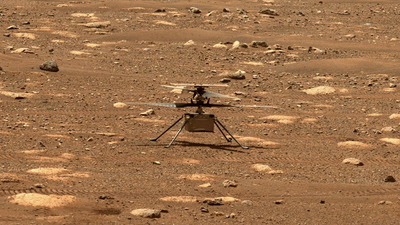
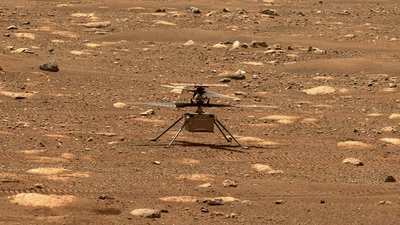
Flying a helicopter on Earth is a remarkable engineering achievement. Flying one on Mars, where the atmosphere is less than 1% as dense as Earth’s, was once considered nearly impossible. Yet on 19 April 2021, Nasa‘s Ingenuity helicopter achieved the first powered, controlled flight on another planet, proving that aerial exploration beyond Earth was possible. Originally designed as a technology demonstration expected to operate for just 30 Martian days (sols), Ingenuity far exceeded every expectation. It remained active for 1,004 sols, completed 72 flights, travelled more than 17 kilometres, and became an indispensable scout for the Perseverance rover before its historic mission came to an end in early 2024.
Ingenuity became the first aircraft ever to fly on another planet
Ingenuity arrived on Mars attached to Nasa’s Perseverance rover, which landed inside Jezero Crater on 18 February 2021 as part of the Mars 2020 mission.Weighing just 1.8 kilograms, the helicopter was designed to answer a single question: could powered flight work in the extremely thin Martian atmosphere?After Perseverance deployed the helicopter onto the surface, Ingenuity made history on 19 April 2021 by lifting off, hovering approximately 3 metres above the ground for about 39 seconds, before landing safely.Although the flight lasted less than a minute, it marked the first powered flight by an aircraft on another world, much as the Wright brothers’ Flyer transformed aviation on Earth in 1903.
Engineers expected only five flights, but the helicopter kept rewriting the record
Ingenuity’s original mission was intentionally modest. Nasa planned for the helicopter to complete up to five demonstration flights during approximately 30 sols before its work ended. The goal was simply to prove that controlled flight was possible under Martian conditions. Instead, Ingenuity exceeded every expectation. As engineers gained confidence in its performance, the helicopter transitioned from a technology demonstrator into an operational scout supporting Perseverance’s scientific mission. It flew ahead of the rover, photographing potential routes, identifying hazards and helping mission planners choose safer paths across rocky terrain.By the end of its mission, Ingenuity had completed 72 flights, remained operational for 1,004 sols, reached altitudes of 24 metres, achieved speeds of nearly 10 metres per second, and covered a total distance of more than 17 kilometres, far beyond anything envisioned before launch.
Flying on Mars required engineering unlike anything used on Earth
Mars presented challenges unlike those faced by any helicopter on Earth. Because the Martian atmosphere is about 100 times thinner than Earth’s, Ingenuity needed two exceptionally large, lightweight carbon-fibre rotors measuring 1.2 metres across. They spun at around 2,400 to 2,900 revolutions per minute, several times faster than the blades of a typical helicopter on Earth, to generate enough lift.The aircraft also had to survive temperatures falling below -90°C during Martian nights. Solar panels charged onboard batteries during the day, while heaters protected its electronics from freezing after sunset.Communication delays between Earth and Mars meant there was no possibility of piloting the helicopter in real time. Every flight relied on onboard computers capable of navigating, stabilising and landing autonomously using cameras, sensors and pre-programmed instructions.
A damaged rotor blade brought one of Mars’ greatest engineering missions to an end
Ingenuity’s final flight took place on 18 January 2024. During its 72nd flight, the helicopter landed successfully but suffered damage to one or more rotor blades, most likely after contacting the Martian surface. Images later confirmed that part of a rotor blade had broken off, making further flight impossible.Although grounded, Ingenuity continued transmitting weather and systems data to Perseverance for several days before communication was permanently lost. On 25 January 2024, Nasa announced that the helicopter’s flying mission had officially ended.Even in retirement, Ingenuity had already transformed planetary exploration. It demonstrated that aerial vehicles could operate reliably on another world, paving the way for future missions that could use helicopters to explore cliffs, caves, canyons and other landscapes inaccessible to wheeled rovers.
Ingenuity changed how scientists will explore other planets
Ingenuity was never intended to make groundbreaking scientific discoveries itself. Its purpose was to prove a concept that many engineers believed might not work.Instead, it became one of the most successful technology demonstrations in space exploration history. By surviving more than 33 times longer than planned and completing over 14 times the number of expected flights, the little helicopter fundamentally changed mission planning for future planetary exploration.Nasa is already applying the lessons learned from Ingenuity to future aircraft concepts, including rotorcraft designed for the Moon, Mars and Dragonfly, the nuclear-powered rotorcraft scheduled to explore Saturn’s moon, Titan.What began as a 30-day experiment became a 1,004-sol triumph, proving that even in the thin skies of Mars, flight is not only possible, it can redefine how humanity explores the Solar System.