


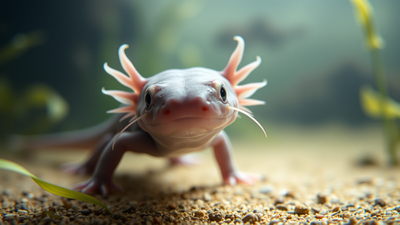
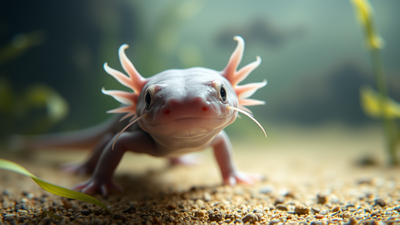
At the bottom of a lake in Mexico City lives a creature that should not, by biological rules, be able to do what it does. Cut off one of its legs, and a new one grows back. Damage its spinal cord, heart, or even part of its brain, and the tissue regenerates with no scarring and no deficit. Meet the axolotl (Ambystoma mexicanum), a juvenile salamander native to Lake Xochimilco, prized by scientists for its extraordinary regenerative ability. Recent gene research has deepened interest in the animal, suggesting some of the same regenerative machinery may already exist, dormant, inside the human body. Yet the wild population of this creature has collapsed by more than 99 per cent in under two decades.
Why the axolotl is considered biology’s ultimate regeneration machine
Few animals in the world can match the axolotl’s regenerative range. According to a species profile maintained by the United States Geological Survey, Ambystoma mexicanum is a paedomorphic salamander endemic to the Lake Xochimilco area in the Valley of Mexico, meaning it never undergoes the metamorphosis most salamanders go through to become land-dwelling adults. When an axolotl loses a limb, cells near the wound revert to an earlier developmental state and form a structure called a blastema, essentially restarting the growth process and rebuilding bone, muscle, nerve, and skin in their correct positions. This same capacity extends to its spinal cord, heart, and parts of its brain, a level of whole-organ regeneration that has made the species one of the most heavily studied model organisms in regenerative biology.
How the axolotl’s neoteny gives it such powerful regenerative abilities
The biological trait behind all of this is called neoteny, a condition in which an animal retains its juvenile features and reaches sexual maturity without ever fully maturing physically. Most amphibians lose this larval flexibility once they metamorphose, but axolotls stay aquatic their entire lives, keeping the external gills and undeveloped tissue structure of a much younger animal. Researchers believe this arrested development keeps axolotl cells in a more flexible, adaptable state than the specialised adult cells found in most vertebrates, and that this flexibility is precisely what allows damaged tissue to revert and rebuild rather than simply scar over. It is also why axolotls remain one of only a small number of vertebrates capable of this kind of large-scale regeneration throughout adulthood.
What new gene research reveals about regrowing human limbs
The axolotl’s biology has direct relevance for human medicine, and recent findings underline why. A study from Wake Forest University, published in the Proceedings of the National Academy of Sciences, identified a gene called SP8, working alongside its partner SP6, as a shared genetic switch controlling limb regeneration across axolotls, zebrafish, and mice. Using CRISPR gene-editing, biologist Josh Currie’s team removed SP8 from the axolotl genome and found the animals could no longer properly regrow limb bones, a result mirrored in mice missing the same genes. The researchers then used a zebrafish-derived gene therapy to partially restore digit regeneration in mice, evidence that the genetic instructions behind regeneration may already exist, dormant, in mammals, including humans.
Why the axolotl is now critically endangered in the wild
The same USGS profile notes that Ambystoma mexicanum is listed as critically endangered in its native range by the International Union for Conservation of Nature, with habitat loss and pollution identified as the primary threats. Wild population surveys around Lake Xochimilco recorded roughly 6,000 axolotls per square kilometre in 1998, a number that had collapsed to just 36 per square kilometre by the time of the last full census in 2014. The causes include rapid urban expansion around Mexico City, agricultural and sewage runoff into the lake system, and the introduction of invasive tilapia and carp that prey on axolotl eggs and compete for food, pressures that have pushed one of biology’s most studied animals to the edge of disappearing entirely from the wild.
How conservationists in Mexico are trying to save the axolotl
Efforts to reverse the decline are now underway at Lake Xochimilco, a UNESCO World Heritage Site. According to Conservation International, the Ecological Restoration Laboratory at Mexico’s National Autonomous University, led by biologist Luis Zambrano, has developed a network of protected “chinampa-refuge” canals that combine traditional floating farm islands with biofilters and barriers that keep invasive predators out. Researchers are also using environmental DNA sampling alongside traditional fishing nets to track the elusive species across the lake system and update population estimates that have not been fully revised since 2014. Whether these restoration efforts can reverse decades of decline remains uncertain, but for now they represent the clearest hope of keeping a wild population of the axolotl alive at all.