


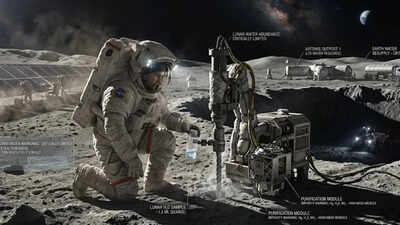
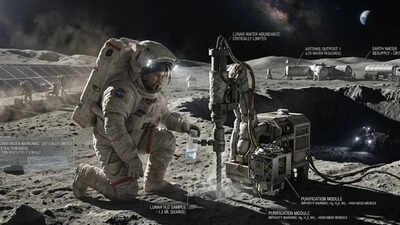
The discovery of water on the Moon was once a paradigm-shifting discovery that would revolutionise deep-space logistics in the universe in ways we never thought possible; this would allow astronauts to travel to and stay on the Moon or beyond before leaving. However, recent scientific data from agencies like NASA and the ESA reveal a sobering reality: while hydration is present, its concentration is strikingly low. Scattered across the regolith in parts per million, lunar water is currently estimated to be roughly drier by two orders of magnitude than the Sahara Desert. For future missions aiming to colonise the Moon or launch to Mars, the sheer volume of soil required to extract even one litre of liquid poses a monumental logistical and engineering hurdle that could stall long-term settlement plans.
Moon’s water may fall short for future missions
The vast shortage of water molecules is the primary challenge. Scientists at NASA’s Moon Mineralogy Mapper estimate that it takes about 1 metric ton of lunar soil to extract 1 liter of water, making large-scale harvesting very energy-intensive to perform with current In-Situ Resource Utilization (ISRU) technologies by heating required amounts of regolith until the trace ice sublimates, or to heat sufficient amounts of material to break chemical bonds and exploit minerals for their constituent water.
Why harvesting Moon ice is so hard
Although the South Pole of the Moon has cold traps that may have a higher occurrence of water, these areas exist in complete darkness and experience temperatures that can drop to -230 degrees Celsius. Designing machinery that can drill into the rock-like and cryogenic regolith without seizing or tearing apart is an engineering challenge. Further complicating issues is the European Space Agency’s (ESA) determination that current prototypes are not yet capable of precisely controlling pressure and temperature during the phase transition from sublimation in a vacuum to vapour, both of which must occur in a continuous sequence to harvest water effectively.
Why does lunar water need heavy filtration
Lunar water is not the same as the ‘pure’ ice we have here on Earth; it may have some toxic impurities (volatiles) mixed in with it. The LCROSS mission gathered data that confirmed there were contaminants, including mercury, methane, ammonia and hydrogen sulfide in lunar water. If future missions are going to use this water for human needs (i.e., drinking and rocket fuel), significant and heavy purification systems will need to be sent to the moon for that purpose, likely offsetting the advantages of ‘living off the land.’