


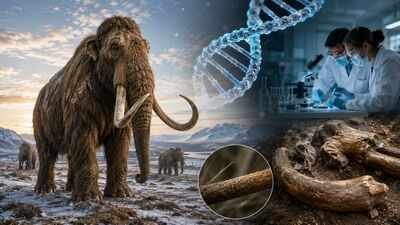
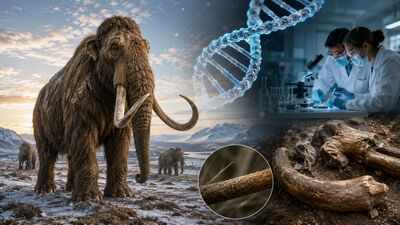
For years, the disappearance of the last woolly mammoths seemed to have a straightforward explanation. A tiny population became isolated, interbred for thousands of years and eventually reached a point where its own genetics made survival impossible. That idea found its way into documentaries, textbooks and scientific discussions alike. A study published in Cell, titled “Temporal dynamics of woolly mammoth genome erosion prior to extinction”, in 2024 has reopened that conversation. By examining ancient DNA from mammoths spanning tens of thousands of years, scientists arrived at a different picture of their final chapter. The findings suggest that although the last mammoths carried the genetic marks expected in a small, isolated population, those changes alone do not explain why they vanished.
Why the last woolly mammoths survived on Wrangel Island for 6,000 years
The final known population of woolly mammoths lived on Wrangel Island, a remote Arctic island north of mainland Siberia. According to EarthSky, these animals became separated from mainland populations roughly 10,000 years ago as rising sea levels isolated the island. While mammoths disappeared across most of their former range after the end of the Ice Age, this small island population survived for another six millennia, living until around 1650 BC, long after many ancient civilisations had already emerged.That long survival has always made Wrangel Island scientifically important. The island population probably began with no more than eight founding individuals before recovering to an effective population of roughly 200 to 300 animals. Instead of collapsing immediately after isolation, the mammoths remained demographically stable for more than 200 generations. For decades, scientists regarded this isolated herd as a textbook example of extinction through genetic decline. Since the animals lived in such a restricted population for thousands of years, it seemed reasonable to conclude that inbreeding had gradually sealed their fate.
What 50,000 years of woolly mammoth DNA revealed about their extinction
The 2024 research set out to examine that assumption in greater detail. The team analysed high-quality genomes from 21 woolly mammoths, including 14 individuals from Wrangel Island and seven that had lived on the Siberian mainland before the island became isolated. Together, those genomes covered roughly the final 50,000 years of the species’ existence, allowing researchers to follow changes in genetic diversity over time rather than relying on isolated specimens.The analysis confirmed that the Wrangel Island mammoths experienced what geneticists describe as a severe population bottleneck. Genetic diversity fell sharply after isolation, while evidence of inbreeding became much more pronounced. According to the researchers, overall heterozygosity declined by more than 40%, and long stretches of identical DNA, a hallmark of inbreeding, became far more common than they had been in mainland mammoths.Those findings might appear to support the traditional explanation. Yet the deeper analysis pointed somewhere else. Although mildly harmful mutations slowly accumulated over thousands of years, the population did not continue spiralling into genetic collapse. Highly damaging mutations were gradually removed through natural selection instead of steadily building up from one generation to the next. The researchers also found no genomic evidence that the mammoths experienced an accelerating decline during the centuries leading up to their disappearance.That distinction matters because it challenges the idea that the mammoths simply became too genetically compromised to survive. Co-author Love Dalén told EarthSky that the team could now reject the long-held assumption that the population was inevitably doomed because of its small size alone. He suggested that some sudden event, rather than genetics by itself, was probably responsible for ending the species’ final chapter.
Scientists believe a sudden event may have wiped out the last woolly mammoths
The new evidence leaves scientists with a different puzzle. If the Wrangel Island mammoths managed to persist for around 6,000 years after their population bottleneck, why did they disappear when they did? The available genomes do not point towards an escalating genetic crisis immediately before extinction. The population remained relatively stable despite carrying signs of long-term inbreeding, and the youngest mammoth included in the analysis did not display dramatically worse genetic health than animals that had lived centuries earlier. That pattern makes a slow, inevitable collapse less convincing than it once appeared.Instead, the researchers suggest that the final extinction may have resulted from a sudden event acting on an already vulnerable population. Possibilities include an infectious disease, an abrupt environmental change or another unexpected disturbance that the isolated herd simply could not withstand. The study also leaves room for the idea that genetics still played a supporting role. A population with reduced adaptive potential may have been less able to recover when faced with an external shock, even if inbreeding itself was not the direct cause of extinction.EarthSky reported that the research team has not ruled out any single explanation. The DNA examined in the study does not include individuals from the final few centuries before the mammoths disappeared. Those remains have since been recovered, and researchers hope future genetic analysis may reveal whether something changed during the species’ closing generations. Until then, the exact trigger remains uncertain rather than solved.
What the last woolly mammoths teach us about saving endangered species
Although the work focuses on an extinct animal, its implications extend well beyond mammoths. Many living species have also experienced severe population declines before beginning to recover. Looking only at population numbers may therefore overlook genetic changes that continue for hundreds of generations after the immediate crisis has passed.The researchers argue that conservation programmes should pay attention not only to how many animals survive, but also to what is happening within their genomes over time. The Wrangel Island mammoths gradually accumulated mildly harmful mutations even after their population had stabilised, showing that genetic recovery does not necessarily keep pace with demographic recovery. At the same time, highly damaging mutations were gradually removed, illustrating that the relationship between inbreeding and extinction is more complex than previously assumed.Lead author Marianne Dehasque said mammoths provide an unusually valuable model because their history mirrors the challenges now facing many endangered species. She noted that rebuilding population numbers alone is not enough, and that long-term genetic monitoring should remain part of conservation efforts because the effects of a population bottleneck can persist for thousands of years.The study does not claim to have solved the mystery of the mammoths’ disappearance. Instead, it overturns one of its most familiar explanations. For decades, the last mammoths were widely portrayed as a species that slowly inbred itself into extinction. The evidence now points towards a more complicated ending.