


NEW DELHI: Mrs. Bectors Food Specialities’ new plant in Indore had just started production for some American buyers when the US announced 50% tariffs on Indian imports. With the trade deal likely to be implemented soon, the company is now hoping that things will slowly fall into place. “Under development business had come to a standstill, but the project will now start immediately,” said Anoop Bector, the company’s MD, adding that he now intends to work on a distribution network in the US and also open warehouses. “We are hoping to treble our exports to the US in two years,” he said. Mrs. Bectors Food Specialities, the makers of Cremica and English Oven brands of biscuits, exports biscuits and cookies worth around Rs 100 crore to American retailers and had to take a hit of around 5-7% by offering discount to offset the impact of tariffs. While the US is going to offer duty-free access to some Indian bakery products, Bector is waiting for the list.

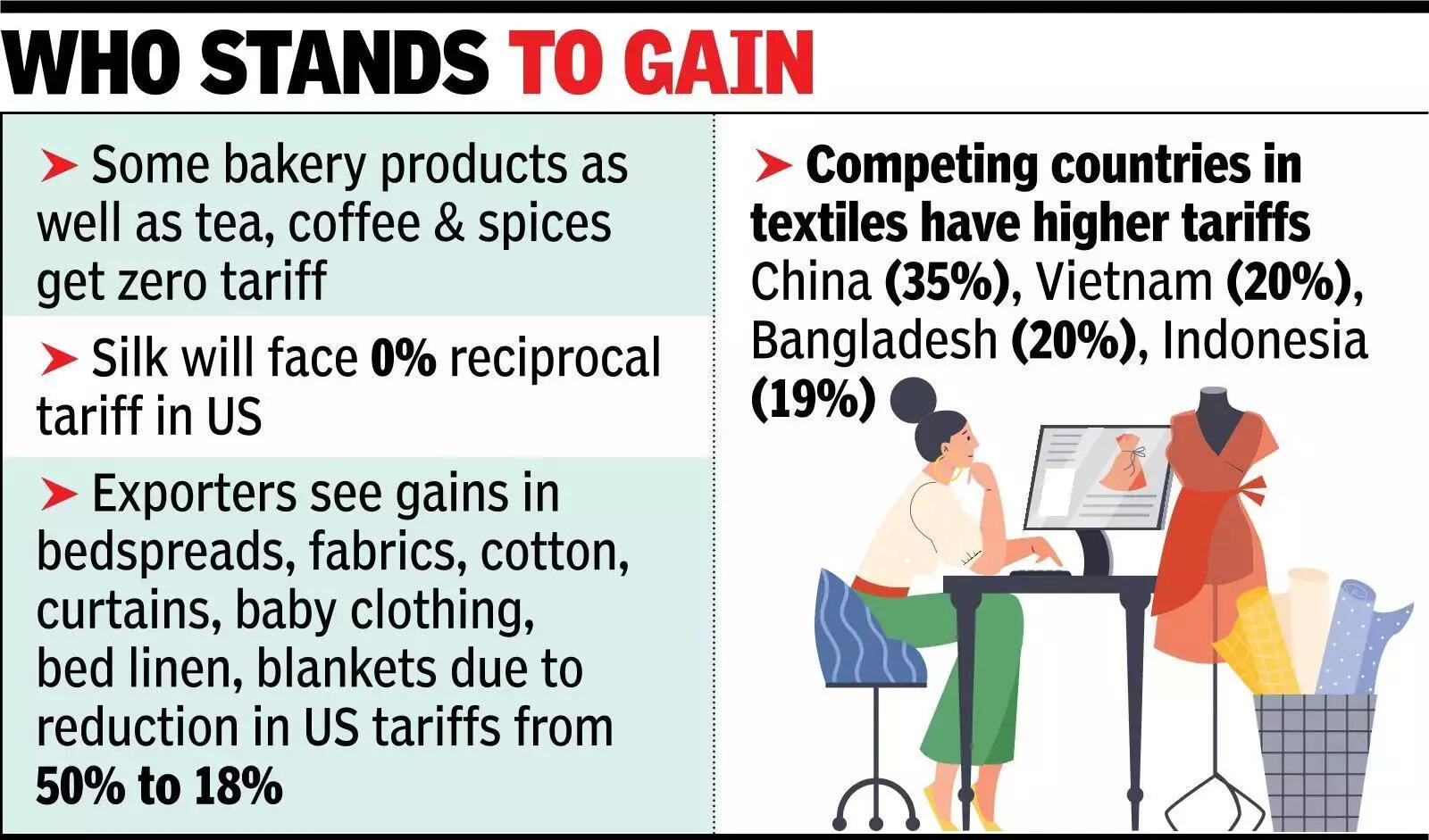
Tea growers too are celebrating duty-free access, more so because of the tariff advantage compared to competitors from Sri Lanka, Kenya and China. Sri Lanka was hit due to their ‘tea-for-oil’ barter deal with Iran, resulting in a 25% tariff penalty. Kenya, which enjoyed duty-free access under AGOA, now has to contend with 10% baseline reciprocal tariff. “The ‘Golden Letter’ exemption restores the price competitiveness of Indian Orthodox and specialty teas against rivals like Kenya and Sri Lanka. By securing zero-duty access, while Sri Lanka is trapped at 25% and Kenya at 10%, India has effectively become the lowest-cost premium producer for the North American market. Furthermore, with Chinese tea facing even steeper tariffs of 33-35%, India has a historic window. While we currently produce lower volumes of green and oolong teas, this tariff advantage provides the perfect incentive for Indian estates to diversify and become the lead specialty supplier to the US,” said Ajay Jalan, MD of Mokalbari Kanoi Tea Estate. A lot of exporters will get clarity when American buyers return to offices on Monday, especially those which were offering steep discounts and have goods in transit. Texport Industries CMD Narendra Goenka wants to know the fate of discounts on goods in transit or ones that are ready to be dispatched. Most players in the textiles business were offering 15-18% discount to retain buyers. “With tension in Iran rising, some of the buyers were getting even more anxious but we somehow managed to hold on to most of them, although we did lose some order, which we will have to work on,” said Goenka. Most textiles players have taken a hit on their bottom lines due to the hefty discount so that they could retain buyers and did not have to retrench too many workers. “This will be the first time in several years that the balance sheet will show a loss. We were doing minimum business, but now volumes will come in a big way,” says Puran Dawar, an Agra-based leather footwear exporter. In Tiruppur, K M Knitwear CMD KM Subramanian is seeing enquiries from buyers and is hoping to reach last year’s level of exports after losing nearly half the US orders in the last few months due to tariffs. But he is unsure if the buyers are going to adjust the orders. “It is a buyer’s market, we may seek compensation in the new orders through 3-4% price increase,” he said over the phone. With the joint statement signed over the weekend, companies have much greater clarity in talking to their buyers in the US. The reduction in additional tariffs from 50% to 18% is expected to ensure that many factory jobs, which would have been lost as buyers moved orders out of India, are now safe.