


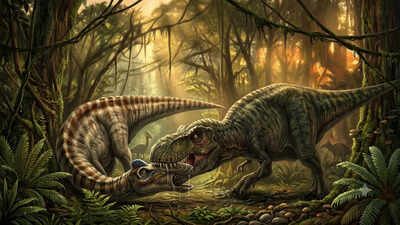
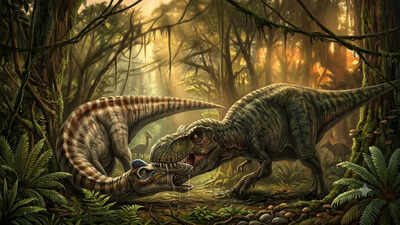
A broken tooth, embedded in the skull of a dinosaur for 66 million years, offers major hints on how Tyrannosaurus, aka T. rex, the apex predator, may have hunted. The fossil, sitting in the collection of Montana State University’s Museum of the Rockies, appears to have preserved an extraordinary moment of violence frozen in time. The specimen contains a tyrannosaur tooth still embedded in another dinosaur’s skull. Researchers from Montana State University and the University of Alberta in Canada studied the fossil, catalogued as MOR 1627, which they believe is one of the clearest physical records ever recovered of a tyrannosaur attack caught mid-action. The findings are published in the journal PeerJ.
A rare fossil
Around 66 million years ago, near the end of the Age of Dinosaurs, Tyrannosaurus dominated what is now Montana. These apex predators shared the landscape with horned Triceratops and duck-billed herbivores such as Edmontosaurus. In 2005, researchers unearthed a nearly complete skull of Edmontosaurus from the Hell Creek Formation in eastern Montana, on land managed by the Bureau of Land Management. This fossil is part of the Museum of the Rockies’ palaeontology collection. Two decades later, that same skull has become the centrepiece of research.University of Alberta doctoral student Taia Wyenberg-Henzler and Museum of the Rockies Curator of Palaeontology John Scannella conducted a study of the skull displayed in the museum’s Hall of Horns and Teeth. The skull had a tooth embedded in it, along with 23 additional tyrannosaur bite marks.“Although bite marks on bones are relatively common, finding an embedded tooth is extremely rare. The great thing about an embedded tooth, particularly in a skull, is that it gives you the identity of not only who was bitten but also who did the biting. This allowed us to paint a picture of what happened to this Edmontosaurus, kind of like Cretaceous crime scene investigators,” Wyenberg-Henzler said.
In your opinion, how significant is the discovery of the Edmontosaurus skull with a tyrannosaur tooth?
3k+ users shared opinion today
5k+ users already voted today
3k+ users shared opinion today
Caught mid-action
In order to identify the predator, the researchers compared the embedded tooth against every known meat-eating dinosaur species found in the Hell Creek Formation. It matched Tyrannosaurus. Scans revealed more about how the tooth got trapped in the skull.“A fossil like this is extra exciting because it captures a behaviour: a tyrannosaur biting into this duckbill’s face. The skull shows no signs of healing around the tyrannosaur tooth, so it may have already been dead when it was bitten, or it may have died because it was bitten,” Scannella explained.The researchers added that the position of the tooth in the skull gave them major clues about how the predator and prey fought. “Looking at the way the tooth is embedded in the nose of the Edmontosaurus suggests that it met its attacker face-to-face, something that usually happens to an animal that was killed by a predator. The amount of force necessary for a tooth to have become broken off in bone also points to the use of deadly force. For me, this paints a terrifying picture of the last moments of this Edmontosaurus,” they said.Whether Tyrannosaurus actively hunted or largely scavenged has divided palaeontologists for generations, and neither side has had much direct physical evidence to point to. As one of the largest meat-eating animals ever to have walked the Earth, it has been the subject of constant study. MOR 1627 does not settle the argument; however, it provides crucial evidence of how the apex predator may have hunted.