


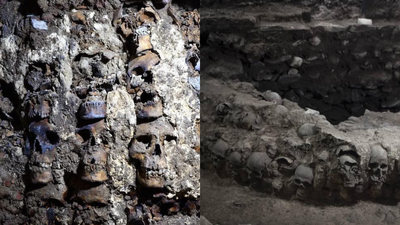
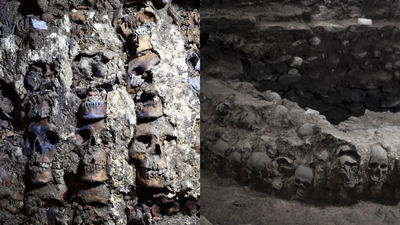
When Spanish conquistadors entered the Aztec capital of Tenochtitlan in 1519, they described a sight so horrifying that many later historians believed it had to be exaggerated. According to their accounts, a massive tower and racks built from thousands of human skulls stood near one of the city’s most important temples. For centuries, these descriptions were dismissed as colonial propaganda intended to portray the Aztecs as barbaric and justify Spain’s conquest. But more than 500 years later, archaeologists excavating beneath the streets of modern Mexico City uncovered the remains of the very structure, confirming that one of history’s most chilling stories was rooted in reality.
The gruesome structure made of thousands of human skulls that shocked the Spanish
Among the first Europeans to witness the Aztec capital were Spanish conquistador Hernán Cortés and soldier Bernal Díaz del Castillo. They described an enormous skull display near the Templo Mayor, the city’s main ceremonial complex. Known as the Huey Tzompantli, or “Great Skull Rack”, it consisted of towering wooden racks lined with human skulls alongside a cylindrical tower constructed from skulls cemented together, making it one of the most striking features of the Aztec capital.According to Spanish chronicles, the monument was unlike anything they had ever encountered. Bernal Díaz del Castillo wrote of rows upon rows of skulls mounted on wooden poles, while other accounts suggested the site contained thousands of human remains. Although the exact number remains debated, the scale of the display left a lasting impression and became one of the most widely discussed aspects of the Spanish conquest.Yet many historians remained sceptical. They argued that the conquistadors had political and religious reasons to exaggerate Aztec rituals, portraying the civilisation as exceptionally brutal to justify Spain’s conquest and the forced conversion of Indigenous peoples to Christianity. Without physical evidence, the accounts were widely dismissed as colonial propaganda for centuries.
The discovery beneath Mexico City
That changed in 2015 when archaeologists from Mexico’s National Institute of Anthropology and History (INAH) began excavations near the Metropolitan Cathedral, which stands atop the ruins of ancient Tenochtitlan. They uncovered part of a circular tower built from hundreds of human skulls bound together with lime mortar, closely matching descriptions recorded by the Spanish more than five centuries earlier.Excavations have since identified more than 600 human skulls incorporated into the structure, though researchers believe the original monument was significantly larger and that portions remain buried beneath modern Mexico City. The remains include men, women and children, challenging earlier assumptions that only captured male warriors were sacrificed.
What was the purpose of the skull tower?
The Aztecs built tzompantli, or skull racks, as part of their religious traditions. Human sacrifice played a central role in ceremonies dedicated to deities such as Huitzilopochtli, the god of war and the sun. The displayed skulls were believed to honour the gods, commemorate military victories and demonstrate the power of the Aztec Empire, while also serving as a warning to its enemies.
A discovery that changed history
The excavation has reshaped historians’ understanding of both the Aztec civilisation and the Spanish conquest. While it does not validate every claim made by the conquistadors, it confirms that one of their most disputed descriptions was based on a real structure. At the same time, archaeologists have placed the Huey Tzompantli within its cultural and religious context, offering a more balanced interpretation than earlier colonial narratives.
Mysteries that remain unsolved
Despite years of research, many questions remain unanswered. Archaeologists continue to investigate who the victims were, how they were chosen for sacrifice and whether additional sections of the monument still lie hidden beneath Mexico City’s historic centre. As excavations continue, the Huey Tzompantli remains one of the most remarkable archaeological discoveries in the Americas, revealing that one of history’s most controversial stories was far closer to the truth than many once believed.