


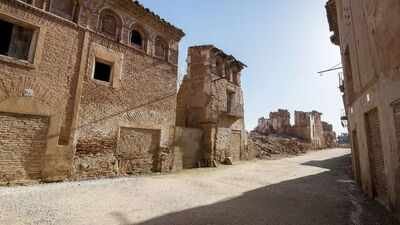
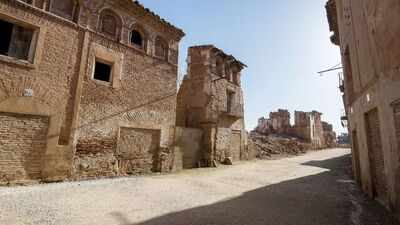
On the edge of Zaragoza province, the remains of Belchite sit among dry grass and scrub, their broken walls exposed to the weather. Towers rise without roofs, doorways lead nowhere and sections of masonry have been left much as they were after the fighting. A newer settlement stands nearby, separated from the ruins by a road and by decades of ordinary life. Yet the old town has never quite become an ordinary archaeological site. Its damaged streets, trenches and scattered objects belong to one of the most violent periods in modern Spanish history. Beneath the soil, archaeologists continue to find small traces of the people who fought, worked and died here during the Spanish Civil War.Someone carried medicine. Someone lost a button. Someone kept a bottle close at hand. These fragments do not explain the entire conflict, but they show how it was experienced at ground level.
The old Belchite was left behind as a new town emerged
Belchite was badly damaged during fighting in 1938, when Republican and Nationalist forces battled for control of the area. The town became one of the many places caught up in the wider conflict between supporters of Spain’s Republican government and the forces led by General Francisco Franco.After the fighting, the original settlement was not rebuilt in the usual way. Franco ordered that the ruins remain standing. A new Belchite was constructed beside them, with much of the labour carried out by Republican prisoners captured during the war. The newer settlement was laid out according to the planning ideas of Franco’s regime. Its straight streets and ordered blocks contrasted sharply with the irregular remains of the old town. Beneath the ruins archaeologists found traces of the battlefieldFor archaeologists, the most revealing parts of Belchite are not necessarily the towering ruins. Some of the evidence lies almost invisibly beneath the vegetation.During archaeological work teams led by archaeologist Alfredo González-Ruibal worked across parts of the old battlefield. Excavation exposed the shape of a military trench, allowing researchers to reconstruct sections of a defensive position that had been used during the fighting.The trench had changed considerably over the decades. Soil had accumulated, vegetation had spread and later human activity had altered the landscape. But the basic outline was still recoverable.A machine-gun position on higher ground presented a different problem. Farmers had moved rocks into it over the years, obscuring the structure beneath the accumulated material. Archaeological work therefore involved more than simply looking for objects. In places, the landscape itself had to be carefully taken apart.
Bullets and everyday objects reveal the human side of Belchite
According to the International Brigade Memorial Trust, there were cartridges and bullets, fragments of grenades and pieces of military equipment. Some have spent decades corroding in the soil. Their origins can sometimes be identified from their design and manufacture, offering clues about the weapons used by the opposing sides.Republican forces used ammunition and weapons supplied from several countries, including Soviet material. Nationalist forces received substantial military assistance from Germany and Italy. A cartridge recovered from the ground can therefore tell archaeologists something about the wider international dimension of the Spanish conflict.A rusted food tin speaks of someone who needed to eat. A medicine bottle points towards illness or injury. A piece of boot leather, a button or a broken bottle may appear almost insignificant, yet each belongs to the practical world of people living through the war. Among the finds are fragments of everyday belongings, including glass containers and personal items.
Belchite became a battlefield twice
The original battle may have ended decades ago, but the ground has continued to attract competing interpretations.Belchite was incorporated into the memory politics of Franco’s Spain. Leaving the ruins intact created a physical reminder of the Nationalist victory and the destruction associated with Republican forces. The neighbouring new town, meanwhile, was built under the dictatorship.The people who constructed it included prisoners from the defeated Republican side. Forced labour formed part of the wider system through which political opponents of the new regime were imprisoned and exploited after the Civil War. The distinction between the old and new settlements consequently carries more than architectural meaning.The ruins represent the violence of the war itself. The new town also carries evidence of what followed: imprisonment, forced labour, political repression and the reshaping of Spanish society under Franco. That period lasted far beyond the end of the fighting. Franco remained in power until his death in 1975.
Every fragment can reveal another layer of Belchite’s past
Archaeologists approaching a place such as Belchite have to work with more than physical remains. They are dealing with layers of memory that have accumulated around those remains. González-Ruibal has used the idea of anamnesis to describe a form of remembering through material traces. An object can carry information that is not written down. Its location, condition and relationship to other objects may help reconstruct something about the circumstances in which it was left behind.That does not mean an artefact can provide a complete story by itself. A cartridge cannot tell an archaeologist exactly what the person who fired it was thinking. A broken bottle cannot reveal everything about its owner. But when hundreds of such fragments are examined together, a more detailed picture begins to emerge.
The human cost beneath the ruins
Belchite suffered enormous destruction during the fighting, with thousands of people killed in and around the battle for the town. The surviving structures offer only a partial view of that loss. There are also indications of possible mass burial sites, adding another layer to the archaeological investigation.Human remains can be especially difficult to deal with in places where the political consequences of the Civil War remain sensitive. Excavating a battlefield is one thing. Investigating where people may have been buried can reopen questions that families have carried for generations.Spain spent much of the Franco period under a political system that restricted discussion of the Republican experience and the repression that followed the war. The transition to democracy after Franco’s death brought major political change, but the treatment of the country’s Civil War memory has remained complicated.Belchite is therefore not simply a place where archaeologists study an old battle.It is also a place where physical evidence can intersect with questions about what was remembered, what was suppressed and what later generations are prepared to investigate.
A landscape marked by two kinds of silence
Walking through the old town means moving through spaces that no longer function as they once did. The churches of San Martín de Tours and San Agustín remain among the most recognisable structures. Their towers and damaged walls stand above the surrounding ruins, while the absence of roofs and the vegetation growing through the masonry make clear how long the settlement has been exposed to the elements.There are no functioning homes in the old town. No shops open onto its streets. The buildings have become archaeological remains rather than part of daily life.That emptiness can make the physical evidence easier to overlook. A piece of glass in the dirt may be passed without a second glance. A depression in the ground may resemble nothing more than an old ditch.
From Franco’s memorial to an archaeological site
Belchite’s meaning has shifted as Spain’s relationship with its dictatorship has changed. Under Franco, the ruins could be read as evidence of Republican destruction and Nationalist victory. In later decades, the site became increasingly associated with the wider history of the Civil War and the experiences of those who lived through it.Archaeology has helped broaden that picture. The trenches do not belong exclusively to one political narrative. Both Nationalist and Republican soldiers occupied positions around the battlefield. The ammunition in the soil reflects both sides. The remains of camps and forced labour point towards the repression that followed the fighting. The site consequently resists a simple interpretation.It contains military history, political history, religious history and the history of civilians caught between competing forces. The remains of the dictatorship sit alongside the remains of the war itself.