


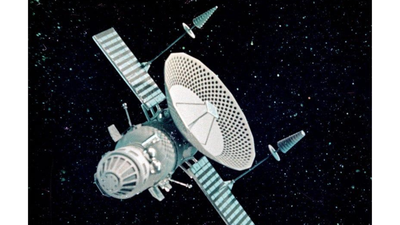
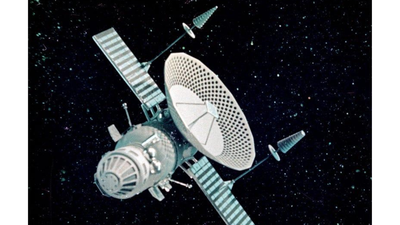
A Soviet spacecraft designed to land on Venus in 1972 finally completed its journey more than half a century later, though not in the way its builders intended. Kosmos 482, part of the Soviet Union’s ambitious Venera programme, was supposed to explore the Solar System’s hottest planet. Instead, a rocket malfunction left the spacecraft trapped in Earth orbit, where it remained for 53 years. On 10 May 2025, the capsule re-entered Earth’s atmosphere after decades in space. Built with a rugged titanium shell to survive Venus’s crushing pressure and scorching temperatures, the capsule may have endured re-entry largely intact, turning a failed mission into one of the most remarkable stories in space exploration.
How a timer error stranded the Soviet spacecraft for 53 years
Kosmos 482 was launched on 31 March 1972, just four days after its sister spacecraft, Venera 8, which would go on to successfully land on Venus later that year. During the height of the Cold War, Venus was a major target for the Soviet Union, which launched nearly 30 missions towards the planet over two decades. Scientists hoped to uncover the secrets hidden beneath Venus’s thick clouds, while Soviet leaders viewed successful missions as proof of technological superiority.However, everything changed moments after launch. After reaching a parking orbit around Earth, the spacecraft’s Blok L upper stage shut down prematurely, most likely because of a timer malfunction. The failed mission was quietly reclassified as “Kosmos 482”, a generic name routinely used for Earth-orbiting satellites. Rather than admit failure, Soviet authorities kept the probe’s true identity hidden for years.
Built for hell and too tough to die
What made Kosmos 482 unique was its descent capsule. Unlike ordinary satellites, it was specifically engineered to survive Venus, where temperatures reach around 470 degrees Celsius and atmospheric pressure is nearly 90 times greater than on Earth. The one-metre-wide titanium sphere weighed about 495 kilograms and was designed to endure enormous forces, temperatures and corrosive conditions.The spacecraft’s toughness became apparent almost immediately. Just days after launch, four glowing titanium spheres from the failed rocket stage crashed onto farmland near Ashburton in New Zealand. The Soviet Union denied ownership, and since no nation claimed them, the objects eventually became the property of local farmers. Another similar object was discovered near Eiffelton in 1978.Most of the spacecraft itself fell back to Earth during the following years, but the descent capsule remained in a highly elliptical orbit. Slowly, atmospheric drag reduced its altitude. By the 2020s, satellite observers such as Dutch astronomer Marco Langbroek had begun tracking the ageing relic and suggested that its Venus-grade construction might allow it to survive re-entry.
A mysterious return after 53 years
On 10 May 2025, Kosmos 482 finally came home. The European Space Agency confirmed that the object had re-entered Earth’s atmosphere after completing more than five decades in orbit. Russia’s space agency Roscosmos later said the capsule most likely fell into the eastern Indian Ocean, though no independent confirmation or debris recovery has been made.Experts noted that while most spacecraft burn up completely during re-entry, Kosmos 482’s titanium shell, built to survive a descent through Venus’s atmosphere, may have allowed the capsule to remain largely intact. Travelling at an estimated 240 kilometres per hour without a functioning parachute, the spacecraft probably struck the ocean with tremendous force. Whether it survived intact or broke apart during impact remains unknown.
The last survivor of the Soviet Venus programme
Kosmos 482 became the final surviving relic of the Soviet Union’s legendary Venus programme. It outlived the Cold War, the space race and even the Soviet Union itself, which dissolved in 1991. While the probe never reached its intended destination and never sent back a single scientific reading from Venus, it demonstrated the extraordinary engineering of the Venera programme.In a strange twist of history, the spacecraft succeeded in the one challenge few thought possible. Built to withstand the harshest world in the Solar System, it survived long enough to make an accidental return to the planet it had never truly left. More than 53 years after launch, Kosmos 482 closed one of the longest and most unusual chapters in the history of space exploration.