


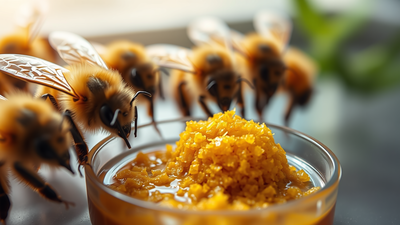
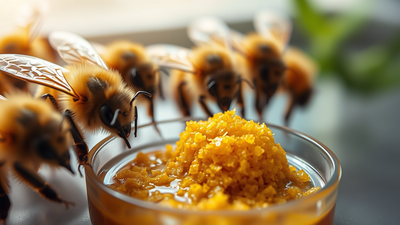
Honeybees have long depended entirely on flower pollen for a group of essential fats called sterols, nutrients they cannot produce inside their own bodies and cannot get from any other natural food source. As climate change and modern farming reduce the variety of flowers available to bees, access to these sterols has become increasingly scarce, leaving many colonies nutritionally stressed. A team led by the University of Oxford has now developed an engineered superfood that solves this problem directly, using genetically modified yeast to manufacture the exact sterols bees need in a form that can finally be produced at meaningful scale.
Why existing pollen substitutes have never worked properly
Beekeepers already rely heavily on artificial pollen substitutes when natural pollen runs low, but these products have a major built-in flaw. According to the University of Oxford’s official announcement, commercial substitutes made from protein flour, sugars and oils lack the correct sterol compounds bees require, making them nutritionally incomplete no matter how much protein or sugar they contain. Since bees cannot make these fats on their own, a diet missing the right sterols leaves colonies undernourished even when food appears plentiful, a gap that has quietly limited colony health for years.
How researchers engineered yeast to solve the sterol shortage
The breakthrough came from turning to a completely different biological source rather than trying to extract sterols from flowers directly. According to the peer-reviewed study titled Engineered yeast provides rare but essential pollen sterols for honeybees, published in Nature, researchers engineered a yeast called Yarrowia lipolytica to produce six key sterols normally found only in pollen. Professor Geraldine Wright of Oxford’s Department of Biology, senior author of the study, explained that most of the sterols bees rely on are not naturally available in quantities that could ever be harvested commercially, which had made a truly complete pollen substitute impossible to create until now.
A diet nearly identical to what bees would find in nature
Lead author Dr Elynor Moore, who worked on the study while at Oxford and is now based at Delft University of Technology, said the difference this diet makes for bees is comparable to the difference between a person eating balanced, complete meals versus meals consistently missing essential nutrients like fatty acids. The engineered feed was designed specifically to match the nutrient profile bees would naturally encounter while foraging across a diverse range of flowers, rather than simply offering a generic protein and sugar mix as most substitutes currently do.
Colonies raised up to fifteen times more young
The results from controlled trials were striking. According to Oxford’s official announcement, colonies fed the sterol-enriched diet showed a significant boost in reproduction, with some producing up to fifteen times more young compared with colonies fed standard commercial substitutes. This kind of increase in brood production directly affects a colony’s long term survival, since larger, healthier populations of young bees are better equipped to sustain the colony through seasonal food shortages and other environmental pressures.
A collaboration spanning several major research institutions
The research was carried out through a partnership between the University of Oxford, the Royal Botanic Gardens Kew, the University of Greenwich and the Technical University of Denmark. Co-author Professor Phil Stevenson of Royal Botanic Gardens Kew and the University of Greenwich noted that the engineered supplement could also benefit wild bee species indirectly, since honeybees kept in very large numbers near crops such as almonds, apples and cherries often compete heavily with wild bees for the same limited wildflower resources, a pressure this supplement could help ease.
Why bee nutrition matters far beyond the hive
Danielle Downey, executive director of the honeybee research nonprofit Project Apis m, who was not involved in the study, pointed out that honeybees pollinate roughly one in three bites of food people eat, making their health a matter of much broader food security rather than a concern limited to beekeepers alone. With honeybee populations already under pressure from climate change, habitat loss and reduced floral diversity, an engineered feed capable of closing this specific nutritional gap offers a rare, concrete tool for supporting colonies during periods when natural pollen simply is not available in sufficient variety or quantity.
What comes next for this engineered bee food
While this published research demonstrates the science behind the sterol-enriched yeast supplement, a related but separate pollen-replacing feed developed by Washington State University and Belgian company APIX Biosciences, which does not use this same synthetic biology approach, is separately being field tested with a targeted launch in the United States in 2026. Together, these parallel efforts reflect a growing push across the research community to finally close the nutritional gap that has limited artificial bee feeds for years, offering beekeepers a genuine alternative to relying solely on unpredictable natural pollen supplies.