


A spider web can look like a single delicate sheet of thread, but its construction is far more complicated. Different strands are made for different jobs, with some providing the strength needed to hold the web together and others stretching to trap prey. Orb-weaver spiders are particularly good examples of this division of labour. Their familiar circular webs combine a rigid framework, radiating support lines and a flexible capture spiral coated with sticky droplets. Silk also serves purposes away from webs, helping spiders secure themselves, protect eggs and wrap prey.What makes the material especially interesting to scientists is that the spider does not simply produce one type of fibre. It controls the chemistry and structure of each silk as it is made, creating a surprisingly versatile biological material from proteins.
How spiders use different silks to build a working web
Calling something a spider web can make it sound as though the whole structure is made from one material but actually it is not. A web is closer to a small piece of engineering assembled from different silks, each suited to a particular job.Orb-weaver spiders provide a useful example. Their familiar circular webs have strong threads forming the outer framework and spokes running towards the centre. Across those lines sits the capture spiral, which is much more flexible and carries the sticky material that helps hold insects in place. Other silk can be used for attachment points, temporary construction lines, shelters or egg protection.Every spider produces silk, but plenty of species do not construct the classic insect-catching structures people associate with them. Silk can act as a lifeline when a spider falls, a material for wrapping prey or a protective covering for eggs.
How spiders build webs and detect prey through vibrations
A spider does not simply release a finished web into the air. Construction happens in stages, with the animal adjusting its movements as the structure takes shape.For an orb web, the process can begin when a fine strand catches on something across a gap. Once that connection is secure enough, the spider reinforces it and builds out the basic frame. Radial threads are then added, creating the spokes that meet around the centre.A temporary spiral follows. It gives the spider something to work around while the final capture spiral is put into place. The temporary material can then be removed, leaving the finished web with its characteristic arrangement of structural and sticky threads.
The science behind spider silk’s unusual strength
Silk begins as protein rather than as a solid thread. According to the research published in biomimetics in MDPI, titled ‘Review of Spider Silk Applications in Biomedical and Tissue Engineering’ reveals that the main proteins involved are known as spidroins, large molecules with sections that behave differently from one another. Some regions can pack together into relatively rigid structures, while others provide flexibility.

How spiders turn liquid proteins into solid silk
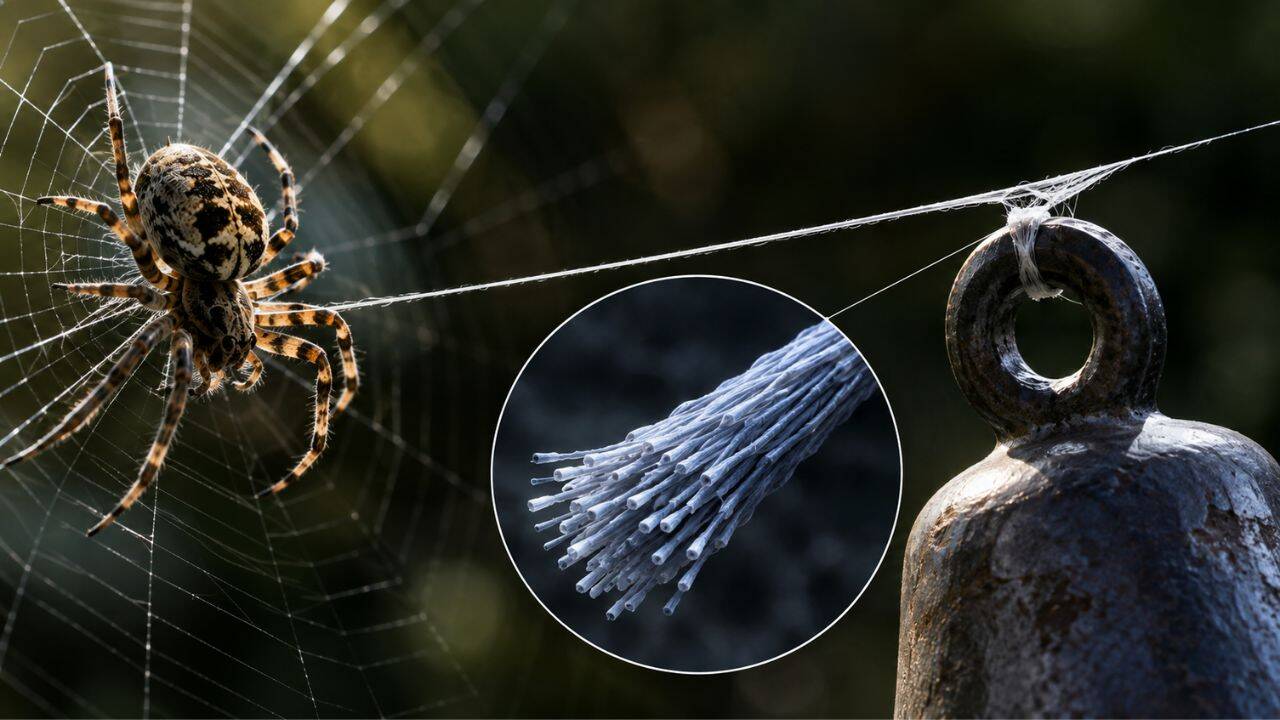
Perhaps the most interesting feature of spider silk is not just what it can withstand, but how the spider produces it. Inside the abdomen, silk proteins are stored in a concentrated liquid. As that material travels through a specialised duct, its surroundings change. Water is progressively removed, acidity shifts and the balance of ions changes. The movement through the narrowing passage also helps arrange the proteins.By the time the material leaves the spinning apparatus, those changes have encouraged the proteins to assemble into a solid fibre. The process takes place in water and at relatively ordinary temperatures. Industrial fibre production can involve substantial heat or chemical solvents, depending on the material being made. Spiders manage their transformation using biological machinery instead.
Silk could help control how medicines are released
A drug does not always need to be delivered all at once. Some treatments work better when a compound is released gradually, keeping its concentration within a useful range for longer. Engineered spider-silk materials are being investigated for precisely this purpose. A silk-based particle or gel can act as a small reservoir, holding a drug and allowing it to move out over time.Laboratory work has explored these systems with small molecules as well as larger biological medicines, including proteins. In one experimental system, engineered silk particles were able to release a small molecule at a relatively steady rate for roughly two weeks. The attraction is partly down to the material’s biological compatibility and its ability to be broken down. But these are still experimental approaches, not ready-made replacements for established drug delivery systems. Much work remains before such materials can move from laboratory experiments into routine medical treatment.
From wound coverings to scaffolds, silk has wider medical uses
Drug delivery is only part of the picture. Silk can also be turned into a scaffold; a temporary structure intended to give cells somewhere to attach and grow.That is useful in tissue engineering because injured tissue is not simply missing a patch of material. Cells need an environment in which they can organise, communicate and produce new tissue. A three-dimensional scaffold can provide some of that physical support while gradually changing or degrading as repair progresses.Scientists can modify engineered silk with biological signals that encourage cells to attach to the material. Depending on the application, the resulting structure could be designed as a covering for a wound or as an internal scaffold intended to fill or bridge damaged tissue.Note: Spider silk has not suddenly become a miracle medical material. Much of the work remains at the experimental stage, and reproducing the full complexity of natural silk is difficult.A spider controls protein concentration, chemistry, flow and molecular arrangement with extraordinary precision. Scientists can imitate pieces of that process, but recreating the whole system is another matter.