


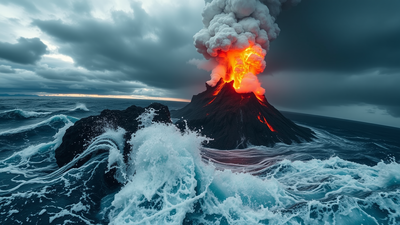
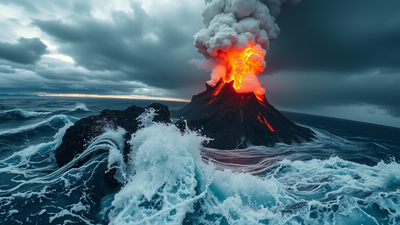
An underwater volcano erupting quietly beneath the Bismarck Sea, just north of Papua New Guinea, could soon push a brand new island above the waves. Satellites first picked up signs of trouble on May 8, 2026, when seismometers recorded a small swarm of earthquakes beneath the ocean floor, and within days, NASA’s Aqua and Terra satellites confirmed something far more dramatic was unfolding underwater. Since then, a steady stream of orbital imagery has tracked the eruption’s evolution in remarkable detail, capturing steam plumes rising kilometres into the sky, oddly discoloured seawater, and rafts of floating volcanic rock drifting across the surface. Scientists are now watching closely to see whether this rare, slow motion event will actually break the surface and leave behind a permanent new piece of land.
Why the eruption caught scientists by surprise
The Bismarck Sea sits in one of the most geologically complicated corners of the planet, crossed by active faults, volcanic ridges, rifts and both subduction and spreading zones, all lying at depths that make detailed sonar mapping extremely difficult. According to NASA’s Earth Observatory, there is a well known saying among oceanographers that the surfaces of the moon and Mars are mapped more precisely than much of Earth’s own deep seafloor, and this stretch of ocean is a clear example of that gap. When satellites first detected the eruption, volcanologists quickly ran into a frustrating problem, there were no detailed maps of the area available, leaving scientists uncertain about which volcanic feature was actually behind the activity, how deep the vent sat before erupting, or when it had last been active.
What the satellites have captured so far
Since the initial earthquakes, a whole fleet of satellites has tracked the eruption’s progress almost day by day. NASA’s PACE satellite detected water turning green and increasingly disturbed around the eruption site, while sharper imagery from the European Space Agency’s Sentinel-2 satellite and the NASA and USGS operated Landsat 9 later revealed volcanic activity moving noticeably closer to the surface. On May 12, the Suomi NPP satellite picked up thermal anomalies spread across roughly seven square kilometres, a reading volcanologist Simon Carn of Michigan Technological University said points to a large amount of hot material sitting unusually close to the surface, suggesting a much shallower eruption vent than the existing, if limited, seafloor maps had implied.
Why this eruption is unlikely to turn explosive
Despite the dramatic imagery, scientists say there is good reason to expect this eruption to stay relatively calm compared to some recent submarine events. The activity appears to be centred along a feature called Titan Ridge, close to where a transform fault meets a back arc spreading centre, a type of tectonic setting generally associated with gentler eruptions. Carn has explained that spreading centres tend to produce less explosive activity, while the most violent submarine eruptions usually occur along subduction zones involving large stratovolcanoes, a very different geological setting from the one currently active in the Bismarck Sea. So far, the eruption has been notably less explosive than recent high profile submarine events such as the 2022 Hunga Tonga Hunga Ha’apai eruption or the 2021 Fukutoku Okanoba eruption, though NASA notes that things could escalate if seawater ever reaches the shallow magma chamber that has built up beneath the site.
The pumice rafts drifting across the sea
One of the most visible side effects of the eruption has been the sudden appearance of huge rafts of pumice, a light, porous volcanic rock that forms when gas escapes from lava and leaves it riddled with bubbles as it cools. According to a separate NASA Earth Observatory report, these floating rafts drifted northwest from the eruption site through early June and ended up clogging the coastlines of several islands in Papua New Guinea’s Admiralty group. NASA’s chief scientist at the Goddard Space Flight Center, Jim Garvin, noted that ash can help weld pumice fragments together into much larger rafts, a process also seen during the 2022 Tonga eruption, and that these floating platforms can even act as temporary rafts for marine life such as microalgae, barnacles and bryozoans, allowing them to disperse across vast distances on ocean currents.
Whether a new island will actually survive
Even if the eruption does eventually push enough material above sea level to form new land, there is no guarantee it will last. Volcanic islands born this way sometimes build up into a tuff cone with a long lived vent crater, while others collapse and erode away within months once wave action gets to work on their loosely packed material. History in this same stretch of ocean offers little certainty either way, a nearby eruption in 1972 lasted just four days, while another in 1957 continued for almost four years, giving scientists no clear precedent for how long the current activity might persist. For now, researchers are treating the event as a rare scientific opportunity, since eruptions of this kind are seldom observed in this much detail from start to finish, and every new satellite pass adds a little more insight into a process that usually plays out completely hidden from view, deep beneath the surface of the ocean.