


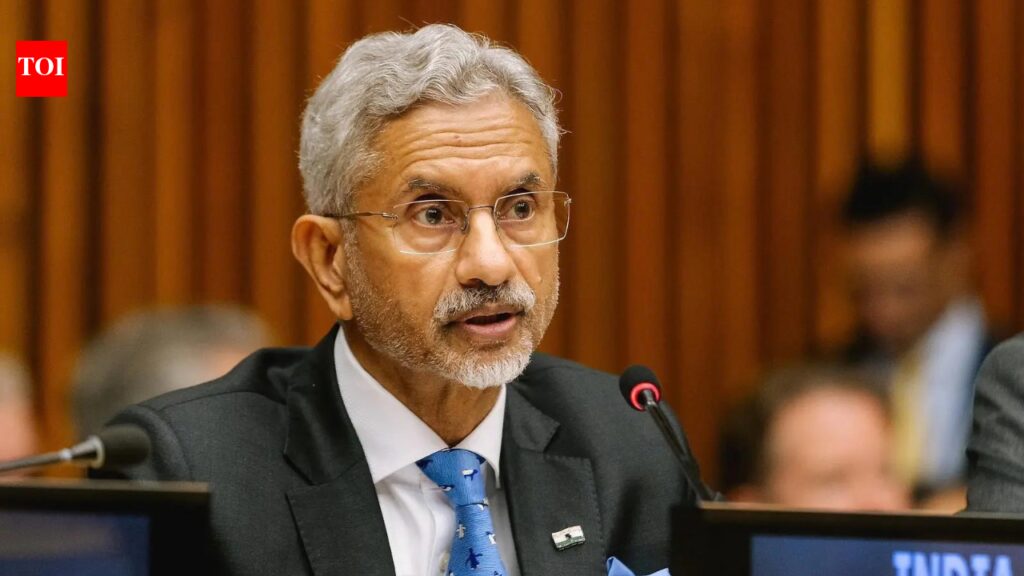

S Jaishankar (PTI file photo)
NEW DELHI: India hailed its direct talks with Iran as the “most effective way” to restart shipping through the disrupted Strait of Hormuz, which has affected global supplies, while Tehran allowed Indian-flagged vessels to pass through the route.In an interview with the Financial Times, external affairs minister S Jaishankar praised the direct dialogue with Iran’s leadership, saying, “My talking has yielded some results,” referring to renewed access to the crucial Strait of Hormuz, after Donald Trump called on about seven countries to deploy warships to police the key waterway vital for global energy markets.
Follow for live updates on Iran warTrump urged countries such as China, France, the United Kingdom and others to protect the Iran-controlled waterway as “their own territory”. His demand comes as governments, hit by surging energy prices after Tehran closed the route, weigh their options — including talks with Iran or possible military involvement that could risk dragging them into the spiralling Middle East conflict.
Poll
Which approach do you think is most effective in resolving international shipping crises?
Jaishankar told Financial Times that negotiations between New Delhi and Tehran, which allowed two Indian-flagged gas tankers to pass through the Strait of Hormuz on Saturday, showed what diplomacy could achieve.“I am at the moment engaged in talking to them and my talking has yielded some results,” he said in the FT interview. “This is ongoing. If it is yielding results for me, I would naturally continue to look at it.”Jaishankar also outlined India’s approach to handling the crisis and indirectly suggested a similar path for other countries. “Certainly, from India’s perspective, it is better that we reason and we co-ordinate and we get a solution than we don’t,” he said. “So if that sort of allows other people to engage, I think the world is better off for it.”Oil prices closed above $100 last week for the first time since August 2022, with some industry analysts expecting further increases as the conflict stretches into the spring. Iran’s new supreme leader, Mojtaba Khamenei, said last week that the country’s military would continue to block the narrow waterway, through which roughly one-fifth of the world’s oil and gas previously transited.France and Italy are among the European countries that have opened talks with Tehran on a possible diplomatic solution that could allow energy shipments to resume.Iran’s foreign minister Abbas Araghchi told CBS on Sunday that Iran was “open” to countries that want to discuss “safe passage of their vessels”.Jaishankar spoke ahead of his participation in a meeting of European Union foreign ministers in Brussels on Monday, where discussions are expected on whether to expand the mandate of the EU’s Aspides naval mission in the Red Sea to include the Strait of Hormuz. The mission currently comprises three warships from France, Italy and Greece.“Each relationship frankly, in a way stands on its own merits,” he said when asked whether European countries could replicate India’s arrangement. “So now, it’s very hard for me to compare this with some other relationship which may or may not have these.”“I’d be happy to share with [EU capitals] what we are doing . . . I know many of them have had conversations [with Tehran] as well,” he added.Jaishankar said there was no “blanket arrangement” with Iran for Indian-flagged vessels and that “every ship movement is an individual happening”.The veteran diplomat also denied that Iran had received anything in return, citing a “history of dealing with each other . . . which is the basis on which I engaged”.“It’s not an exchange issue,” he said. “India and Iran have a relationship. And this is a conflict that we regard as something very unfortunate.”“These are still early days. We have many more ships there. So while this is a welcome development, there is continuing conversation because there is continued work on that,” he added.