


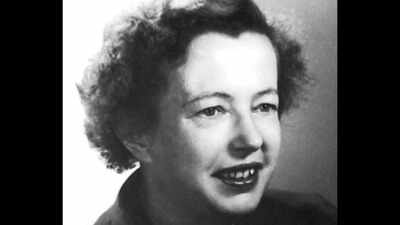
Maria Goeppert Mayer is remembered as one of the most important physicists of the twentieth century. She was born in Germany in 1906 and later moved to the United States, where she worked in theoretical physics. She was the second woman ever to win the Nobel Prize in Physics, after Marie Curie, in 1963. Mayer won the prize for coming up with the nuclear shell model, which shows how protons and neutrons are arranged in the nucleus of an atom. Her research helped scientists figure out why some atomic nuclei are more stable than others.The quote above shows how Mayer got into physics on a personal level. She started out studying math, but later switched to physics because she thought it answered questions that came from nature. She thought that math was mostly about solving problems that people made up, while physics was more about figuring out things that were already in nature. Her words show how excited scientists are when they try to figure out how the universe works. This idea still guides students, researchers, and teachers who want to learn more about how the natural world works.
Quote of the day by Maria Goeppert Mayer
“Mathematics began to seem too much like puzzle solving. Physics is puzzle solving, too, but of puzzles created by nature, not by the mind of man.”
What Maria Goeppert Mayer meant by “puzzles created by nature”
Maria Goeppert Mayer talks about the difference she saw between math and physics in this quote. Mathematics frequently addresses abstract problems and logical frameworks formulated by human intellect. People still make these problems, even though they can be beautiful and hard.Physics, on the other hand, tries to answer questions that are already there in nature. These include questions about atoms, stars, gravity, and the structure of matter. Scientists do not invent these puzzles. They don’t do that; instead, they look at natural events and try to figure out why they happen.This process made physics interesting for Mayer. Every experiment or observation could reveal something new about the universe. The puzzle is already there, and scientists are working to find the answer one step at a time.
How Maria Goeppert Mayer’s quote relates to modern science
Scientists still do research the way Mayer said they should do it. Many areas of study involve figuring out puzzles that nature throws at us. Some examples are learning about climate change, looking into the structure of faraway galaxies, and watching how subatomic particles act.Researchers look for patterns in data, come up with theories to explain them, and then test those theories with experiments. This process is like what Mayer said about physics: it’s a search for answers that are hidden in nature.Her quote sums up the curiosity that drives scientists to learn new things. It explains why scientists keep working on problems that might take years or even decades to figure out.
Why Maria Goeppert Mayer’s words still inspire students and researchers
People still share Maria Goeppert Mayer’s quote because it makes science easy to understand and relate to. Students often learn about science for the first time by doing puzzles, experiments, or asking questions about how things work.Mayer helped convey the thrill of discovery by calling physics “solving puzzles made by nature.” Readers are reminded by her words that there are still many things about the natural world that we don’t know.This idea can make hard subjects seem easier for students who are just starting in science. They can see science as a way to learn about the mysteries of the universe instead of as hard formulas or theories.
Maria Goeppert Mayer’s journey from mathematics to physics
At first, Maria Goeppert Mayer wanted to be a mathematician. She went to the University of Göttingen, which was one of the most important scientific schools in Europe in the early 1900s. She was surrounded by some of the best physicists in the world who were changing the way we think about quantum mechanics while she was there.Mayer became more interested in physics as time went on because it linked math to things that happened in the real world. She understood that physics gave her a way to use math to figure out how things in nature work. This change in her interests eventually led her to theoretical nuclear physics, where she made her most famous discoveries.The quote has a lot to do with how she went from math to physics. It shows how she thought of physics as a way to figure out the universe’s natural puzzles.
The nuclear shell model and Maria Goeppert Mayer’s Nobel Prize
Maria Goeppert Mayer is best known for coming up with the nuclear shell model in the late 1940s. Before her work, scientists were having a hard time figuring out why some atomic nuclei were so stable. When the number of protons or neutrons reached certain values, later known as “magic numbers,” these stable nuclei formed.Mayer suggested that protons and neutrons in the nucleus are arranged in layers or shells, just like electrons are arranged in shells around an atom. The nucleus gets more stable when a shell is full.This theory helped physicists make sense of many experimental results that had been bothering them for years. Mayer won the Nobel Prize in Physics in 1963 for this work. She shared the prize with physicists J. Hans D. Jensen and Eugene Wigner.
Challenges Maria Goeppert Mayer faced in her career
Maria Goeppert Mayer had to deal with a lot of professional problems, even though she was a successful scientist. For a long time, universities in the US didn’t hire her for a paid academic position because of rules that made it hard to hire spouses at the same school. Joseph Edward Mayer, her husband, was also a scientist.Because of this, Mayer often did research work for free or worked part-time while still doing her scientific work. She did important research and worked with top physicists even when she didn’t have a formal salary for long periods of time.The scientific community around the world finally recognised her work, and she won the Nobel Prize. People often talk about her career as an example of how to be determined even when there are institutional barriers.
Other famous quotes by Maria Goeppert Mayer
Maria Goeppert Mayer did not publish many widely quoted sayings, but several statements attributed to her reflect her approach to science and research:
- “Winning the prize wasn’t half as exciting as doing the work itself.”
- “When something is new, it is naturally questioned.”
- “Science grows through curiosity and persistence.”