


Some decisions never survive being explained out loud. You know why you trust someone, why a place feels like home, why you love who you love, yet none of it holds up as a tidy argument. Blaise Pascal, the French mathematician and philosopher, put a name to that gap nearly four centuries ago. “The heart has its reasons of which reason knows nothing,” he wrote, describing a kind of knowing that logic can neither produce nor properly explain. It remains one of the most quoted lines about the limits of rational thought, precisely because almost everyone has felt the truth of it firsthand, usually in the exact moments when a careful, sensible argument fails to capture why they actually feel the way they do.
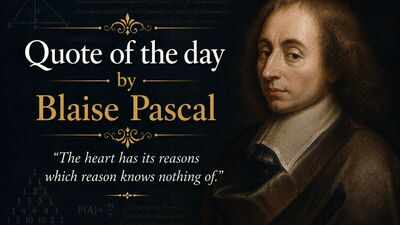
Quote of the day by Blaise Pascal
“The heart has its reasons of which reason knows nothing.”
Who is Blaise Pascal
Pascal was born in France in 1623 and became one of the most significant mathematicians and physicists of his era before turning much of his later attention to philosophy and religious thought. He made lasting contributions to probability theory, geometry and fluid mechanics, work that still carries his name today in fields like the Pascal unit of pressure and Pascal’s triangle in mathematics.This particular quote comes from Pensées, a collection of notes and fragments on philosophy and Christian faith that Pascal was still writing when he died in 1662, published posthumously in 1670. The book was never finished as a single argument. It survives as a series of sharp, often unconnected reflections, of which this line is among the most frequently quoted.Pascal’s health had been poor for most of his adult life, and he experienced what he described as a profound religious experience in 1654, an event he recorded on a piece of parchment he kept sewn into his coat for the rest of his life. That experience marked a turning point away from pure mathematics toward the questions of faith and human nature that would occupy his final years and eventually produce the fragments collected in Pensées.
What is the meaning of the quote by Blaise Pascal
Pascal is drawing a line between two different ways of arriving at conviction. One is reason, built from logic, evidence and argument, the kind of knowing that can be explained, defended and passed on to someone else in words. The other is what he calls the heart, a form of certainty that arrives without needing to justify itself through a chain of logical steps.This is not an argument against reason. Pascal, a working mathematician, understood the value of logical proof better than almost anyone of his time. His point is narrower and, in some ways, more interesting: certain kinds of knowledge, love, faith, a sense of what matters, simply do not arrive through logic in the first place, and demanding that they justify themselves in logical terms misunderstands what they actually are.
Why this quote is especially relevant today
Modern life runs on the assumption that good decisions come from data, analysis and clearly stated reasons. Businesses build dashboards, individuals make pro and con lists, and entire industries exist to help people reason their way to better choices. Pascal’s line pushes back against the idea that this is the whole picture.Behavioural science has, in its own way, caught up with him. Researchers studying decision-making have repeatedly found that people often reach a conclusion first, through instinct or emotion, and only construct a logical justification for it afterward. Pascal was describing this gap between feeling and reasoning three centuries before anyone ran a formal experiment to confirm it existed.
Why the heart’s reasons are hard to defend with logic
The difficulty with this kind of knowing is that it cannot be handed to someone else the way a proof can. A mathematical argument can be checked, step by step, by anyone willing to follow it. A feeling of certainty about a person, a decision or a belief has no equivalent chain to hand over. You either recognise it in yourself or you do not, and no amount of explanation fully closes that gap for someone who has not felt it.This is precisely why the heart’s reasons are so often dismissed as irrational. They fail a test they were never built to pass. Pascal’s quote is, in part, a defence of that failure, arguing that something can be entirely real and entirely valid without being provable in the way a geometry theorem is provable.
How to apply the quote in daily life
The clearest use of this idea is learning to notice when you are demanding logical proof for something that was never going to offer it. Trust in a relationship, a sense that a decision feels wrong despite looking fine on paper, a pull toward a particular path in life, none of these need to survive cross-examination to be worth taking seriously.This does not mean abandoning reason wherever it becomes inconvenient. It means recognising that reason and feeling are answering different questions. Reason is well suited to working out whether a plan is logistically sound. It is far less suited to telling you whether a life built around that plan will actually feel like yours.
What the quote teaches about faith and belief
Pascal wrote this line inside a broader argument about religious belief, and it reflects his own conviction that faith could not be reached through logical proof alone. He is famous for a separate argument, often called Pascal’s Wager, which tried to use logic to justify belief in God as a rational bet. This quote sits somewhat in tension with that wager, suggesting that real faith, in his view, ultimately rests on something felt rather than something calculated.That tension is worth sitting with rather than resolving too quickly. Pascal was comfortable using rigorous logic where logic applied, and comfortable admitting its limits where it did not. Holding both at once, rather than picking a single allegiance to reason or feeling, is arguably the more demanding and more honest position.
The difference between knowing and feeling
Knowing, in the strict logical sense, can be transferred from one mind to another through argument and evidence. Feeling certainty about something cannot be transferred the same way, only described, gestured at, or shared through experience. Pascal’s quote insists that the second kind of certainty is not a lesser cousin of the first. It operates on entirely different terms.This distinction matters most in situations where the two conflict. A relationship that makes no logical sense on paper can still be the right one. A financially sound decision can still feel wrong in a way worth listening to. Pascal is not telling you which side should win in any given case. He is telling you that both sides are real and both deserve a hearing.
Other famous quotes by Blaise Pascal
Pascal’s Pensées produced several other widely quoted lines. A few include:
- “Kind words do not cost much. Yet they accomplish much.”
- “All men’s miseries derive from not being able to sit in a quiet room alone.”
- “The supreme function of reason is to show man that some things are beyond reason.”
- “Justice without force is powerless; force without justice is tyrannical.”
The bigger idea behind Pascal’s words
Pascal was not choosing feeling over reason, or reason over feeling. He was arguing that a full account of how people actually come to believe, trust and love has to include both, and that dismissing one in favour of the other leaves out half the picture. Reason can tell you a great deal. It was never going to tell you everything.