


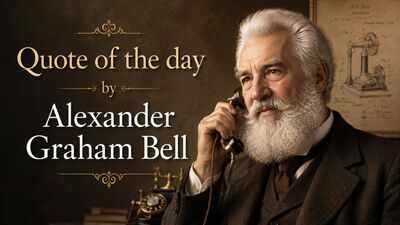
Today’s quote of the day is widely quoted as having been said by Alexander Graham Bell, the Scottish-born inventor best remembered for giving the world the telephone. The line reads, “The only difference between success and failure is the ability to take action.” It has become one of the most shared quotes on productivity and procrastination, printed on office walls and repeated in graduation speeches everywhere. Whether or not Bell wrote it down word for word, it captures something that genuinely defined how he worked. He was not the only person of his era chasing the idea of transmitting sound through wire, but he was the one who moved fast enough, and pushed through enough failed attempts, to get there first. That timing was never an accident. It was the direct result of choosing to act while others were still theorising.
Quote of the day by Alexander Graham Bell
“The only difference between success and failure is the ability to take action”
The patent race that made this Alexander Graham Bell’s quote famous
Bell’s own story backs up the quote better than almost anyone else’s from that period. He was racing against several other inventors who were working on very similar ideas around the same time, most notably Elisha Gray, who filed a patent caveat for a similar device on the very same day in February 1876. Bell’s application reached the patent office first, by a matter of hours, and that narrow margin changed the course of communication history.Being first was not about Bell having a better idea than everyone else chasing the same goal. Several inventors were circling the same concept. What separated Bell was that he kept experimenting, kept testing, and kept pushing his prototypes forward instead of waiting for a perfect version before showing his work. His now-famous first successful call to his assistant, “Mr Watson, come here, I want to see you,” happened because he was willing to test an unfinished, still rough device rather than wait until it was flawless.
From a teacher of deaf students to a household name
Alexander Graham Bell was born in Edinburgh, Scotland, in 1847, into a family deeply involved in the study of speech and elocution. He later moved to Canada and then the United States, where he taught deaf students while experimenting with ways to transmit sound electronically in his spare time. That dual life, teacher by profession and inventor by obsession, meant his breakthroughs came in the margins of an already demanding schedule.His interest in sound was not accidental either. His mother and, later, his wife were both deaf, and that closeness to hearing loss shaped his lifelong fascination with speech and vibration long before the telephone was ever a serious idea. He patented the telephone in 1876 and went on to co-found the American Telephone and Telegraph Company, but he never stopped inventing. His later work touched aviation, hydrofoil boats, and early metal-detector technology, developed partly in an attempt to help locate a bullet lodged in President James Garfield after an assassination attempt.
What the quote is actually asking of you
The quote is often read as a simple pep talk, but it is making a sharper point than that. It is not saying that successful people are smarter, luckier, or more talented than everyone else. It is saying that the gap between success and failure usually comes down to one thing: whether a person actually moves once they have an idea, or whether they sit on it.Most people are not short on ideas. Almost everyone has had a moment where they thought of something worth building, fixing, or trying, only to let it fade because the timing never felt right. This quote argues that the timing was never really the obstacle. The hesitation was.
Why this idea about action still holds up today
Part of why this line keeps circulating, whether or not Bell said it in exactly these words, is that it names a very modern problem using much older language. Overthinking, waiting for the right moment, and needing more information before starting are not habits invented by smartphones and social media. They existed in Bell’s era too, just without the vocabulary around procrastination that we use today.The quote also strips away a convenient excuse. It is tempting to believe that people who succeed simply had access to better resources, better timing, or better connections. Bell’s own life complicates that story. He worked for years as a teacher before his experiments with the telephone ever gained traction, and his path to success was built on years of unglamorous, repetitive work rather than a single lucky break. Even in workplaces today, people cite lines like this one to explain why they finally launched a half-formed idea instead of waiting for it to feel ready.
A simple way to put this into practice
If there is one practical lesson to take from this quote, it is to stop treating the planning stage as the finish line. An idea sitting untested in your head or in a notes app is not progress, no matter how good it feels to think about it. Bell’s real advantage was never a monopoly on good ideas. It was his willingness to test a rough, unfinished version of one instead of waiting for a perfect version that never arrives.That is really the whole difference this quote is pointing at. Success rarely announces itself in advance, and failure rarely feels like a single dramatic event either. Most of the time, both are the slow result of a decision made quietly, over and over again, to either move or to wait. Bell chose to move, long before he had any guarantee that his version of the telephone would work better than anyone else’s. The guarantee only showed up afterwards, once the action had already been taken.The next time an idea feels worth pursuing, the honest question is not whether it is good enough yet. It is whether you are willing to take the first small, imperfect step towards it today.