


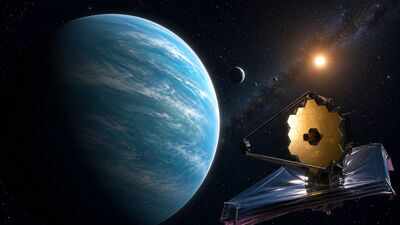
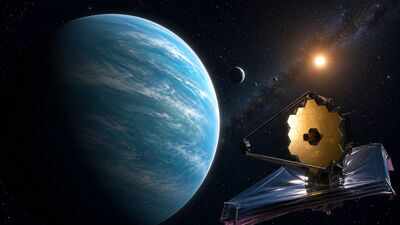
Astronomers have spent years using the James Webb Space Telescope to examine the atmospheres of distant worlds, hoping those thin outer layers would reveal what lies beneath. For one of the galaxy’s most abundant classes of planets, that assumption may need another look.Many warm sub-Neptunes could contain far more water than their visible atmospheres indicate. Instead of remaining evenly mixed with hydrogen throughout the planet, water may separate into deeper layers under the right conditions, leaving the upper atmosphere comparatively depleted. If that happens, even Webb’s remarkably sensitive observations could provide only part of the picture, rather than a complete account of a planet’s interior. According to the new study published in The Astrophysical Journal, titled “A Window for Water-hydrogen Demixing on Warm Metal-rich Sub-Neptunes”, this process may affect a broad population of metal-rich sub-Neptunes rather than being limited to rare or unusually cold worlds.
Scientists discover hidden water layers inside warm sub-Neptune exoplanets
Sub-Neptunes are neither rocky Earth-like planets nor large gas giants. Measuring roughly two to four times Earth’s radius, they are the most frequently detected type of exoplanet, yet their internal make-up remains surprisingly uncertain. Scientists have long debated whether their thick envelopes are dominated by hydrogen and helium, packed with water-rich material, or somewhere in between.According to the study, the answer may not simply be one mixture spread evenly from top to bottom. The team developed a modelling framework called ATHENAIA that combines atmospheric and interior simulations to test when hydrogen and water remain mixed and when they separate into distinct regions. Their calculations point to a previously unrecognised “demixing window” where warm, metal-rich sub-Neptunes could naturally develop hidden composition layers.
Why the James Webb Space Telescope may underestimate water on sub-Neptune exoplanets
Transmission spectroscopy, the technique widely used by the James Webb Space Telescope, analyses starlight filtering through a planet’s atmosphere during transit. It samples only the upper atmospheric layers rather than the planet’s deep interior.That distinction becomes important if hydrogen and water separate over time. According to the study, the atmosphere observed by telescopes could contain substantially less water than exists deeper inside the planet. In that case, atmospheric measurements alone might underestimate both the total amount of water and the overall metallicity of the planetary envelope, leading scientists to infer smaller envelopes and larger rocky cores than actually exist.Rather than representing the planet as a single well-mixed body, future interpretations may need to account for gradual chemical layering between the atmosphere and the interior.
TOI-270 d may contain far more hidden water than James Webb observations suggest
The researchers applied their model to TOI-270 d, a warm sub-Neptune that has already attracted considerable attention because Webb observations detected methane, carbon dioxide and evidence pointing towards a water-rich atmosphere.The planet falls within the range where hydrogen-water separation could occur. If so, the atmosphere visible to telescopes may represent only the upper portion of a much more water-rich envelope below. The study suggests the planet’s total envelope could contain considerably more heavy material than atmospheric observations alone imply, although the authors note that a fully mixed interior remains possible under different thermal conditions.The modelling also indicates that this behaviour is not unique to TOI-270 d. Similar conditions may occur across many warm sub-Neptunes with enriched envelopes.
Hidden water could reshape how scientists interpret James Webb Space Telescope data
The findings do not change what the James Webb Space Telescope measures. Instead, they change how those measurements should be interpreted.According to the study, atmospheric metallicities inferred from transmission spectroscopy may not always reflect a planet’s overall composition if chemical separation has already occurred. The researchers argue that future interior-atmosphere models should consider these composition gradients rather than assuming a fully mixed envelope, especially for warm sub-Neptunes with high metal enrichment.Hydrogen-water separation could influence how these planets cool, how easily they lose atmospheric gases over time, and how scientists estimate their internal structures. If confirmed by future modelling and observations, the galaxy’s most common planets may turn out to be concealing far larger water reservoirs than their atmospheres alone reveal.