


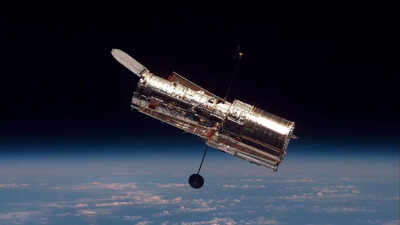
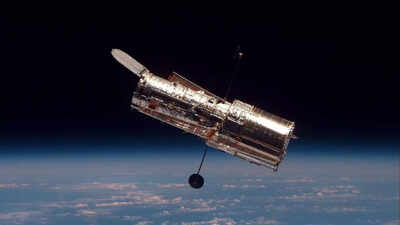
The Hubble Space Telescope has been orbiting Earth for over 35 years now. Billions of miles away, floating above our heads, it has completely changed how we see the universe. Stars, galaxies, nebulae, which Hubble has seen it all and it’s been doing this nonstop since 1990.The telescope might not stay up there forever. Its hardware is aging, the harsh space environment taking its toll. Experts say atmospheric drag is slowly tugging it down. And new studies suggest it could reenter Earth’s atmosphere sooner than anyone expected. Some scenarios even hint at a small chance of casualties. That’s a bit unsettling.
Hubble Space Telescope’s final journey: From shuttle boosts to an uncertain fall around 2030s
Hubble wasn’t just launched and forgotten. Over the years, Space Shuttle missions boosted it to higher orbits. This kept it ticking along. Elon Musk reportedly even proposed a mission to lift it further with a Crew Dragon capsule, though that plan appears to be off the table now.Originally, the idea was for the Shuttle to retrieve it at the end of its life. But the Shuttle program ended. Hubble outlived its planned support system. So now, it slowly drifts downward. Eventually, it will hit the atmosphere. Most likely the ocean. But there’s always a small chance it could hit land.NASA’s own reports seem a little nervous about this. They’ve been running simulations to figure out when and how it might fall. It seems the nominal prediction is around 2033. But some worst-case scenarios put it as early as 2029. The best-case could see it hanging on until 2040.
Hubble’s fall: What could hit Earth
One thing that complicates things: Hubble was never built for controlled reentry. It was meant to be caught by astronauts. So if it does crash down, chunks of debris could survive the fall. That’s not ideal.Researchers stress that the telescope could cause some casualties if unlucky. For example, if debris fell over Macao, they estimate two to four people could be affected. Even Hong Kong or Singapore might see at least one casualty. Still, the overall probability is low. But experts point out that it doesn’t fully meet NASA’s safe-risk standards.
What is the chance of Hubble hitting the Earth
The risk across most of the globe is tiny. Over the South Pacific, the chances drop to something like 1 in 31,000. Across all the regions Hubble passes, it’s about 1 in 330. Scientists are keeping an eye on it. Geomagnetic storms, solar activity, all of that could speed up its descent a bit.Still, Hubble has given us so much. It would be ironic if the telescope is remembered for crashing over a populated area. For decades, it’s been a symbol of exploration. A reminder of curiosity and science. Not a falling satellite.