


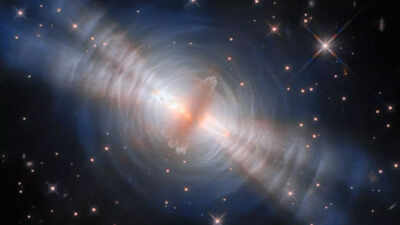
1,000 light-years away in the constellation Cygnus, a sun-like star is reaching the closing chapter of its life. And it is not slipping away quietly. NASA’s Hubble Space Telescope has captured what many are calling the clearest view yet of the Egg Nebula, a glowing, swirling cloud of gas and dust created by this dying star. The image feels almost painterly. Blue-tinted shells. Twin beams of light. A bright centre that looks uncannily like a yolk, creating a rare chance to watch stellar evolution unfold almost in real time.
NASA Hubble captures the glowing ‘yolk’ of a dying star
The Egg Nebula gets its name from its unusual shape. At the centre sits the fading star, often described as the “yolk.” Around it spreads a hazy shell of gas and dust, as egg white suspended in space. It sounds whimsical. But the physics behind it is anything but simple.Unlike many nebulae that glow because their gases are ionised, the Egg Nebula shines mostly with reflected starlight. The light from the dying star punches through gaps in its thick, dusty shell. That is why we see those striking twin beams cutting outward. They almost look like searchlights. Experts say this stage is known as a pre-planetary nebula. It is a brief and fragile period in a star’s life.
What makes a pre-planetary nebula special
Planetary nebulae have nothing to do with planets directly. Early astronomers simply thought they looked planet-like through small telescopes. In reality, a pre-planetary nebula forms when a sun-like star begins shedding its outer layers. The core contracts and the outer gases drift outward. The Egg Nebula is reportedly the youngest and closest known example of this stage. That matters. Because it gives astronomers a front-row seat.Over time, the star’s core will grow hotter. It will eventually ionise the surrounding gas. When that happens, the nebula will glow in its own light, entering the next stage as a fully fledged planetary nebula.One of the most intriguing features in the new Hubble Space Telescope image is the symmetry. The arcs ripple outward in surprisingly neat layers. It seems unlikely that such orderly patterns would come from a chaotic supernova explosion.