


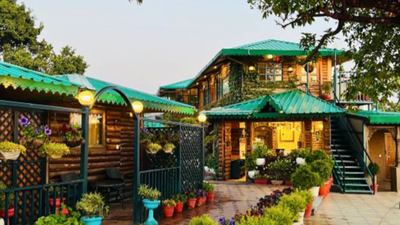
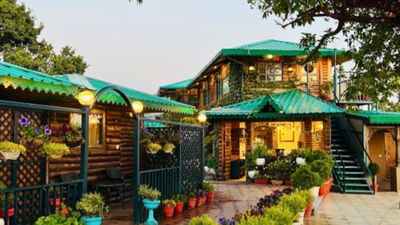
Some places on screen are so beautiful, you almost forget they’re real until you find out they actually are. That’s exactly what’s happening with Musafir Cafe, Vikrant Massey’s new Netflix show, where a cosy hilltop cafe, framed in ivy-covered walls, misty mountains and old stone archways, has viewers convinced they’ve almost arrived inside a European postcard.Except this isn’t Europe at all. It’s Mussoorie and is actually real.The dreamy backdrop belongs to Jharipani Castle, a nearly hundred-year-old heritage property that’s quietly been standing in the hills for nearly two decades before Netflix ever noticed it. If the show has left you daydreaming about castle stays and mountain views, here’s the story of the real place behind the fiction.
The Musafir cafe in Jharipani Castle
Vikrant Massey’s Netflix drama has viewers pausing mid-episode just to admire its setting, and that admiration is quite beautiful. The series in question is Musafir Cafe, a Hindi romantic drama that premiered on Netflix, starring Massey alongside Vedika Pinto and Mahima Makwana. The charming, mist-wrapped cafe that anchors much of the story isn’t a permanent establishment, but the property it was built inside very much is the Jharipani Castle, located in the hills just outside Mussoorie.
The story of the castle’s origins goes back to the colonial era
Built in 1932, the castle has led several lives. It began building during the British era not as a royal residence but as a functional colonial-era guesthouse, constructed by Crown Breweries to host British officers and soldiers travelling through the region.And even today, the original purpose is visible in the property’s layout, with the red and brown stone construction, wide verandas designed to let in the cooler mountain air, and a boarding-house structure meant to comfortably host groups of travelling guests.It later became the summer house of the Maharaja of Patiala post-independence, and was then nicknamed the “Patiala House.” Over time, though, the property fell into disrepair, its grandeur fading along with the era it belonged to.That changed in 2003, when the Bahri family took over the estate and began restoring it, and not by tearing it down and rebuilding something new, but by carefully bringing its original character back to life. According to Jharipani Castle’s official website, “Our story is not just about restoration; it is about preserving soul, celebrating culture, and creating moments that linger long after you’ve departed.”
The design and architecture of the place still echo the colonial-era architecture
The stone archways and sprawling gardens reflect its colonial bones, while the ivy-covered walls and sweeping Himalayan views give it the romantic, European feel that recent viewers have noticed on screen. It seems as if every rock, stone and beam of Jharipani Castle still carries the tales of an era gone by, from the original craftsmanship to the valley views that have remained untouched by time.While the on-screen cafe exists only for the story, nearly everything around it is real and open to guests. Mornings here begin with birdsong instead of traffic, afternoons can be spent wandering quiet garden pathways or relaxing under century-old trees, and evenings often end with a coffee in hand, watching clouds roll over the Doon Valley.

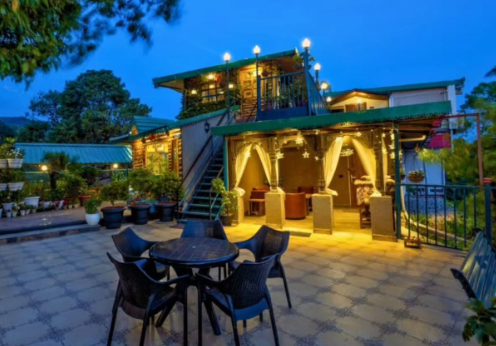
Photo: @jharipanicastle/ Instagram
The Jharipani Castle also offers stay facilities
What began in 2005 as Uttarakhand’s first Swiss tent resort eventually evolved into a small five-room homestay, and today has grown into a boutique heritage property with individually designed rooms, including cliff-facing suites and rustic log huts, each built to preserve the estate’s character and also offer modern comfort.