


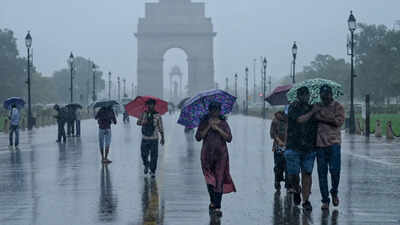
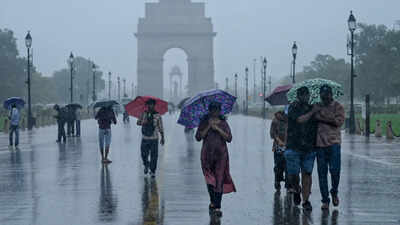
NEW DELHI: Southwest (summer) monsoon covered the entire country by advancing into remaining parts of Rajasthan, Haryana and Punjab on Thursday, one day after the normal date (July 8) of covering entire India, said IMD.It took 36 days for the monsoon to cover the entire country after making a three-day delayed onset over Kerala on June 4. Normally, the monsoon covers the entire India in 38 days (June 1-July 8). It usually starts retreating from northwest India around Sept 17 and fully withdraws by Oct 15.Early/delayed onset or early/delayed coverage, however, doesn’t impact quantitative or spatial aspects of rainfall during the four-month monsoon season. But it certainly guides the progress of kharif (summer sown) crops sowing operations and choice of crops as farmers have to take calls on the basis of the irrigation cycle a crop may need.Backed by good rains in the past eight days, the monsoon, meanwhile, reduced its overall nationwide cumulative (June 1-July 9) deficit from 40% on June 30 to 14% on Thursday. Its skewed distribution, however, throws up a different challenge, with 10 states such as Bihar, Jharkhand, Uttar Pradesh, Kerala, Punjab, Assam, Meghalaya, Arunachal Pradesh, Nagaland and Goa still reporting big deficits.As a result, sowing operations remained sluggish in these states, affecting the overall acreage. Data available till July 6 shows that the acreage of Kharif crops was reported 21% down compared to the corresponding period last year, with paddy, pulses, oilseeds, millets and cotton reporting a decline in sown area compared to 2025.The current respite from the low phase of monsoon is likely to be short-lived in certain parts of the country as the Met department on Thursday predicted “significant reduction in rainfall activity” over central India, including Maharashtra, Gujarat and Madhya Pradesh, and south peninsular India in the coming days.Its impact is likely to be felt in the ‘monsoon core zone’ — the rain-fed area which largely depends on monsoon rains for farming operations.