


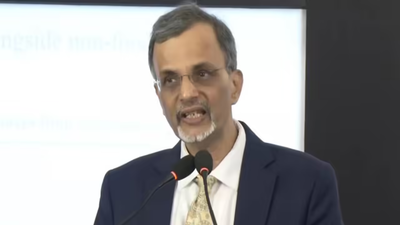
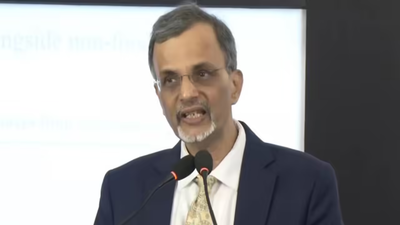
Balancing India’s manufacturing expansion ambitions with its net zero commitments is emerging as a key structural challenge, Chief Economic Advisor (CEA) Anantha Nageswaran said, noting that the country must grow industrial capacity even as it works to lower its carbon footprint.Speaking to ANI on the sidelines of the launch of the Niti Aayog study report titled ‘Scenario Towards Viksit Bharat and Net Zero’, Nageswaran said the report marks an important milestone in India’s long-term climate and development planning.
“While emissions are largely a legacy of fossil fuel-led growth in advanced economies, India now faces an unprecedented challenge as it seeks to expand manufacturing while simultaneously lowering its carbon footprint. The release of this report is a significant milestone in India’s planning for net zero and combining it with its mixed goals, which come before the net zero transition,” he said.Nageswaran said the Niti Aayog report is rigorous and high quality and will serve as a benchmark for future policy deliberations.Highlighting structural trends, he noted that manufacturing has contributed about 18 per cent to India’s GDP over the past decade, while services have driven growth for several decades.He emphasised that manufacturing is central to India’s ambition of becoming a global economic power, citing its role in lowering the cost of capital, strengthening the currency and improving state capacity.“Manufacturing matters much more for state capacity than services do. A renewed push for manufacturing, also highlighted in the recent Union Budget and the Economic Survey, would inevitably raise the emission intensity of the economy, making India’s net-zero journey more complex than that of many other countries,” he said.On financing the transition, the CEA said that amid geopolitical tensions, pressure on multilateral institutions and rising protectionism, India will need to rely largely on domestic resources. This would require sustained economic growth, higher household savings, employment generation and investment creation, forming an “endogenous” growth-investment cycle, he said.Nageswaran also pointed to the energy-intensive nature of renewable technologies. Citing Economic Survey data, he said generating one gigawatt of solar power requires large amounts of silver, polysilicon and aluminium, while wind power depends heavily on copper, whose extraction and processing are energy intensive.“These facts remind us that the energy intensity of renewable energy itself is quite high, making a strong case for investment in moonshot technologies such as carbon capture, utilisation and storage (CCUS), as well as breakthroughs to address intermittency and storage challenges in renewable energy systems,” he said.He said India’s advances in science, research and development will not only help its own energy transition but also support other emerging economies facing similar constraints.The CEA called for a sharp scale-up in R&D investments in areas such as reducing renewable energy intensity, improving storage technologies and advancing carbon capture solutions.On the Niti Aayog study, he said it should be treated as a “living document” that will need periodic updates as technology, economic conditions and global realities evolve.“This document will be a stable reference for researchers, policymakers, and students of economics and climate change,” he said.