


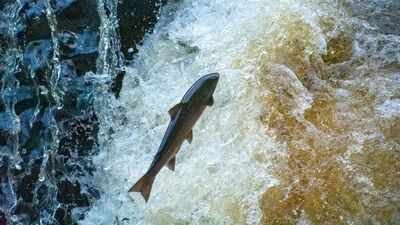
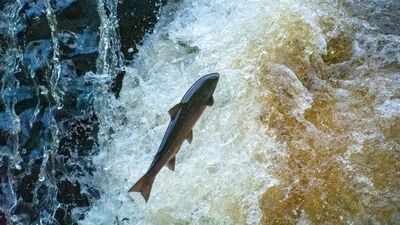
Maine has removed a 60-year-old river barrier on the Narraguagus River where only about 25 wild adult Atlantic salmon return each year, replacing it with a nature-like fishway designed to reopen migration routes for endangered fish. The old ice-control dam in Cherryfield, built by the US Army Corps of Engineers in 1961, long blocked salmon, shad and river herring from reaching upstream spawning grounds. With construction underway since June and completion expected by November, the new stepped channel aims to restore connectivity while still protecting the town from ice jams and flooding, according to reporting by The Maine Monitor.
A river built for salmon, but short on fish
The Narraguagus runs about 40 miles from its source in the downeast lakes to its head-of-tide in Cherryfield. Along much of its length, the river and its tributaries are wild and largely undeveloped, with shaded stretches and rocky bottoms that biologists describe as prime Atlantic salmon habitat. Yet for decades, the salmon have been missing. In recent years, only around 25 wild adult salmon have returned to the Narraguagus annually to spawn, a tiny fraction of the hundreds of thousands that once migrated through Maine’s rivers each spring.Gulf of Maine Atlantic salmon are listed as endangered under the federal Endangered Species Act. Across the state, only about 1,000 adults come back from the sea each year. To move the population from endangered to threatened, Maine would need at least 1,500 wild adults returning each year for multiple years. Full delisting would require around 6,000 wild adults spread across different watersheds, with enough suitable habitat and a growing population.
The last big barrier on the main stem
The Cherryfield dam was the final major obstacle on the main stem of the Narraguagus. The US Army Corps of Engineers built it in 1961 to hold back ice jams that used to flood the town. It had a fish ladder on one side that alewives navigated relatively well, but many salmon and shad struggled to find or use it. Fisheries officials often saw adult salmon gathering below the dam, unable to pass.Over time, inspections showed the structure was aging. The town could not afford to repair or replace it on its own. That opened the door for a coalition of conservation groups, including the Maine Coast Heritage Trust, the Downeast Salmon Federation, the Atlantic Salmon Federation and The Nature Conservancy, to propose a different solution. They suggested replacing the dam with a nature-like fishway that would maintain ice and flood control while allowing fish to move more freely.
From federal dam to community project
Before the replacement could begin, Cherryfield had to take ownership of the dam from the Army Corps. That required a town vote and an act of Congress. In a special meeting in 2023, residents voted unanimously to take over and then take down the dam. Shortly afterward, Congress de-authorized the structure. The project received $9.1 million from NOAA’s Restoration Center as part of the Bipartisan Infrastructure Law, and construction started in June 2026.The new design uses a series of stair-stepping pools that mimic a natural stream channel. This nature-like fishway is intended to slow ice and reduce flood risk without creating the sharp drop and turbulence that blocked fish at the old dam. Alongside the river work, the project is also revamping a nearby park that was rarely used, adding bathrooms, an amphitheater, electricity and a floating dock requested by local children.
Measuring success with shad DNA
Scientists plan to measure the impact of the new fishway using shad as a proxy for salmon and other sea-run fish. Shad are more numerous than salmon in the Narraguagus but are also more sensitive to barriers, so their movement can signal how well the passage is working. Researchers are collecting water samples above and below the dam site and sending them to the University of Maine in Orono to test for shad DNA.Baseline samples taken in spring 2026, before the dam was removed, showed more shad DNA below the Cherryfield dam than above it. The team will repeat the sampling next summer and hopes to see similar concentrations of shad DNA on both sides of the new fishway. If shad begin moving freely, it is a strong sign that salmon, river herring and other species will also benefit.
Climate change and the limits of restoration
Even with the barrier gone, the future of Atlantic salmon in the Narraguagus is uncertain. Maine sits at the southern edge of the species’ range, and the Narraguagus runs warm compared with more northern rivers. Atlantic salmon begin to experience stress when water temperatures rise above 68 degrees Fahrenheit, a threshold the river often exceeds in summer. As summers grow longer and hotter, that thermal stress is expected to increase.Scientists have flown infrared cameras over the river to map temperature variations and identify the coolest stretches and tributaries. Early results suggest that while much of the main stem is warm, some tributaries remain cold enough to support salmon. The new fishway should give more fish access to those refuges, but long-term survival will depend on how quickly the climate changes and whether the population remains large enough to adapt.
Hatcheries as life support
For now, Maine’s remaining salmon population depends heavily on hatcheries. The federal government operates two Atlantic salmon hatcheries in the state, and the Downeast Salmon Federation runs two more. These facilities produce hundreds of thousands of eggs and juveniles that are stocked in rivers each year to prop up wild numbers. In the Narraguagus, scientists estimate that an average of about 1,700 stocked juveniles survive to become smolts, the life stage when they leave for the sea. Of those, only a couple dozen at best return as adults, a survival rate of less than 1 percent.Hatcheries have helped keep Atlantic salmon from extinction, but they have not succeeded in rebuilding self-sustaining wild populations. Biologists describe the system as a life support valve. If that valve were closed today, extinction would become a real possibility. The official federal recovery plan, updated in 2019, estimates that restoring the Gulf of Maine population could take 75 years and cost more than $800 million, while also improving overall watershed biodiversity.
A multi-generational effort
Saving Maine’s salmon has always been a multi-generational project. Ernie Atkinson, a fisheries biologist with the Maine Department of Marine Resources, has studied salmon on the Narraguagus since 1993 and doubts he will see a full comeback in his career. His protégé, Christopher Federico of Project SHARE, began as an intern under Atkinson and now leads a regional coalition of landowners and conservationists working to improve habitat. Federico says he intends to keep working until the team either makes a difference or has no options left.The effort also depends on communities like Cherryfield. Local historian Jacob van de Sande arrived in 1995 to study salmon and tend a trap at the top of the dam’s fish ladder, just as the recreational fishery was ending. Older residents remember Fourth of July gatherings where salmon were caught, grilled and served with fresh garden peas. Selectman Corey Smith, who missed that era by a few years, hopes the population might one day rebound enough to allow recreational fishing again, bringing economic benefits back to town. He acknowledges he may not see it in his lifetime, but believes his children might.
Why this matters beyond salmon
Scientists increasingly see salmon as a indicator species for the health of entire ecosystems. Atlantic salmon evolved alongside other species in their watersheds, from rainbow smelt to river herring, which provide food and cover. Recovery is unlikely to succeed by focusing on salmon alone. Restoring rivers like the Narraguagus also benefits mussels, birds, mammals and the people who depend on clean, functioning watersheds.The removal of the Cherryfield dam and construction of the nature-like fishway will not solve every problem facing Gulf of Maine salmon. Ocean conditions, warming waters and shifts in marine food webs remain major unknowns. But by reconnecting the river and improving habitat, conservationists are buying time and creating the conditions where a comeback becomes possible, even if it unfolds over decades.