


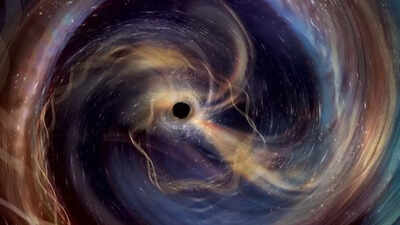
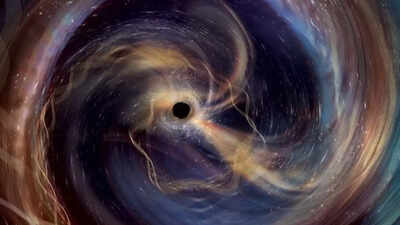
The universe has delivered the loudest gravitational wave ever recorded, and it appears to have given Einstein’s theory of general relativity one of its toughest tests so far. According to the study published in the APS Journal, the signal, known as GW250114, travelled roughly 1.3 billion light-years before reaching Earth. It was produced by the dramatic merger of two black holes, an event so violent it sent ripples through space-time itself. Researchers say the clarity of this detection is unlike anything previously observed.
How loudest gravitational wave detected and what it reveals
As cited in the study published, titled, “Black Hole Spectroscopy and Tests of General Relativity with GW250114”, the signal was detected by scientists working with LIGO in the United States. Since first confirming gravitational waves in 2015, LIGO has continued refining its instruments with each upgrade, and sensitivity improves slightly. The signal was reportedly about three times clearer than earlier detections. Gravitational waves are ripples in space-time caused by massive accelerating objects, such as black holes spiralling into one another. When these waves pass through Earth, they stretch and compress space by tiny amounts.
How Einstein’s theory faced one of its toughest tests yet
The existence of gravitational waves was first predicted in 1915 by Albert Einstein as part of his general theory of relativity. That theory describes gravity not as a force in the traditional sense but as the curvature of space and time caused by mass. With GW250114, scientists were able to put general relativity through another demanding test. Black hole mergers represent some of the most extreme gravitational environments in the universe. After two black holes collide and form a single, larger black hole, the new object vibrates briefly. It rings, almost like a struck bell. These vibrations create distinct tones in the gravitational wave signal.
What the ringdown reveals about black holes
The ringdown phase carries crucial information about a black hole’s mass and spin. By analysing the tones within the gravitational wave signal, scientists can infer properties of the newly formed black hole. GW250114 provided an unusually clean look at these features.Gravitational wave astronomy is still in its early stages. The field is less than a decade old, yet it has already transformed how we observe the cosmos. For now, GW250114 stands as a landmark event. The loudest gravitational wave ever recorded has once again supported Einstein’s century-old theory. It also signals that the era of precision gravitational wave science has truly begun.