


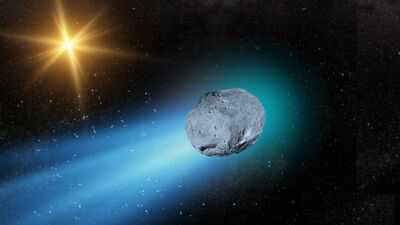
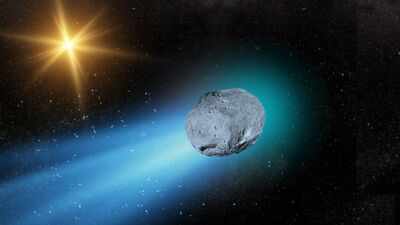
Interstellar comet 3I/ATLAS has given astronomers an opportunity they rarely expect to receive. Unlike the countless icy bodies that circle the Sun, this object formed around another star before drifting into our solar system, carrying frozen material that has remained largely unchanged for billions of years. After passing closest to the Sun in late 2025, its warming surface released gases that allowed NASA’s James Webb Space Telescope to examine its chemical makeup in unprecedented detail. The results suggest the comet originated in a remarkably cold and ancient stellar environment, one that may have existed long before the Sun was born. Rather than simply identifying another visitor from interstellar space, the observations provide an unusually clear glimpse into the conditions that shaped distant planetary systems during the early history of the Milky Way.
NASA James Webb Space Telescope reveals Interstellar comet 3I/ATLAS’s ancient chemistry
Only three confirmed interstellar comets have ever been identified travelling through our solar system, making every observation an unusually valuable event. Unlike ordinary comets, which remain bound to the Sun by gravity, 3I/ATLAS arrived from another planetary system before continuing on a one-way journey through interstellar space.The comet was first detected by the Asteroid Terrestrial-impact Last Alert System (ATLAS), which also gave it part of its name. As it rounded the Sun during 2025, astronomers realised they had a brief opportunity to investigate material that had spent billions of years beyond the reach of our own star.The most productive time to study the comet came after it had begun moving away from the Sun. Heat from its close approach caused frozen material beneath the surface to vaporise, surrounding the nucleus with a cloud of gas known as a coma. Those escaping gases contained molecules that had remained locked inside the comet since its formation.NASA interrupted part of the James Webb Space Telescope’s observing schedule so its Near-Infrared Spectrograph (NIRSpec) could examine the expanding cloud. Rather than producing ordinary photographs, the instrument separated light into detailed spectra, allowing astronomers to identify specific chemical compounds and isotopes within the gas.
What the comet’s ancient ice revealed about its origins
Among the first surprises was the amount of deuterium detected in the comet’s water. Deuterium is a heavier form of hydrogen and acts as an important indicator of the temperatures at which ice originally formed.The measurements showed around thirty times more deuterium than scientists normally find in comets belonging to the solar system. Such an unusually high abundance suggests the comet developed in an environment that remained intensely cold, allowing its original chemistry to survive without being altered by prolonged warming.The findings indicate that the frozen material making up 3I/ATLAS has remained largely unchanged since the earliest stages of its existence, preserving conditions that disappeared long ago in many younger planetary systems.
Interstellar comet 3I/ATLAS revealed clues through its carbon isotopes
The telescope also examined different forms of carbon, producing another unexpected result. The comet contains relatively little carbon-13 compared with the lighter carbon-12 isotope.Astronomers know that galaxies gradually become richer in carbon-13 as successive generations of stars produce heavier elements and release them into space. Because of that process, younger stellar systems generally contain larger amounts of carbon-13 than older ones.The low abundance measured inside 3I/ATLAS suggests it formed before much of that enrichment had taken place. Combined with the hydrogen measurements, the chemical evidence points towards an object that originated billions of years before our own solar system.
What the comet’s age reveals about the early Milky Way
Using the isotope measurements, scientists estimate that the comet may have formed between 10 and 12 billion years ago. If that estimate is correct, its birthplace existed during a period when star formation across the universe was occurring at a much higher rate than it does today.The parent system is thought to have been surrounded by a dense cloud of extremely cold gas and dust. In that environment, ice could accumulate while preserving chemical signatures that remain visible even after billions of years drifting through interstellar space.Rather than representing an unusual process, 3I/ATLAS may be preserving conditions that were common during the early history of the Milky Way but have become increasingly difficult to observe directly.