


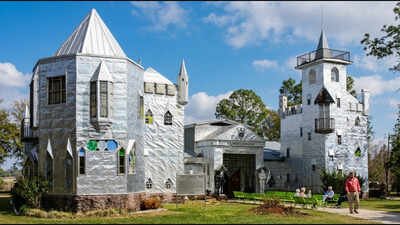
In 1972, Howard Solomon set out to build a quiet retirement home in rural Florida, but the land he chose was far from ordinary. Instead of a conventional building site, he found a swamp, yet the challenging terrain did little to discourage him. Solomon adapted his plans and began constructing upwards, slowly transforming the property into a striking three-storey, medieval-style castle. What started as a personal home-building project continued for more than four decades, expanding into a remarkable 12,000-square-foot maze of towers, stained glass, sculptures, workshops and curious handmade details. The castle’s most distinctive feature is its gleaming exterior, which gives the structure an almost otherworldly appearance. Rather than using conventional siding, Solomon covered much of the building with discarded aluminium printing plates that had once been used by a local newspaper. The unusual material was inexpensive, durable and perfectly suited to his passion for transforming unwanted objects into imaginative works of art.
How Howard Solomon turned a Florida swamp into a 12,000-square-foot castle of folk art
Solomon bought his land in 1972 after returning to the United States from the Bahamas, choosing an inexpensive stretch of Florida wilderness near Ona. As per Atlas Obscura, he had initially envisioned a more conventional home, but the swampy ground made building horizontally difficult. Rather than abandon the project, he changed direction and began constructing upwards. The result gradually took on the appearance of a medieval fortress, complete with turrets, a drawbridge, towers and a moat. The building was never designed from a finished architectural plan. Solomon worked on it incrementally, using his skills in woodworking, metalwork, glass and construction to transform his ideas into physical form. What began as a retirement home became a constantly evolving piece of folk art. By the time of his death in 2016, the structure covered around 12,000 square feet and had become both a home and a gallery for his creations.

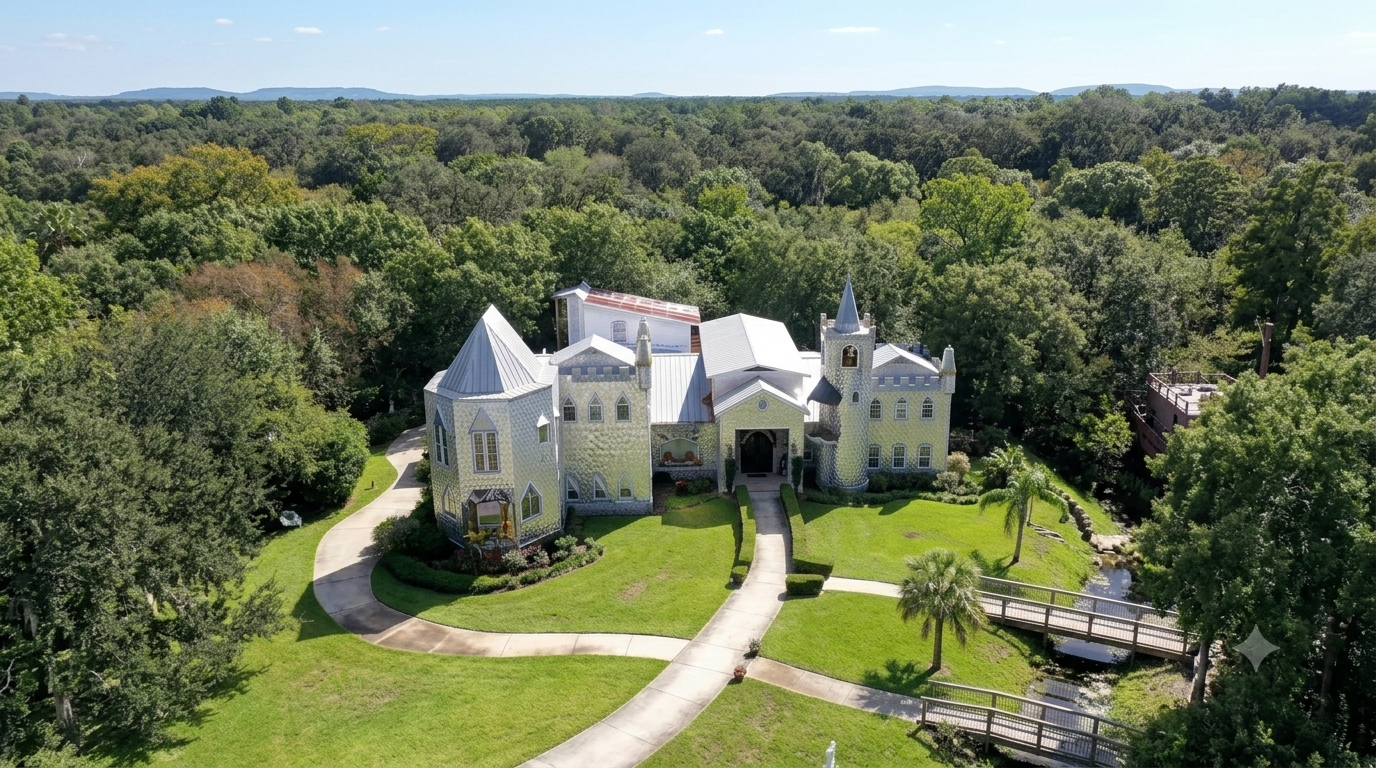
How Howard Solomon turned a Florida swamp into a 12,000-square-foot castle of folk art (Image: FOX 13 Tampa Bay)
Why Solomon’s Castle is covered in discarded newspaper printing plates
The castle’s extraordinary silver exterior is what makes it immediately recognisable. Instead of conventional stone or brick cladding, Solomon covered the structure with aluminium offset printing plates discarded by a local newspaper. The unusual material gave the building a bright, metallic appearance, while allowing Solomon to transform something destined for the rubbish into part of his enormous artwork. The idea was particularly suited to Solomon’s approach to making art from objects other people no longer wanted. He used reclaimed materials throughout the property, turning junk and industrial leftovers into sculptures and architectural details. The printing plates were reportedly purchased for just 25 cents apiece, making them an inexpensive solution as well as a creative one. Over time, thousands of these plates became part of the castle’s identity, their blank surfaces reflecting Florida’s intense sunlight.
From retirement home to Florida’s strangest roadside castle
Solomon’s project eventually became much more than a private residence. The castle developed into an attraction filled with his whimsical sculptures, many assembled from discarded machinery, automotive parts, oil drums, wood and other found objects. His creative philosophy was simple, keep making things and find another use for materials that others had thrown away. The property also grew beyond the main building. A 60-foot replica of a 16th-century Portuguese galleon sits in the moat and became the Boat in the Moat restaurant, while the grounds contain additional artworks and unusual structures. The castle’s interior became a gallery of Solomon’s work, preserving decades of experimentation under one roof. What makes Solomon’s Castle remarkable is that it was never simply intended to imitate a medieval fortress. It was a personal experiment that kept expanding for decades. A retirement home built on difficult swampy ground became a shining three-storey landmark, proving that an impractical idea can sometimes become an extraordinary work of art.