


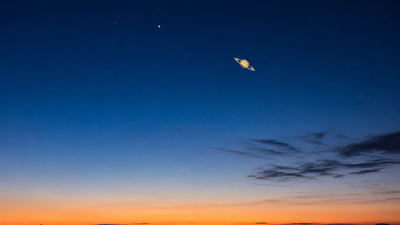
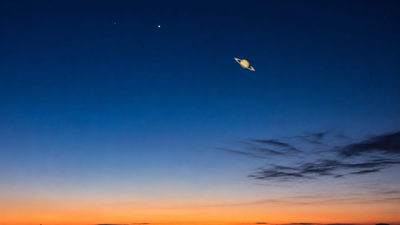
For much of the summer, planet watchers have had to contend with bright dawn skies and awkward viewing angles. Several planets are beginning to emerge from the Sun’s glare, yet many remain difficult to pick out before sunrise. Saturn, however, gradually becomes easier to find as July progresses. By the end of the month, the ringed giant climbs higher above the horizon and spends more time in darker skies before dawn, creating noticeably better opportunities for observation.Throughout July, the rings remain tilted by roughly nine degrees, with Saturn’s southern hemisphere angled towards Earth. This is a considerable improvement compared with conditions seen near the end of 2025, when the rings appeared almost edge-on and were far less striking through amateur instruments.Early risers will still need clear horizons and some patience during the first half of the month, but Saturn’s position steadily strengthens. According to the BBC, the planet reaches a more favourable altitude by late July, allowing observers to view it under darker conditions before twilight begins to dominate the sky.
Where to see Saturn in July 2026: Skywatching tips for early July mornings
The opening days of July are not especially kind to Saturn observers. The planet appears low above the eastern horizon during the early hours, competing against increasing twilight. Around 02:30 BST (01:30 UT) at the beginning of the month, Saturn sits only modestly above the horizon, making it vulnerable to atmospheric haze and poor seeing conditions.Even so, it remains bright enough to be identified once located. Saturn shines at approximately magnitude +0.7 during this period and can be found in the constellation of Pisces. Low-altitude observations often suffer from unstable air. Light from the planet must pass through a thicker section of Earth’s atmosphere when viewed close to the horizon, causing fine details to shimmer or blur. For telescope users, this can make the difference between a sharp view of the rings and a soft, wavering image.
7–8 July could be the best time to watch Saturn
The Moon provides a useful marker during the first full week of the month. On the mornings of 7 and 8 July, the last-quarter Moon passes close to Saturn in the predawn sky. While the two objects are separated by a considerable physical distance, their apparent proximity from Earth’s perspective creates an easy reference point for observers who may be searching for Saturn for the first time.The pairing should be visible from many locations with an unobstructed eastern horizon. Binoculars will comfortably frame both objects, while telescopes can then be directed towards Saturn for a closer examination. By the middle of the month, the planet is already showing signs of improvement. Saturn rises shortly after midnight BST and reaches an altitude of around 23 degrees by approximately 03:00 BST (02:00 UT). Those extra degrees above the horizon may sound insignificant, yet they often translate into noticeably steadier views. Planetary observers routinely wait for targets to gain altitude before beginning serious observations, as atmospheric distortion decreases the higher an object climbs. The difference becomes increasingly apparent as July continues. Each morning Saturn appears slightly earlier and slightly higher, gradually moving into a position that favours extended observation sessions before dawn.
Why 31 July 2026 offers the best Saturn views of the month
The final days of the month mark the beginning of a much stronger observing season for Saturn. On 31 July, around 03:00 BST (02:00 UT), the planet reaches roughly 30 degrees above the southeastern horizon. At this height, observers are looking through substantially less atmosphere than they were at the beginning of the month, improving the chances of obtaining a crisp telescopic image.BBC notes that this late-July position effectively signals the start of a more rewarding period for Saturn observation that will continue over the coming months. By then, the planet has also brightened slightly to magnitude +0.6.The increase in brightness is modest, but combined with the improved altitude and darker observing conditions, it makes Saturn a considerably more attractive target than it was only a few weeks earlier.
Best equipment for observing Saturn in July 2026
Saturn remains one of the most rewarding objects for small telescopes. Instruments with apertures of around 75mm can already reveal the planet’s famous rings, while larger telescopes begin to show atmospheric banding across the disc and some of its brighter moons.Steady atmospheric conditions are often more important than sheer magnification. On nights of calm air, even moderate equipment can deliver impressive views, whereas larger telescopes may struggle when turbulence is severe. Binoculars are unlikely to reveal ring detail, but they can still help observers locate the planet and follow its movement among the background stars. A modest telescope is enough to reveal the ring structure under good conditions. Even small instruments can separate the rings from the planet’s disc, while larger apertures begin to show subtle variations in brightness and more detail across the globe itself.