


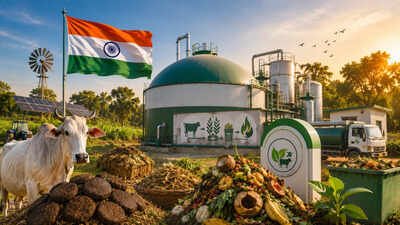
For years, India has spoken about the enormous amount of energy locked inside its agricultural residue, cattle dung and organic waste. The challenge has been turning that potential into a commercially viable industry.Now, the government is making one of its most serious attempts yet.The Union Cabinet on August 6 approved GOBARdhan, the National Circular Bioenergy Scheme, with a total outlay of Rs 23,731 crore for FY 2026-27 to FY 2035-36. The scheme has set a target of ten-fold increase in domestic production of Compressed Biogas (CBG) and brings together everything from assured demand and pricing to capital assistance, pipelines and credit under a single framework.The idea sounds simple: take waste that would otherwise be burnt, dumped or left to decompose, and process it in a biogas plant and turn it into fuel that can be used much like natural gas.

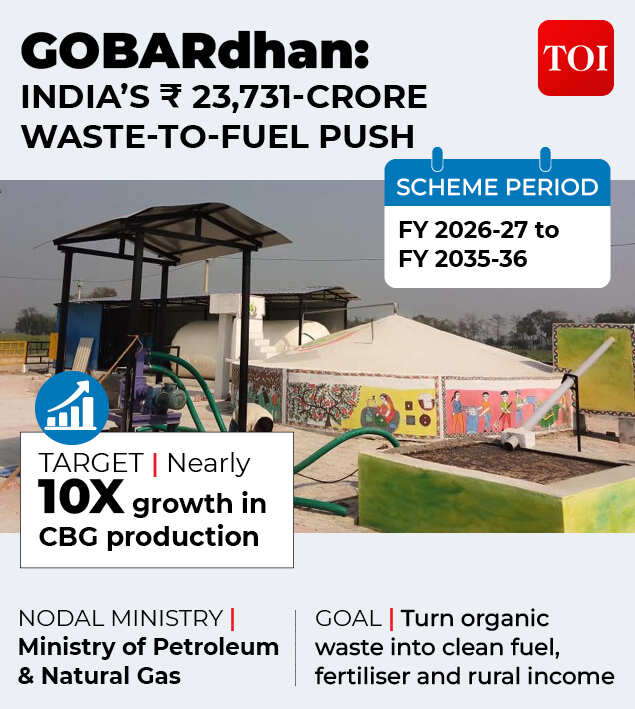
The initiative aims to increase nation’s CBG production
But the government’s ambition goes much further.It wants villages to become centres of energy production, farmers to become suppliers to the energy industry and organic waste to become an economic resource rather than a disposal problem.The question is whether the new scheme can solve the problems that have held back India’s CBG industry for years.
What exactly is GOBARdhan?
GOBARdhan is not an entirely new idea.The initiative was originally launched in 2018 under the Swachh Bharat Mission-Grameen as a waste-management programme. Its focus was on converting cattle dung, kitchen waste, crop residue and other organic material into biogas and bio-slurry, helping villages manage waste while generating useful products.The 2026 version is much broader.The government has now positioned GOBARdhan as a national framework for the Compressed Biogas industry, bringing several existing measures under one umbrella and placing the scheme under the ministry of petroleum and natural gas.These include the Sustainable Alternative Towards Affordable Transportation (SATAT) initiative, the Market Development Assistance scheme for organic manure, the Biomass Aggregation Machinery scheme, pipeline infrastructure support and central financial assistance for CBG plants.In simple terms, the government is moving from “how do we manage organic waste?” to “how do we build an industry around it?”
How does waste become fuel?
The process begins with organic material such as cattle dung, agricultural residue, press mud from sugar mills and municipal organic waste.This material is fed into an anaerobic digester, where microorganisms break it down in the absence of oxygen and produce biogas. The raw biogas contains methane along with carbon dioxide and other impurities.The gas is then purified to remove these impurities and compressed.

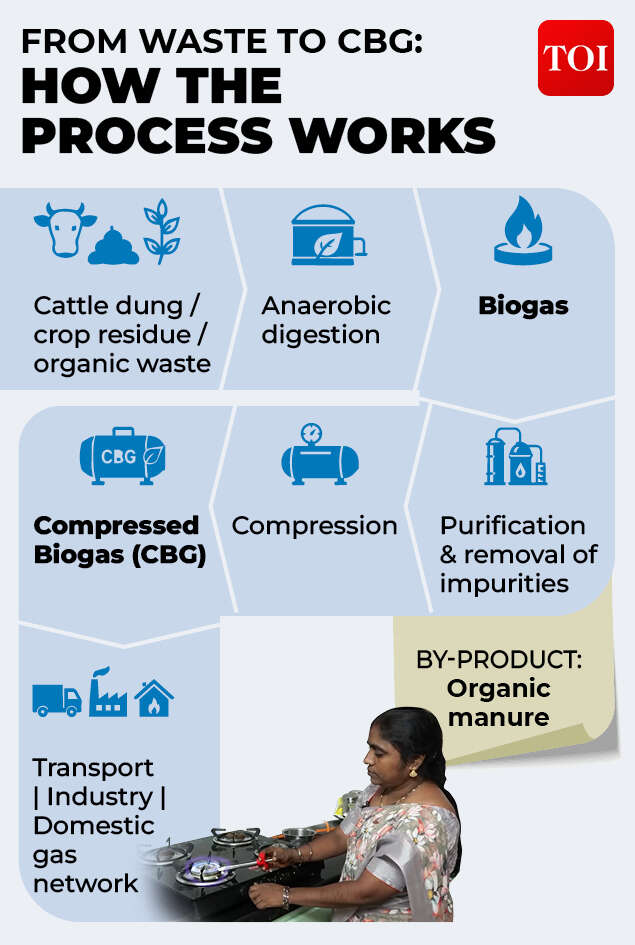
Production process of CBG
The resulting Compressed Biogas, or CBG, has properties comparable to natural gas and can be used within the existing gas ecosystem. This is one of its biggest advantages: India does not necessarily need to create an entirely separate fuel infrastructure for it.The process also produces organic material that can be processed into fertiliser.That means one plant can potentially create several economic outputs:Waste → CBG + organic manure + rural jobs + additional income opportunitiesThis is the circular economy the government is trying to build.
Why does India need CBG?
The biggest reason is energy security.India currently imports nearly 50% of its natural gas requirement, according to the government’s latest GOBARdhan backgrounder. That leaves the country exposed to international gas prices, shipping disruptions and geopolitical shocks.Domestic CBG offers a way to produce a portion of that gas from resources that India already has in abundance.

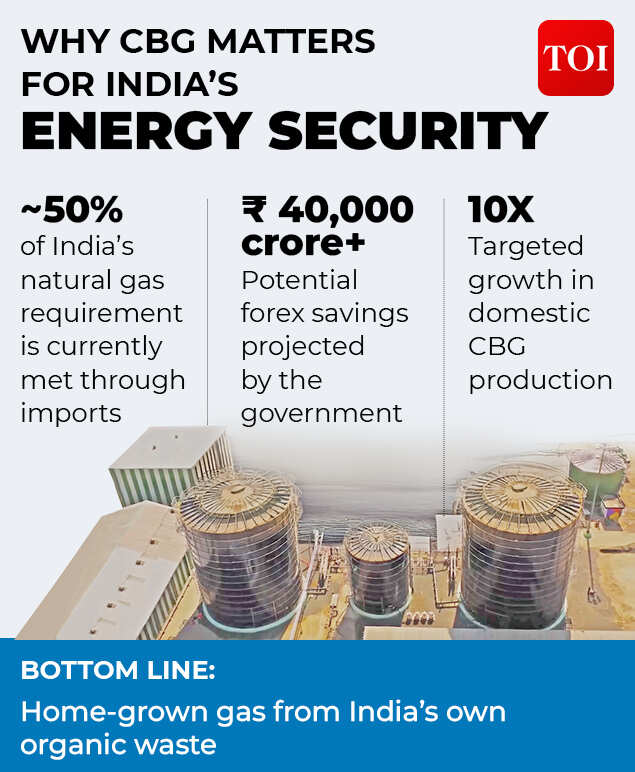
Importance of CBG for India
The government estimates that lower dependence on imported fossil fuels under GOBARdhan could eventually save more than Rs 40,000 crore in foreign exchange. That is a government projection rather than a guaranteed saving, but it illustrates the scale of the ambition.There is also an environmental argument.Agricultural residue that is not economically used can become a waste-disposal problem, while organic waste dumped in landfills can generate methane and other emissions. Converting such material into fuel gives it an economic value while potentially reducing waste-related emissions.For farmers, the attraction is an additional market for residue and dung.For energy companies, it is another source of domestic gas.For the government, it is a way of connecting waste management, rural development and energy security.
India has tried CBG before. So what went wrong?
This is where the GOBARdhan story becomes more complicated.India’s push for CBG production predates the new scheme by several years.The government launched SATAT in October 2018, with an ambitious target of establishing 5,000 CBG plants producing 15 million tonnes a year.But the industry struggled to scale at the pace initially envisaged.A 2022 review by the Parliamentary Standing Committee on Petroleum and Natural Gas found that against the target of 5,000 plants by 2023-24, only 40 had been set up at that point. The committee also highlighted problems with financing, multiple approvals, pricing and feedstock availability.One of the biggest problems was that a CBG plant needs much more than a piece of land and a digester.It needs a reliable supply of biomass, equipment to collect and transport that biomass, storage facilities, technology, financing and, crucially, a buyer for the gas.One big complication with agricultural residue is that it is seasonal.Crop waste may be available in large quantities for only a few months of the year, forcing plants to invest in storage and logistics if they want to operate throughout the year. The parliamentary committee specifically flagged this issue.Bansal estimates that India generates around 230 million tonnes of surplus agricultural residue annually, suggesting that the problem is not a shortage of biomass but the difficulty of turning dispersed and seasonal supplies into a reliable, year-round feedstock chain.GOBARdhan’s focus on biomass mapping, aggregation infrastructure and district-level planning is therefore critical to making plants operate at high utilisation.There was also a financing problem.Banks and investors were wary of projects whose revenues depended on uncertain feedstock supplies and evolving CBG prices. The committee noted concerns over the low internal rate of return of plants and called for more remunerative pricing.This is the gap GOBARdhan is now attempting to close.Kapil Bansal, partner, energy transition and decarbonization at EY-Parthenon India, told TOI that the biggest change is that GOBARdhan tackles the entire CBG value chain rather than individual bottlenecks.Earlier measures addressed issues such as biomass aggregation, organic manure, pipelines and financial assistance separately, but developers continued to face uncertainty around demand, pricing and financing.“The sector is moving from a project-led approach to a market-led approach, where demand, pricing and financing visibility are available before developers invest,” Bansal said.The combination of assured offtake, a ten-year pricing framework, capital assistance, pipeline connectivity and credit guarantees, he said, should improve project bankability and give investors greater confidence.
What changes under the Rs 23,731-crore scheme?
The government has structured GOBARdhan around six major components, each designed to address a different weakness in the existing CBG ecosystem.

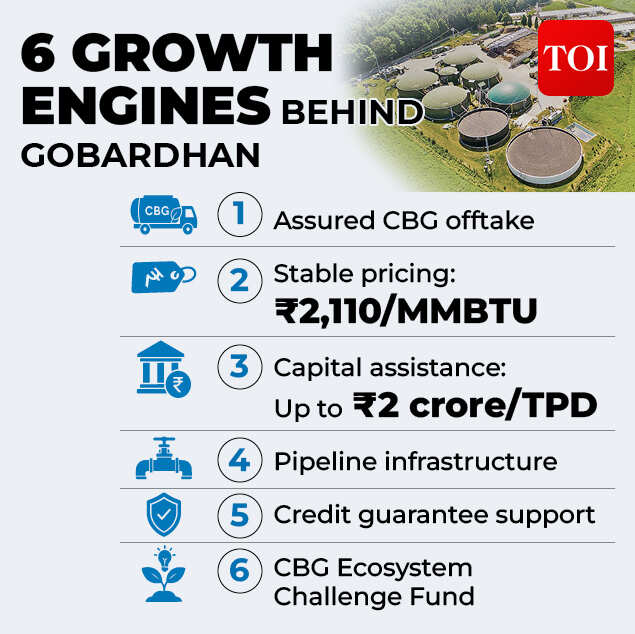
New changes introduced in the upgraded scheme
1. Assured demand for CBGPerhaps the biggest change is that producers will have greater certainty that someone will buy their gas.City Gas Distribution companies will procure CBG in line with a notified obligation that rises from 3% in FY 2026-27 to 4% in FY 2027-28 and 5% from FY 2028-29 onwards for the CNG transport and PNG domestic segments.This creates a predictable demand signal.For investors, that matters because a plant is much easier to finance when there is greater clarity about who will buy its output.
2. A stable price
GOBARdhan introduces a government-backed CBG price of Rs 2,110 per MMBTU, with a minimum ten-year framework.The objective is to give producers greater revenue visibility and make projects more attractive to investors and lenders.This directly addresses one of the problems identified in the earlier CBG ecosystem: uncertainty over whether the economics of a plant would work after it was built.
3. Capital assistance
Eligible greenfield CBG projects will receive capital assistance of up to Rs 2 crore for every tonne per day (TPD) of installed capacity.Importantly, the support is not restricted to the core plant.It can also cover critical assets linked to feedstock aggregation, organic manure processing and value addition. Brownfield projects expanding existing capacity will also be eligible.That matters because the economics of CBG depend on the entire supply chain, not just the digester.
4. Pipelines to connect plants with buyers
A CBG plant cannot be commercially successful if its gas cannot reach the market.GOBARdhan therefore provides for cluster-based and standalone pipeline infrastructure connecting plants with trunk pipelines and City Gas Distribution networks.The aim is to reduce evacuation costs, improve reliability and expand the market available to producers.
5. Credit guarantees
The scheme also attempts to solve the financing problem through a dedicated credit guarantee mechanism.By sharing part of the lending risk, the government hopes banks will be more willing to finance MSME-based CBG projects.This could bring smaller companies, cooperatives, women entrepreneurs and first-time developers into an industry that has so far been dominated by larger players and institutional initiatives.
6. A district-level ecosystem fund
The final component focuses on the problem that often receives the least attention: where will the feedstock come from?The CBG Ecosystem Challenge Fund will support biomass mapping, aggregation infrastructure, district-level development plans, technology adoption, process improvements and organic manure value addition.The objective is to build the local ecosystem around each plant rather than treating the plant as an isolated piece of infrastructure.
What does this mean for farmers?
The government’s larger pitch is that farmers should become participants in India’s energy economy.Crop residue and cattle dung can become feedstock for CBG plants, creating potential additional income for farmers and local aggregators.The benefit does not stop with the gas.

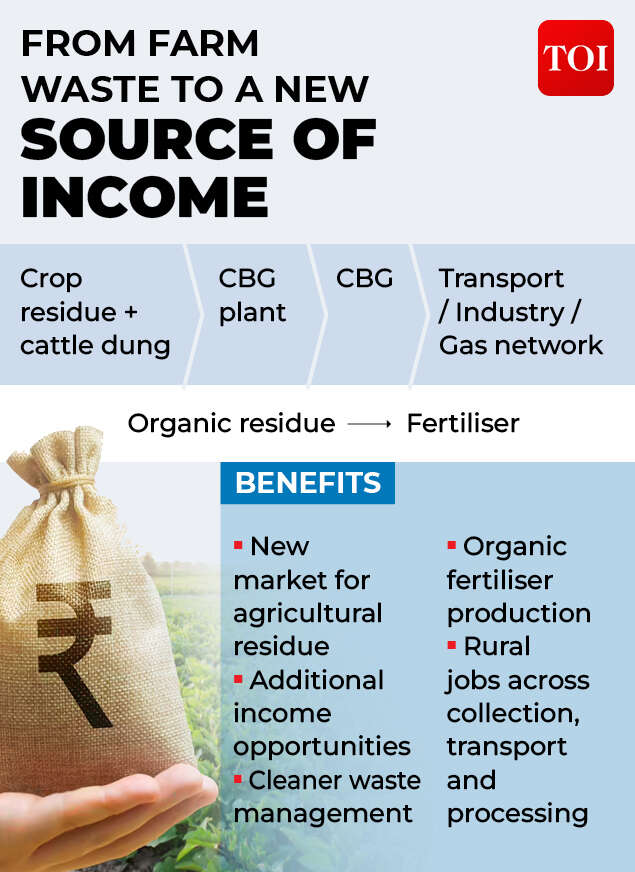
Scheme to empower the farmers
The material left after the biogas production process can be processed into organic fertilisers such as Fermented Organic Manure and Liquid Fermented Organic Manure.This creates a second revenue stream while returning nutrients to agriculture.The government has already been supporting this side of the industry through the Market Development Assistance scheme. Together, these measures are intended to create a cycle in which agricultural and livestock waste becomes an input for both energy and agriculture.That is why GOBARdhan is being presented as more than an energy scheme.It is also a rural infrastructure and waste-management programme.
How big is India’s CBG industry today?
This is perhaps the most revealing part of the government’s latest numbers.As of August 6, the GOBARdhan Unified Registration Portal had recorded 1,908 registered CBG/Bio-CNG plants. Of these, 217 had been commissioned, while another 339 were under construction, according to the government.The numbers show both the opportunity and the problem.

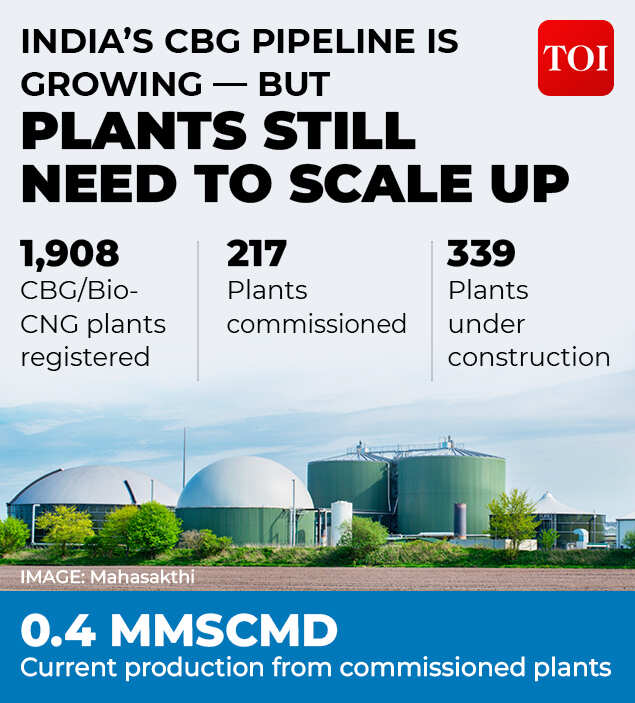
Current capacity of CBG in the country
There is considerable interest in building CBG capacity, but the number of plants actually operating remains far below the number registered.The government says the various initiatives introduced over recent years have helped commission more than 200 CBG plants and establish the initial production and offtake ecosystem. GOBARdhan is now intended to take that foundation to a national scale.In other words, the new scheme is not starting from zero.It is an attempt to make the existing pipeline of projects commercially viable and scalable.
Can GOBARdhan finally make CBG commercially viable?
That remains the biggest question.Government support can reduce the initial cost of a plant and create a market for its gas. But it cannot eliminate the fundamental logistical challenge of collecting biomass.Bansal cautioned that commercial viability will still vary from project to project because feedstock costs, transportation distances, plant utilisation and financing costs will continue to determine returns.

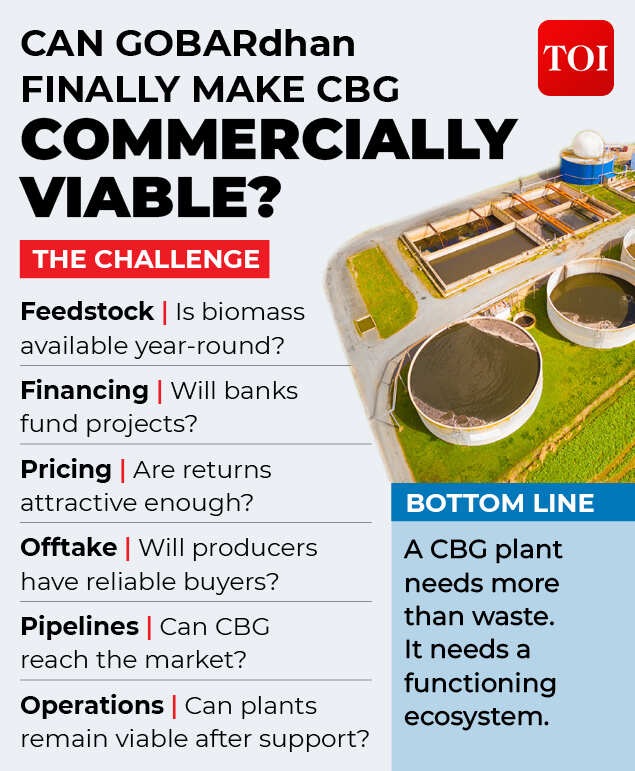
“A project with reliable access to high-quality feedstock can achieve significantly better plant efficiency and returns than a project relying on dispersed or lower-yield biomass resources,” he said.A plant located far from its feedstock source may face high transportation costs. Agricultural residue is seasonal. Competing uses for biomass can raise prices. Plants also need to maintain reliable operations and consistent gas quality.These problems were highlighted by the Parliamentary Standing Committee even before the latest scheme was announced. It pointed to the uneven availability of feedstock, the need for storage and the importance of synchronising CBG production with the national gas grid.This is why the six components of GOBARdhan matter together.A subsidy without a buyer does not solve the problem.A buyer without a pipeline does not solve the problem.A pipeline without reliable feedstock does not solve the problem.And a plant with all three still needs affordable financing and efficient operations.GOBARdhan is effectively trying to solve all of these problems at the same time.
What could India get by 2035-36?
The government has set an ambitious ten-year vision.It expects GOBARdhan to deliver nearly ten-fold growth in domestic CBG production, attract large private investment, create rural employment and expand the organic fertiliser economy. It also projects lower fossil-fuel use and significant reductions in greenhouse gas emissions.These are targets and government projections, not guaranteed outcomes.The more important test will be whether the number of operating plants grows alongside registrations, whether plants remain viable after initial assistance and whether farmers and local businesses actually benefit from the new demand for biomass.If that happens, GOBARdhan could change the economics of waste in India.Instead of paying to collect, transport and dispose of organic waste, communities could potentially build local industries around it.
The bigger picture
India’s CBG journey has already shown that having abundant biomass is not enough.The country had an ambitious 5,000-plant target under SATAT, but financing constraints, feedstock logistics, approvals, pricing uncertainty and weak project economics slowed the industry’s development.GOBARdhan is the government’s attempt to address those weaknesses through one national framework.At Rs 23,731 crore over ten years, the bet is substantial.But the real significance of the scheme is not the size of the allocation. It is the attempt to connect India’s farms, villages, waste streams and gas networks into one economic system.
Share your thoughts in the comments
Be respectful · TOI community guidelines
If the model works, cattle dung and crop residue will no longer be treated merely as waste. They could become feedstock for a domestic fuel industry, while the by-products return to farms as organic fertiliser.That would turn the government’s “waste-to-wealth” slogan into a functioning business model.The challenge is making sure the economics work beyond the subsidy period.For GOBARdhan, success will therefore not be measured simply by how much money is spent or how many plants are registered. It will be measured by how many plants actually operate, how much CBG they produce, whether farmers earn from supplying biomass and whether India’s dependence on imported gas falls.India has plenty of waste. GOBARdhan now has to prove that it can turn that waste into a dependable source of energy, income and economic value.