


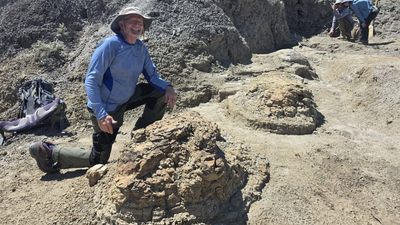
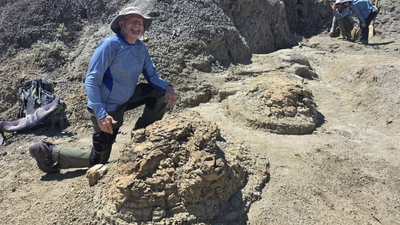
A high school science teacher exploring a fossil-rich region of North Dakota made a discovery that could change what scientists know about how adult Tyrannosaurus rex moved. In 2025, Kent Hups spotted unusual impressions while volunteering on a fossil dig in the Hell Creek Formation. What initially appeared to be a possible dinosaur footprint led researchers to identify a sequence of four giant, three-toed tracks stretching approximately 23 feet. The findings, published in the Journal of Vertebrate Paleontology on September 8, 2026, describe the first reported trackway likely attributable to an adult T. rex. Dating back approximately 66.5 million years, the footprints offer a rare glimpse into the movement of one of the most recognisable predators of the Cretaceous period.
How a high school discovered four giant footprints
Kent Hups was exploring the Hell Creek Formation in southwestern North Dakota when he noticed an unusual shape emerging from the ground. He had been searching for fossils and geological features, rather than specifically targeting T. rex footprints. According to reports, Hups was volunteering on a fossil dig led by palaeontologist Tyler Lyson. While navigating the rugged terrain, he spotted a hardened sandstone formation that resembled giant dinosaur toes. He began measuring the impressions and examining their angles, which strengthened his suspicion that he had found a genuine dinosaur track. Hups described the experience as an unforgettable moment. His initial observation led to a scientific investigation involving researchers from the Denver Museum of Nature & Science and Liverpool John Moores University.
Four footprints reveal a prehistoric walking trail
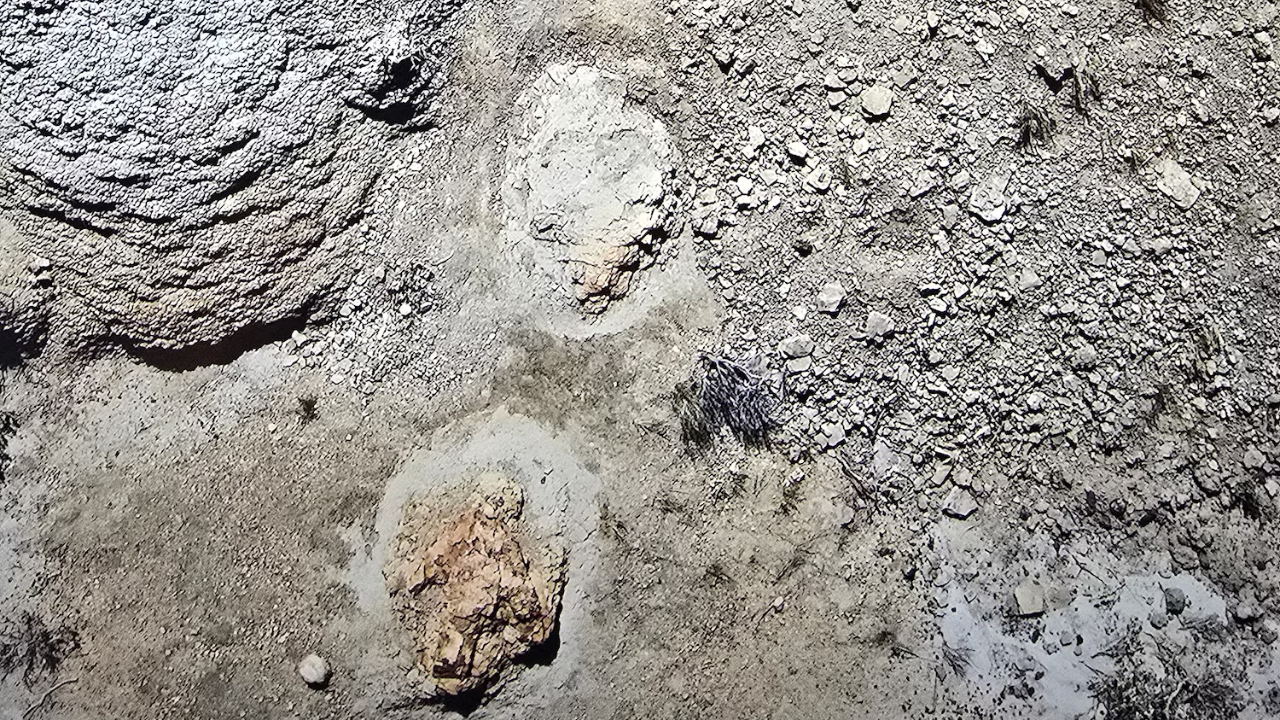
The researchers documented four large, three-toed footprints extending across a trackway approximately 23 feet long. Each print measures around 3 feet in length, or roughly 1 metre. The sequence contains two left and two right footprints, offering evidence of successive steps taken by the animal. The tracks were discovered on federal land administered by the US Forest Service near Marmarth, North Dakota, within the fossil-rich Hell Creek Formation. The study estimates that they formed approximately 66.5 million years ago, near the end of the Cretaceous period. Unlike an isolated impression, the connected prints preserve a record of an animal moving through its ancient environment.

Why researchers linked the footprints to an adult T. rex
Determining which dinosaur made a fossilised footprint can be challenging because different species may leave similar impressions. The research team identified an adult T. rex as the most likely trackmaker based on the tracks’ exceptional size, narrow toes and the abundance of T. rex fossils in the surrounding area. The researchers also compared them with footprints made by other possible trackmakers, including hadrosaurs such as Edmontosaurus annectens. These dinosaurs could produce large three-toed impressions, but their tracks generally have broader digital impressions and different proportions. The paper describes the identification as likely attributable to an adult Tyrannosaurus rex. It also notes that the surfaces are poorly preserved, limiting the anatomical detail available for identification. The finding represents the first reported trackway likely attributable to an adult T. rex, rather than an identification based on a complete fossilised foot.
The footprints reveal how the dinosaur moved
The spacing between the prints allowed researchers to estimate the animal’s walking speed. The strides measure approximately 13 feet, and the study calculates a pace of around 1.5 to 2 metres per second, equivalent to approximately 3.4 to 4.5 miles per hour. This is broadly comparable to a brisk human walking pace. The estimate provides insight into how an adult T. rex may have travelled across its environment, although it cannot establish what the animal was doing at the time. The footprints do not reveal whether it was pursuing prey, avoiding danger or simply crossing the landscape. They preserve a sequence of steps that can be analysed to understand locomotion, adding behavioural evidence to a fossil record largely built around bones and teeth.
3D scanning helps scientists preserve the discovery
Researchers used high-resolution 3D surface scanning to document the prints and create digital models for detailed analysis. Peter Falkingham, professor of palaeobiology at Liverpool John Moores University and the study’s lead author, described how the digital information could be transferred from the field for computer-based visualisation and virtual reality analysis. The scans also support the creation of physical reproductions for research and education. The footprints are preserved as fine-grained sandstone concretions cemented with calcium carbonate, which made the casts harder than the surrounding rock and helped them survive erosion. However, the surfaces are heavily fractured and retain limited anatomical detail. Digital documentation provides a detailed record of the remote site while reducing the need to repeatedly handle the original fossil surfaces.
The significance of the discovery
Tyrannosaurus rex has been studied extensively through its fossilised skeletons, but trackways offer a different kind of evidence by preserving movement and the spacing between steps. Tyler Lyson, senior curator of vertebrate palaeontology at the Denver Museum of Nature & Science, highlighted how footprints can capture moments of behaviour that bones cannot reveal. Although isolated footprints have previously been attributed to adult T. rex, the researchers state that a sequence likely attributable to an adult of the species had not previously been reported. The museum has announced plans to recover three of the footprints and transport them to Denver for preparation and further research. The recovery, tentatively planned for autumn 2026, is expected to require a helicopter because of the remote location. The museum also intends to share updates about the work with visitors.