


Coral reefs are often called the rainforests of the sea, but across the Caribbean, many of them are struggling to survive. Along with warming oceans and habitat loss, bacterial diseases have become a growing threat, capable of wiping out large sections of coral in a short time. Now, researchers in Florida have tested an unusual way to fight back, not with antibiotics, but with bacteria that naturally prey on other bacteria.According to a study published in The ISME Journal, about 57% of the endangered Caribbean coral fragments treated with these microscopic predators showed no bleaching beyond the point where the infection was introduced. While the work is still at an early stage, it suggests that using beneficial bacteria could become a more targeted way to protect corals from disease.
Can one bacterium stop another?
To explore that question, the researchers worked with staghorn coral (Acropora cervicornis), one of the Caribbean’s most important reef-building corals and a species now listed as critically endangered.In laboratory experiments, healthy coral fragments were deliberately exposed to Vibrio coralliilyticus, a bacterium known to cause disease in corals, especially when ocean temperatures are high. Once the infection was established, some of the coral fragments received a dose of Halobacteriovorax, a naturally occurring marine bacterium that survives by hunting and feeding on other bacteria.The scientists then watched what happened over the next several days. They tracked how far the infection spread, measured tissue loss and bleaching, and analysed whether introducing the bacterial predator disturbed the coral’s natural community of beneficial microbes. The goal wasn’t simply to kill harmful bacteria. It was to find out whether the disease could be controlled without upsetting the delicate microbial balance that healthy corals rely on.

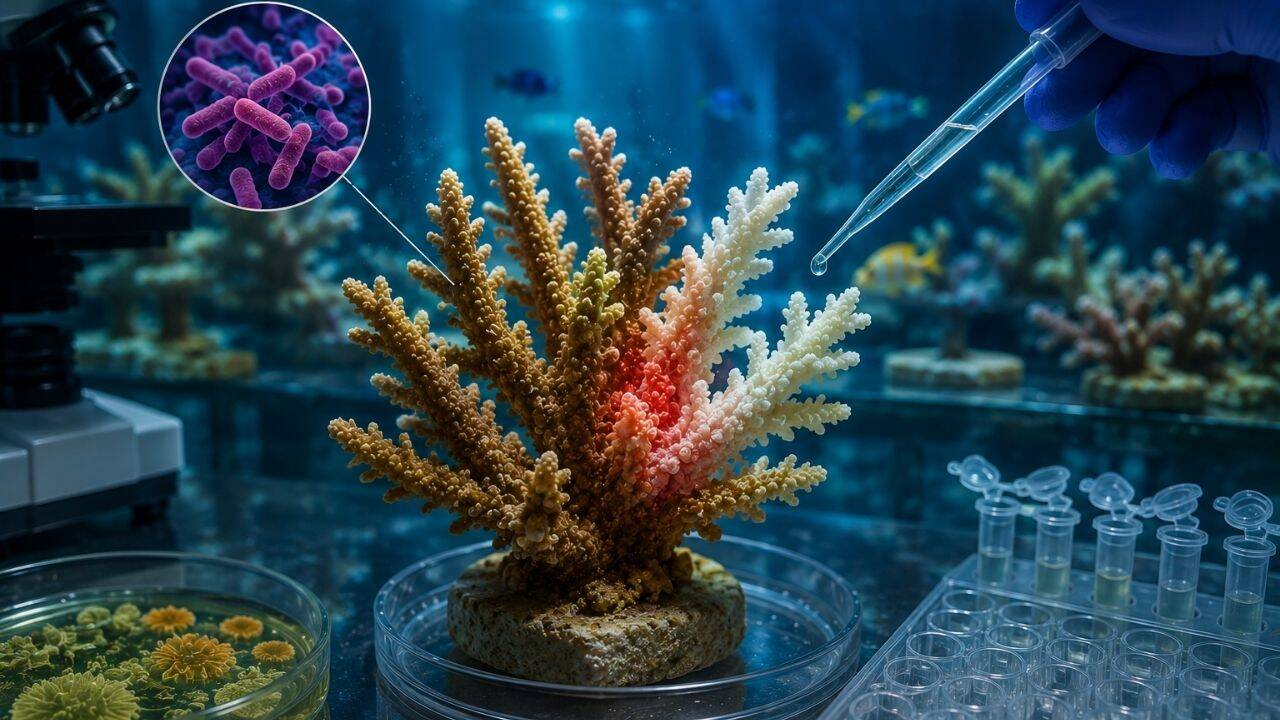
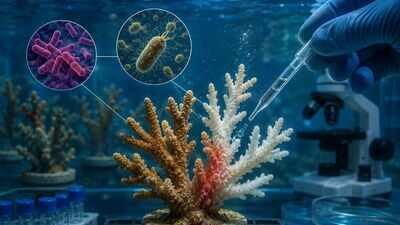
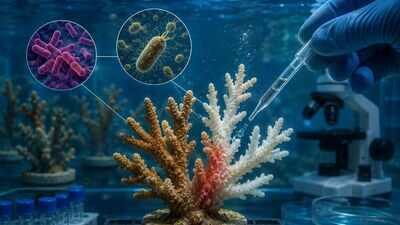
Representative Image (AI-generated)
Disease remained confined in many treated corals
The results were encouraging. In 57% of the coral fragments treated with Halobacteriovorax, bleaching remained confined to the original infection site. In other words, the disease showed little sign of moving through the rest of the coral.Untreated corals told a different story. Once infected with Vibrio coralliilyticus, they generally developed more extensive tissue damage and bleaching, showing how quickly the disease can progress when left unchecked.The researchers also found that the predatory bacterium sharply reduced the number of Vibrio bacteria present. Just as importantly, it left most of the coral’s normal microbiome largely undisturbed.That is one reason the findings stand out. Antibiotics can kill disease-causing bacteria, but they often eliminate beneficial microbes at the same time. Those microbes help corals absorb nutrients, defend against pathogens and recover from environmental stress. A treatment that targets only the harmful bacteria could therefore offer a significant advantage.
A promising approach, but more work lies ahead
The researchers are careful not to overstate the findings. These experiments took place in a controlled laboratory, where conditions are far simpler than those on a natural reef. In the ocean, corals are exposed to changing temperatures, currents, competing microbes and countless other environmental factors that could influence how well the treatment works. More studies, including field trials, will be needed before this approach could be considered for conservation programmes.The team also observed that Halobacteriovorax did not permanently settle within the coral microbiome. Instead, it appeared to do its job by reducing the harmful bacteria and then naturally declined, suggesting it may function as a temporary biological treatment rather than becoming part of the coral’s long-term microbial community.Even so, the study offers a fresh perspective on how coral diseases might be managed in the future. Instead of relying entirely on antibiotics, scientists may be able to harness naturally occurring bacterial predators to control infections while leaving the coral’s beneficial microbes largely intact.For reefs already under pressure from climate change and disease, that possibility is worth exploring. A bacterium too small to see with the naked eye may not solve the coral crisis on its own, but it could eventually become one more tool to help protect some of the Caribbean’s most vulnerable reefs.