


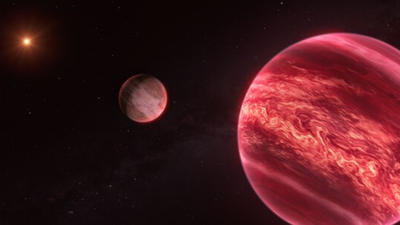
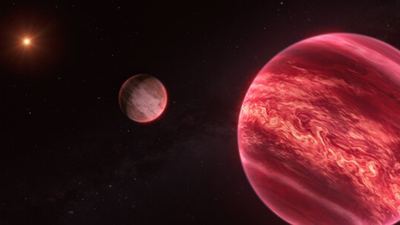
For decades, astronomers have been finding planets orbiting stars far beyond our solar system. More than 6,000 exoplanets are now known.But there is one glaring omission.Not a single moon outside our Solar System has been confirmed with the same level of confidence.That may finally be changing.According to a paper in the journal Nature, astronomers have found strong evidence for a massive object orbiting a brown dwarf in a star system about 70-73 light-years from Earth. The object behaves like a moon in one crucial sense: it does not orbit a star directly. Instead, it circles another body that itself orbits a star.But there is a catch.

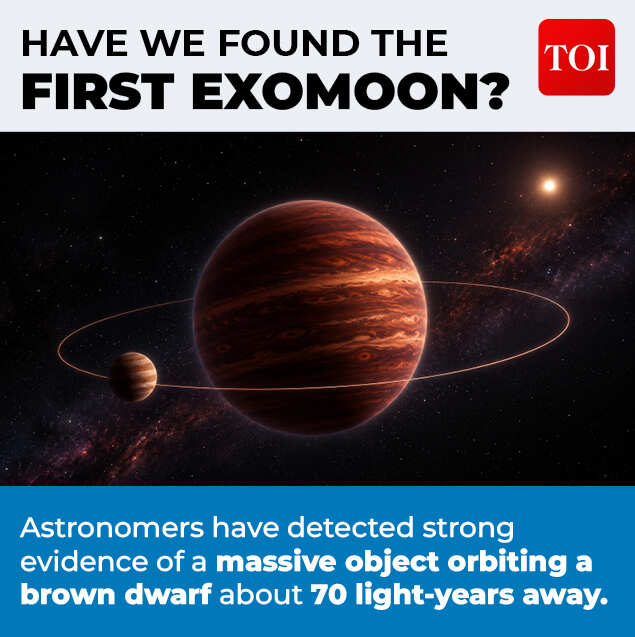
Exomoon revolving around brown dwarf
The suspected moon is enormous — at least around three-quarters the mass of Jupiter — and its host is not a planet. It is a brown dwarf, an object sitting awkwardly between the worlds we call planets and stars.That is why researchers are currently more comfortable calling it an “exosatellite” rather than an exomoon.So, have we finally found the first moon beyond our Solar System? The answer is: possibly — but this is not the neat, familiar kind of moon astronomers were expecting.
First, what exactly has been discovered?
The system is called CD-35 2722 and lies roughly 70 light-years away.At its centre is a relatively small star, CD-35 2722 A. Orbiting that star is a much more massive companion, CD-35 2722 B, which is a brown dwarf.And now researchers have found evidence that another object is orbiting that brown dwarf.Think of it as a cosmic three-level arrangement:Star → brown dwarf → suspected satellite

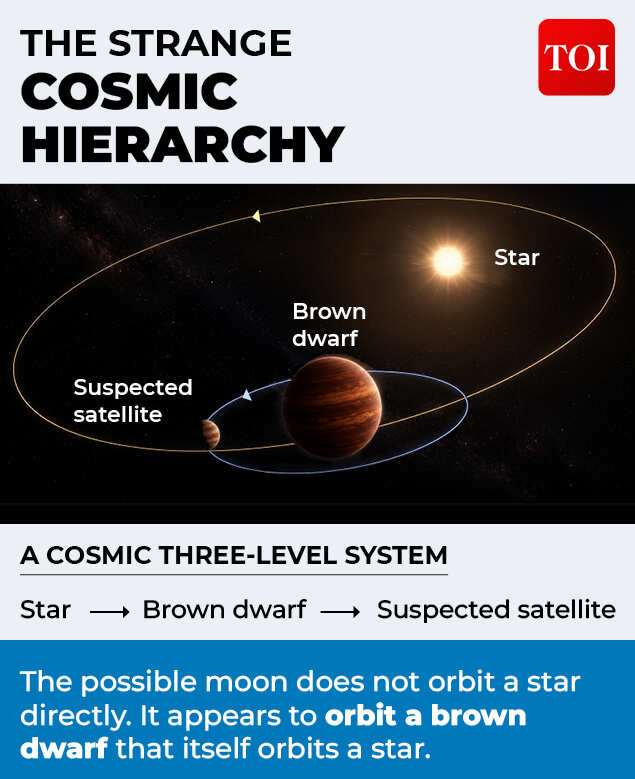
Strange cosmic hierarchy
That makes the discovery unusual from the outset.The brown dwarf is itself about 30-37 times as massive as Jupiter, depending on the estimates used. The newly detected companion has a minimum mass of about 0.74 times Jupiter’s mass, with an orbital period of roughly 169 days.That is extraordinarily large for something being considered a moon.For comparison, Jupiter’s largest moon, Ganymede, is only about 2.5% of Jupiter’s mass. Even our own Moon is only about 1.2% as massive as Earth.Here, the suspected satellite could be around 2.5% of the mass of its brown-dwarf host — a remarkably high ratio compared with most familiar planet-moon systems.

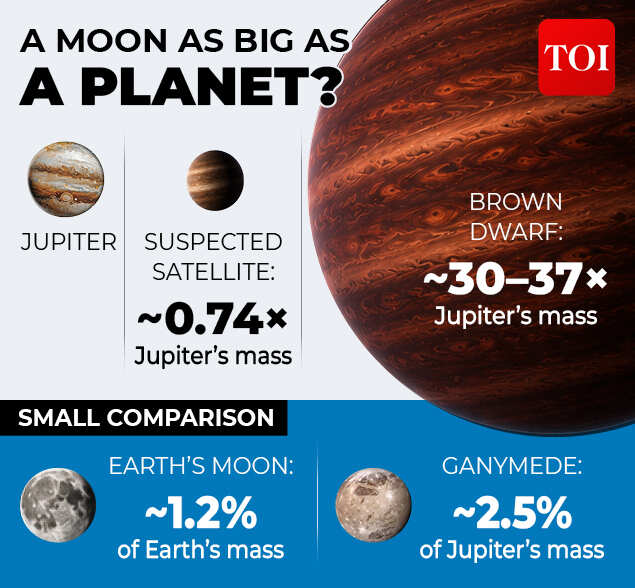
How big is this “moon”?
And that is where things get really interesting.
How did astronomers spot something so far away?
They did not photograph the moon.In fact, even the most powerful telescopes cannot simply take a picture of a tiny Jupiter-sized object orbiting another object tens of light-years away and clearly label it a moon.Instead, astronomers looked for the object’s gravitational fingerprints.The team used the European Southern Observatory’s Very Large Telescope (VLT) in Chile and, specifically, the CRIRES+ infrared spectrograph.They observed CD-35 2722 B over 23 nights between October 2023 and February 2026.

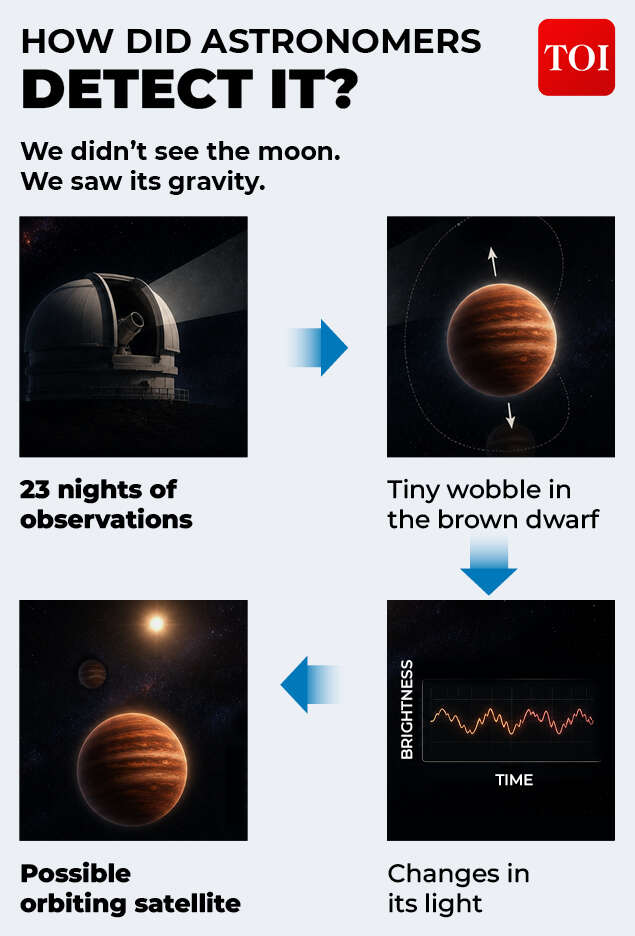
How was this ‘exomoon’ detected?
The basic idea is surprisingly simple.When an object orbits another body, its gravity causes the host to wobble slightly. That movement changes the wavelengths of light coming from the host. By measuring these tiny changes — a technique known as the radial-velocity method — astronomers can infer the presence of an unseen companion.It is essentially the same basic technique that helped astronomers discover the first planet orbiting a Sun-like star in the 1990s.This time, however, the target was not a star being tugged by a planet.It was a brown dwarf being tugged by a possible satellite.The researchers found a periodic signal corresponding to an orbit of around 169-170 days.Their best-fitting model suggests a satellite with a minimum mass of about 0.743 Jupiter masses.The study also found evidence for a second, smaller possible satellite, with a minimum mass of around 0.277 Jupiter masses and an orbital period of about 87 days. But the evidence for this second object is considerably less certain.
But why isn’t it simply called an exomoon?
Because astronomers have run into a naming problem.In our Solar System, the distinction seems obvious.The Sun is a star. Earth is a planet. The Moon orbits Earth.But the universe does not always follow the neat categories humans created for our own cosmic neighbourhood.A brown dwarf is larger than a planet but not massive enough to sustain the hydrogen fusion that powers ordinary stars. That puts it in a strange middle ground.

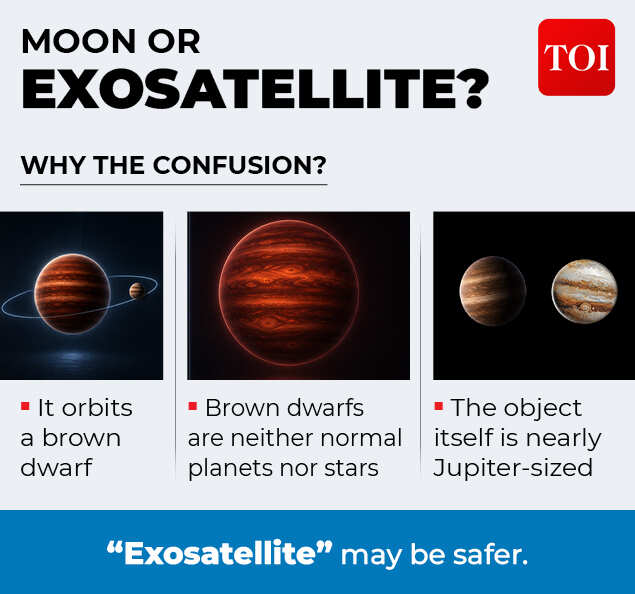
How to define?
So what do you call an object orbiting a brown dwarf?It behaves like a satellite. But calling it a “moon” becomes complicated because its host is neither a conventional planet nor a star.The researchers therefore use the term exosatellite.The problem is made even more confusing by the size of the object. At roughly three-quarters of Jupiter’s mass, it is enormous compared with every moon in our Solar System.In other words, it looks like a moon because of what it orbits, but it looks like a planet because of what it weighs.As researcher Alice Zurlo put it, the system blurs the traditional boundaries between stars, planets and moons.There is also no universally accepted formal definition of an exomoon. That means astronomers are effectively discovering objects first and working out where they fit into the cosmic filing system afterwards.
So is this really the first exomoon?
Not yet, at least not definitively.The new study provides strong evidence for an exosatellite, and the researchers describe it as a major step towards the first unambiguous exomoon detection.But they stop short of saying that the naming question has been settled.That distinction matters because astronomers have been here before.
The long history of the “first exomoon”
In 2014, Nasa reported evidence of a possible exomoon candidate detected through gravitational microlensing. The problem was that the alignment responsible for the observation could never be observed again, meaning researchers could not independently confirm whether they had seen a planet-moon system or a planet-star system.Then came Kepler-1625b-i.In 2018, observations from Nasa’s Kepler and Hubble space telescopes produced tantalising evidence of a possible moon orbiting the gas giant Kepler-1625b, around 8,000 light-years away.


The exomoon hunt so far
Astronomers noticed a small additional dip in the star’s brightness after the planet had crossed in front of it. Hubble also found that the planet’s transit occurred earlier than expected — both clues that could be explained by a moon.The suspected object could have been roughly Neptune-sized.But even Nasa stressed that more observations were needed to confirm it.Another candidate, Kepler-1708b-i, subsequently entered the debate.And the controversy has continued. Different teams have reached different conclusions about how convincing the signals are, with researchers on both sides arguing over data processing and statistical interpretations. The original researchers continue to maintain that both candidates remain viable but require further observations.So despite years of searching, astronomers still have no universally accepted, independently confirmed exomoon.That is why the CD-35 2722 result is potentially so important.
Why is this discovery different?
One major reason is how it was detected.Earlier exomoon candidates were largely identified by looking for tiny changes in a planet’s transit across its star.The new candidate was detected using radial velocity — by watching the brown dwarf itself move under the gravitational influence of the suspected satellite.That gives astronomers a completely different way of searching for moons.It also means they are no longer restricted to planets that happen to pass in front of their stars from our viewpoint.If the technique can be refined, astronomers may eventually be able to search a much broader population of planetary and substellar systems.The researchers also tested whether the signal could be caused by other factors, including Earth’s motion, atmospheric effects and the brown dwarf’s own rotation. Their calculations indicate that the proposed satellite’s orbit is physically stable, lying within the relevant Roche-limit and Hill-radius constraints.That does not make the discovery immune to future scrutiny, but it strengthens the case that something genuinely unusual is happening around CD-35 2722 B.
Why would finding exomoons matter?
Finding a moon around another world would be much more than adding another object to an astronomical catalogue.Moons can tell scientists how planetary systems form and evolve.Our own Solar System offers several examples.Jupiter’s Galilean moons appear to have formed from material surrounding the young planet. Earth’s Moon is thought to have formed after a giant collision involving the early Earth. Saturn’s moons display an extraordinary range of compositions and geological histories.

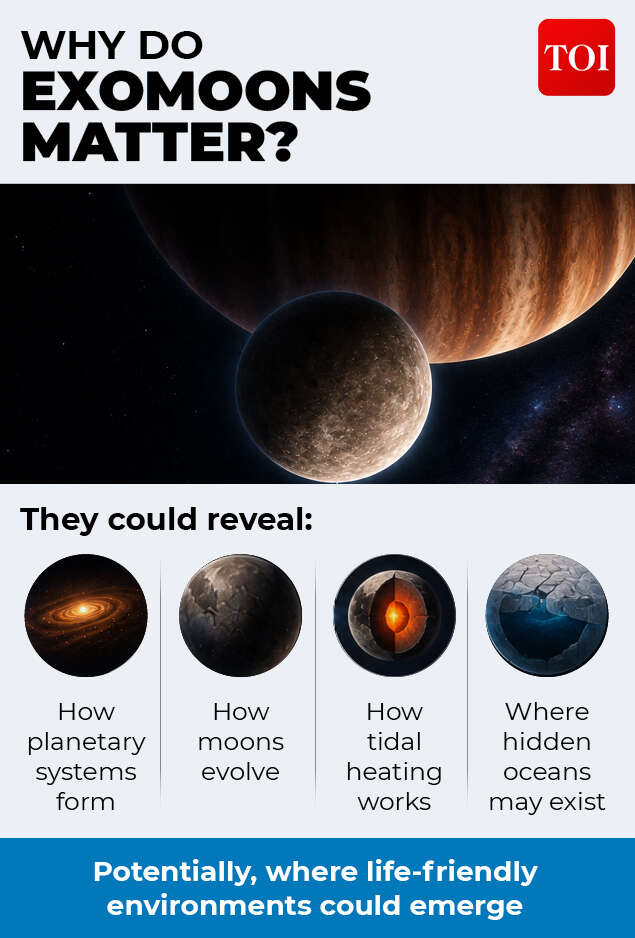
Why finding exomoons matters
So discovering moons elsewhere would give astronomers another set of natural laboratories for testing these theories.And there is an even more exciting possibility: habitability.Some moons in our own Solar System, particularly Europa and Enceladus, are considered promising places to investigate because their interiors may contain liquid oceans.A moon does not necessarily need to sit inside the traditional habitable zone of its star to be interesting. Gravitational interactions with a massive host can generate tidal heating, potentially providing an internal energy source.That raises the possibility that future searches could uncover moons with conditions suitable for chemistry associated with life — even in places where a conventional Earth-like planet might not be expected.The current object, however, is far too massive and gaseous to resemble Europa, Enceladus or our Moon. The discovery is therefore more important as a clue about planetary architecture and formation than as evidence for an immediately habitable world.
What happens next?
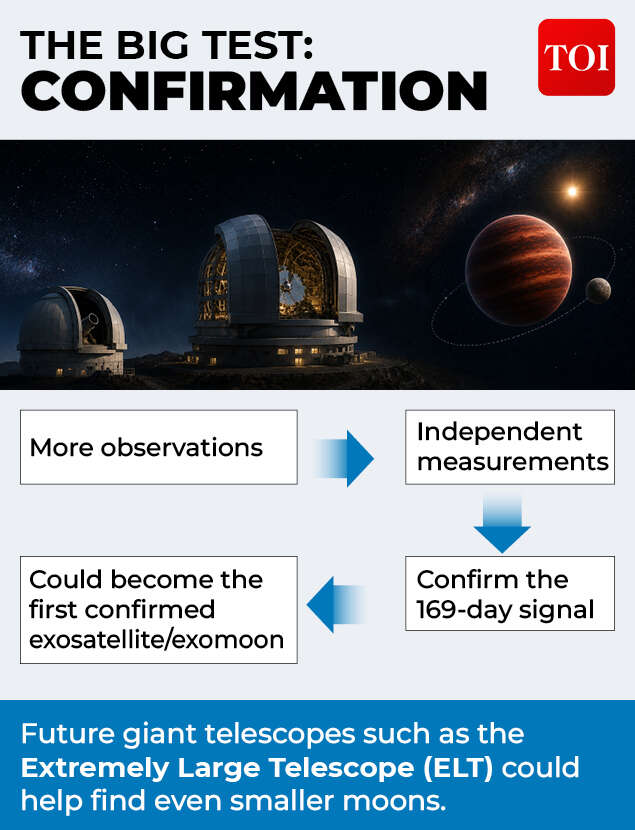
The next step is confirmation.Astronomers will want independent observations using different instruments and techniques to determine whether the periodic signal really comes from a satellite.That is particularly important because the proposed object is so unusual.If the signal survives further observations, the system could become a benchmark for studying objects that sit between conventional categories.

What happens next?
There is also another reason to be optimistic about the future.The Extremely Large Telescope (ELT), now under construction in Chile, will have a 39-metre primary mirror and vastly greater light-collecting power than today’s major optical telescopes. Researchers hope it will eventually help astronomers detect much smaller satellites and investigate systems that are currently beyond reach.And that could change the question entirely.Instead of asking whether one strange object counts as an exomoon, astronomers may soon be asking how many different kinds of moons exist across the galaxy.
The bigger picture
The most fascinating part of the CD-35 2722 discovery may be that it does not fit neatly into the categories we already have.It is a possible moon orbiting a brown dwarf.But the moon itself may be almost as massive as Jupiter.Its host is too massive to be a planet but too light to be an ordinary star.And the entire system sits roughly 70 light-years away, offering astronomers a glimpse of a type of cosmic architecture that does not have an obvious equivalent in our Solar System.So, have we found the first exomoon?The cautious answer is not quite.What we have is something potentially more interesting: the strongest evidence yet for a satellite outside our Solar System using a new detection method and an object that is forcing astronomers to rethink what exactly qualifies as a moon.For now, “exosatellite” may be the safer word.But if future observations confirm the signal, this strange Jupiter-sized companion could mark the beginning of a new chapter in the hunt for moons beyond the Solar System.And the first confirmed exomoon may turn out to look nothing like the Moon we know.